

"All That Is Solid Melts into Air": Since 1870, Roughly One-Fifth of the Economy Is Transformed Every Thirty Years
This time, we experts in the liberal arts—the artes liberales, the skills appropriate to enrich the lives and make productive those of us who are free and must find a way to live by our wits, as we...

This time, we experts in the liberal arts—the artes liberales, the skills appropriate to enrich the lives and make productive those of us who are free and must find a way to live by our wits, as we are not bound by servile chains or possessed of some powerful form of status-group societal capital and privilege—join those in the barrel. Schumpeterian ceative destruction has massively raised living standards, but not all boats rise the same way, or at all. And it is a different set of boats that are most materially affected in each generation…
Does this have a place in my Econ 196 course for next semester? Behind the paywall for now as it is only a draft, and I should revise it heavily before I release it to run free in this wide green world:
Since 1870, worldwide, on average, according to our flawed standard measures, every thirty years about 4/5 of the economy have improved in technology and productivity by roughly 25%, at a rate of roughly 0.8% per year. And 1/5 of the economy has quintupled in technology and productivity, at a rate of about 5.4% per year. That leaves average productivity, worldwide, roughly twice what it was a generation before. And it is a different, although overlapping, share of the economy that undergoes this massive leading-sector push every generation.
And so, since 1870, we have seen successive Steampower, Applied-Science, Mass Production, Globalized Value-Chain, and now Attention Info-Bio Tech modes, with these transformations occurring faster and more completely in today’s rich countries and slower and incompletely in today’s poor countries, but with life even in poor countries being substantially transformed vis-à-vis life 150 years ago.
And for a century before 1870, roughly, the same process was going on in the then-Dover Circle Plus: the 400 miles around the port of Dover in the southeastern corner of Britain, plus its offshoot across the Atlantic in New England, the coastal Mid-Atlantic, and the American Midwest plus Ontario. But the pace was slower, taking not 30 but 100 years for the leading sectors to lift their productivity fivefold. Before Steampower there had been Commercial-Imperial society. And the three centuries or so before 1770 had seen the transformation from the second to the first, with again a roughly doubling of average productivity in the Dover Circle Plus (and perhaps a 50% gain in potential elsewhere from the Columbian Exchange and the coming of the world market, but with nearly all of that gain elsewhere eaten up by Malthusian population growth).
Benchmarks to orient ourselves:
Karl Marx & Friedrich Engels (1848): The Communist Manifesto <https://www.marxists.org/archive/marx/works/1848/communist-manifesto/>: ‘The bourgeoisie… has accomplished wonders far surpassing Egyptian pyramids, Roman aqueducts, and Gothic cathedrals…. Constant revolutionising of production, uninterrupted disturbance of all social conditions, everlasting uncertainty and agitation…. All fixed, fast-frozen relations, with their train of ancient and venerable prejudices and opinions, are swept away, all new-formed ones become antiquated before they can ossify. All that is solid melts into air, all that is holy is profaned….
National industries… are dislodged by new industries, whose introduction becomes a life and death question for all civilised nations… [using] raw material drawn from the remotest zones… whose products are consumed… in every quarter of the globe… universal inter-dependence…. It has agglomerated population, centralised the means of production, and has concentrated property….
The bourgeoisie, during its rule of scarce one hundred years, has created more massive and more colossal productive forces than have all preceding generations together. Subjection of Nature’s forces to man, machinery, application of chemistry to industry and agriculture, steam-navigation, railways, electric telegraphs, clearing of whole continents for cultivation, canalisation of rivers, whole populations conjured out of the ground — what earlier century had even a presentiment that such productive forces slumbered in the lap of social labour?…
Plus:
Cosma Shalizi (2010): The Singularity in Our Past Light-Cone <http://bactra.org/weblog/699.html>: ‘The Singularity has happened; we call it “the industrial revolution” or “the long nineteenth century”. It was over by the close of 1918. Exponential yet basically unpredictable growth of technology, rendering long-term extrapolation impossible (even when attempted by geniuses)? Check. Massive, profoundly dis-orienting transformation in the life of humanity, extending to our ecology, mentality and social organization? Check. Annihilation of the age-old constraints of space and time? Check. Embrace of the fusion of humanity and machines? Check. Creation of vast, inhuman distributed systems of information-processing, communication and control, “the coldest of all cold monsters”? Check; we call them “the self-regulating market system” and “modern bureaucracies” (public or private), and they treat men and women, even those whose minds and bodies instantiate them, like straw dogs. An implacable drive on the part of those networks…. Drive” is the best I can do; words like “agenda” or “purpose” are too anthropomorphic, and fail to acknowledge the radical novely and strangeness of these assemblages, which are not even intelligent, as we experience intelligence, yet ceaselessly calculating…
And, of course, from my Slouching Towards Utopia:
The technological and productivity economic underpinnings of human society in 1903 were profoundly different from those of 1870—underpinnings of industry and globalization as opposed to one that was still agrarian and landlord-dominated. The mass-production underpinnings of 1936, at least in the industrial core of the global north, were profoundly different also. But the change to the mass consumption-suburbanization underpin- nings of 1969 was as profound, and that was followed by the shift to the information-age microelectronic-based underpinnings of 2002. A revolutionized economy every generation cannot but revolutionize society and politics, and a government trying to cope with such repeated revolutions cannot help but be greatly stressed in its attempts to manage and provide for its people in the storms.
Much good, but much ill also flowed: people can and do use technologies—both the harder ones, for manipulating nature, and the softer ones, for organizing humans—for great good, but also to exploit, to dominate, and to tyrannize. And the long twentieth century saw the worst and most bloodthirsty tyrannies that we know of.
And much that was mixed, both for good and for ill, also flowed. All that was solid melted into air—or rather, all established orders and patterns were steamed away. Only a small proportion of economic life could be carried out, and was carried out, in 2010 the same way it had been in 1870. And even the portion that was the same was different: even if you were doing the same tasks that your predecessors had done back in 1870, and doing them in the same places, others would pay much less of the worth of their labor-time for what you did or made.
As nearly everything economic was transformed and transformed again—as the economy was revolutionized in every generation, at least in those places on the earth that were lucky enough to be at all near the growth poles—those changes shaped and transformed nearly everything sociological, political, and cultural as well…
Now comes the very sharp Brian Klaas, author of the subtle and amusing Fluke:
Brian Klaas: We are different from all other humans in history <https://www.forkingpaths.co/p/we-are-different-from-all-other-humans-ad0>: ‘As I wrote in Fluke: “[In] the past… local instability…. One day you could be healthy, the next day… struck down by… plague. Childbirth was a death trap. Starvation was a constant threat.… But… also… global stability… [as] society ticked along…. If your parents were agrarian peasants, you were likely to be an agrarian peasant…” We… have inverted that…. Our daily lives are highly regimented, regulated, and stable. Routine defines us…. We experience local stability. It gives us a profound illusion of control, forged through lived experience. But it is an illusion. The macro-framework… is constantly changing…. Mobile phones… artificial intelligence… pandemics, wars, climate upheaval… [as the] experience of life changes drastically from one generation to the next. Unlike the overwhelming majority of our ancestors, we experience global instability. We’ve invented an upside-down world where Starbucks never changes, while rivers dry up and democracies collapse…
Brian is, I think, overstating it to some degree. For most people, a generation sees (i) some change in their roles as producers in the organization and productivity of their jobs and the pieces of the societal division of labor that they do, some change in their roles as consumers and utilizers of most of the products of the human division of labor, but about one-fifth or so of their life as consumers and utilizers of the products of the human division of labor completely upended, largely in a good way. And then there are the 1/5 of people whose jobs and whose roles as producers were caught up in the Schumpeterian creative-destruction leading-sector technology tsunami, for whom little is the same as it was thirty years before. That change is to their substantial detriment if they tried to do the old thing in the old way: their real incomes then would be only 1/4 or so of what they would have expected. But that change would have been to their substantial benefit had they found a way to successfully surf the wave.
To summarize: Since 1770, the modern economy changes by puncture, not glide. Every thirty years these days, a sector explodes—lifting productivity, reorganizing firms, and scrambling career ladders. Roughly four-fifths inch forward, while one-fifth quintuples and redefines the frontier. Those leading sectors—steam, mass production, information—rebuild institutions and stress politics as they march. Most people experience partial gains in consumption and workflow; the unlucky fifth face brutal displacement unless they pivot fast. Past waves forged industry, mass production, suburbia, microelectronics; each remapped the social order, often painfully. Average living standards rise, but the distribution is jagged, and the politics volatile. Today’s leading edge runs through data centers and cognitive work: prompts, context engineering, evaluation, and synthesis. The liberal arts—long buffered—now sit at ground zero. Survival means translation: turn judgment, clarity, and taste into leverage over machines and markets, while rebuilding public capacity to manage the turbulence.
And so now in this generation it is the turn of we intellectuals, the experts in the liberal arts, to be caught up in the full force of the tsunami, rather than be among the majority for whom the wave casts up substantial benefits and changes in a fraction of their lives as consumers and utilizers of the products of the human division of labor, but for whom much of the core of day-to-day life as producers, consumers, and utilizers sees (relatively) little change.
Who and what are the experts in the liberal arts, the artes liberales? “Artes” in the sense not so much of “art” as painting and sculpture, but rather the skills appropriate to be productive and enrich your life. “Liberales” in the sense of pertaining to people who are free—free in the sense of being freed from hereditary or quasi-hereditary obligation slotting them into a subservient position in the societal division of work as a slave, a serf, or a laborer; and also free in the sense of having no productive property or guild-right or fief, of having no membership in a status-group slotting you into a specific even though non-subservient position in the societal division of labor. Those who learn the artes liberales are, rather, those who have to make a living by the use of their wits.
And, right now, the ways in which we must learn to use our wits to enrich our lives and be usefully productive are changing rapidly. We are in the position of the poor stockingers of the 1770, those who became the army of General Ludd.
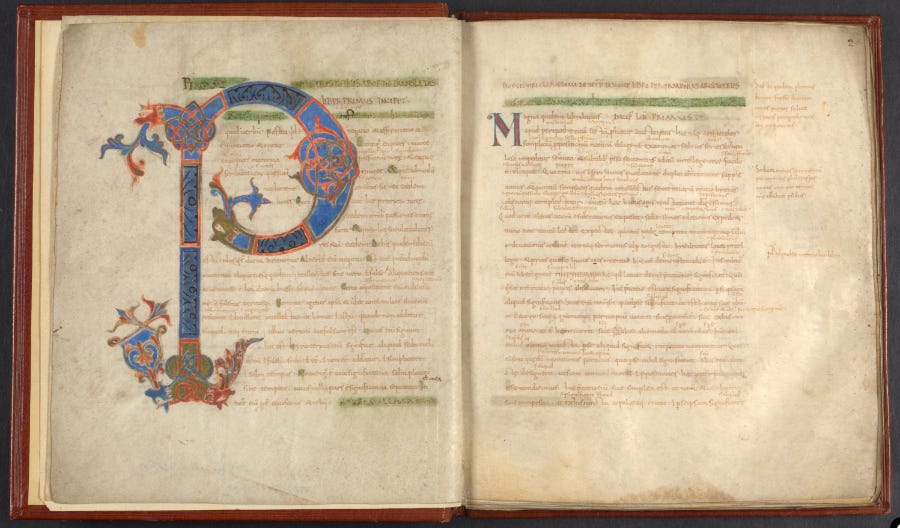
Right now, for example, because of the state of my lower back and right hamstring, I am not sitting at my desk looking at my “computer”, but rather semi-reclining on the couch. And I am cut off from the world by a headset that is, right now, projecting the illusion of a wrap-around computer screen ten feet high and forty feet wide fifteen feet in front of my eyes. And on this screen I have called up, in one of the “windows” through which my eyes metaphorically look out upon an information documenr in the world, Christine E. Bachman (2000): “A Liberal-Arts Education for the (Middle) Ages: Texts, Translations, & Study”, a curated online exhibit of the University of Pennsylvania library 2000 miles away, centered around a ms. called LJS 101, which is:
a remarkable example of a Carolingian monastic textbook. The main text of the manuscript is Boethius’s translation of and commentary on Aristotle’s De Interpretatione, also known as the Peri Hermenias, which was central to the study of logic, or dialectic, in the early middle ages. This text is paired with shorter texts, such as a sample letter and definitions of words, which transforms the manuscript into a useful handbook for studying the first three subjects of the medieval liberal arts – grammar, rhetoric, and dialectic. Several of the items in the exhibition demonstrate the educational context of early medieval monasteries in which LJS 101 was written and studied. Other items illustrate how the subjects of grammar, rhetoric, dialectic, arithmetic, geometry, music, and astronomy were interpreted and studied throughout the middle ages. Together, the manuscripts reflect the rich medieval intellectual tradition of studying the liberal arts…
Academic reading for me is thus an experience that is indeed a very far cry from the experience of my Great-Great Uncle Abbott, with his study carrel in Harvard’s Widener Library stacks on level 4-E.
References:
Bachmand, Christine E. 2000. “A Liberal-Arts Education for the (Middle) Ages: Texts, Translations, & Study”. LJS101. University of Pennsylvania Libraries, 1 June <https://ljs101.exhibits.library.upenn.edu>.
Boethius, Anicius Manlius Severinus. ca. 520 [2014]. On Aristotle On Interpretation. Trans. Michael Griffin & Andrew Smith. London: Bloomsbury Academic. <https://archive.org/details/commentariiinlib00boetuoft>.
DeLong, J. Bradford. 2022. Slouching Towards Utopia: The Economic History of the 20th Century. New York: Basic Books. <https://archive.org/details/slouchingtowards0000delo>.
Klaas, Brian. 2025. “We are different from all other humans in history”. The Garden of Forking Paths, . <https://www.forkingpaths.co/p/we-are-different-from-all-other-humans-ad0>.
Klaas, Brian. 2023. Fluke: Chance, Chaos, & Why Everything We Do Matters. New York: Scribner. <https://brianpklaas.com/fluke>.
Marx, Karl & Friedrich Engels. 1848 [1888]. The Communist Manifesto. <https://www.marxists.org/archive/marx/works/1848/communist-manifesto/>.
Shalizi, Cosma. 2010. “The Singularity in Our Past Light-Cone”. Three-Toed Sloth, November 28 <http:// .org/weblog/699.html>:
Zhuangzhi. -301. The Writings of Master Zhuang. Ed. Guo Xiang. Luoyang. <https://archive.org/details/thebookofchuangtzu_202002>.
The last 30 years have been much more uneven than the previous periods you mention. Moore's Law yields annual gains of 35-50 per cent in the basic technology of computing, and that produces much more than 5 per cent gains in the ITC sector. Not seen so much in GDP because prices are falling so fast. Solar and wind also improving much faster than this
Meanwhile, it's hard to see even 0.8 per cent in the rest of the economy, most notably transport, which used to be the big measure (Steam Age, Jet Age etc).
I would love to see someone work up an analysis of what slavery meant in terms of "productivity" in an age when homes were heated by woodburning fireplaces, and trees were cut down, sawed to proper lengths, split into burnable firewood, and carried across fields into homes and up the stairs to fireplaces to heat, for example, bedrooms, not to mention for wood stoves and fireplaces that cooked food to eat. It took more than a dozen slaves to provide the wood to heat Monticello, for example. The end of slavery must have been a gigantic impetus to come up inventions and production of new sources of heat and food production that did not require so much free labor.