

Anthology Super-Intelligence: Thursday Economic History (Hicks Lecture Extended Outtake)
Does each of us have a big enough brain to compensate for our lack of fangs, claws, sprinting speed, & dodging quickness? I say: “Definitely not!”—not individually we don’t. The Scarecrow in “The...

Does each of us have a big enough brain to compensate for our lack of fangs, claws, sprinting speed, & dodging quickness? I say: “Definitely not!”—not individually we don’t. The Scarecrow in “The Wizard of Oz” had a greatly exaggerated view of what he would have been able to do if he only had a brain. Another outtake from my Hicks Lecture, greatly extended. (Mostly) behind the paywall because I have not yet made the slides, because I have not chosen what the punchline is, and because I am out of time to work on this…
Thesis
Humanity’s unique superpower is its twin abilities to collaborate in the creation and development of knowledge on the one hand, and of production via specialization and the division of labor on the other. We are not smart animals who learned to cooperate. We are a cooperative organism that acquired intelligence as an emergent property of our cooperation. These are not the same thing, and the distinction matters enormously — especially now.
I. The Naked East-African Plains Ape’s Problem
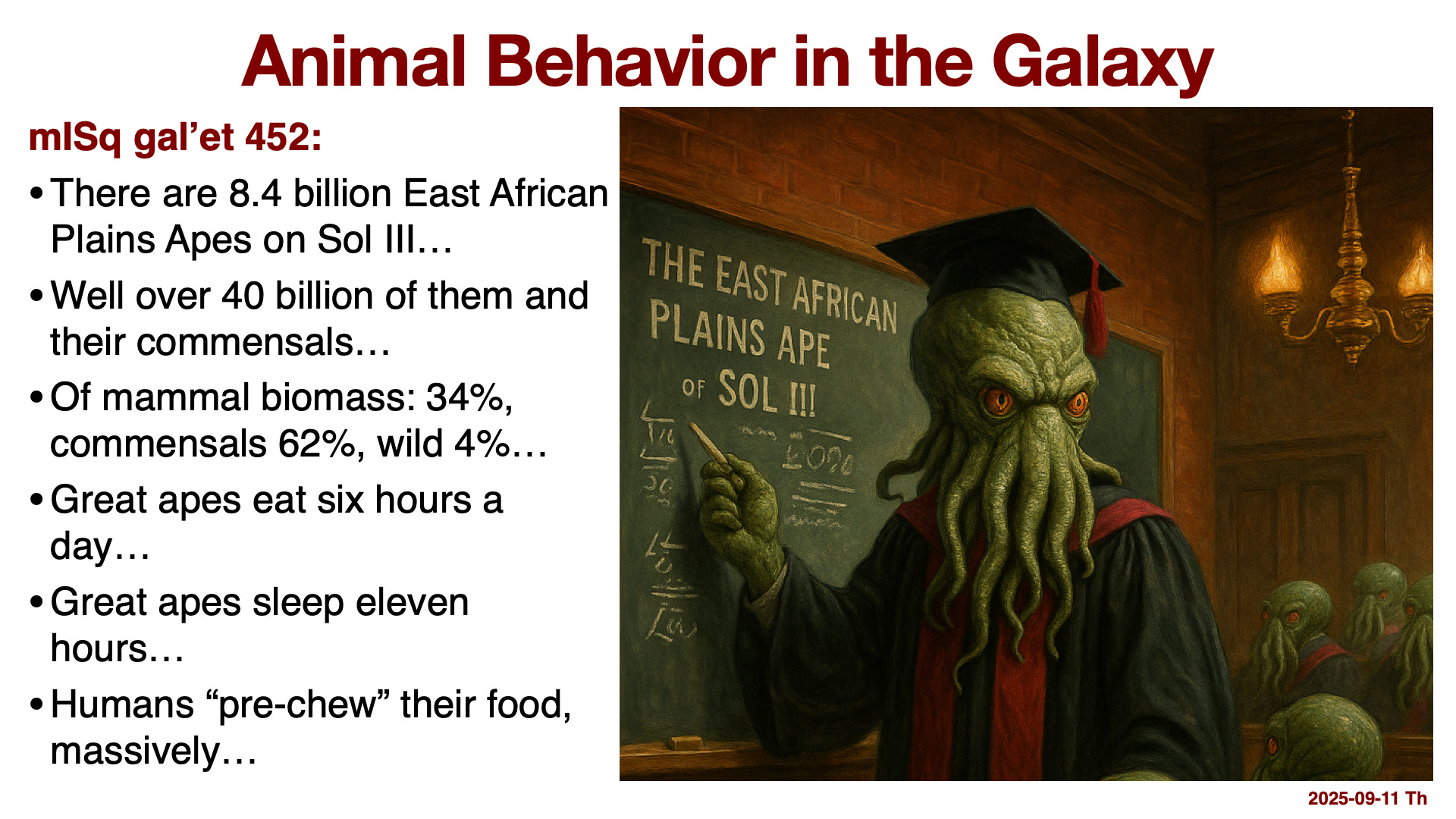
Step outside and view us from an exterior standpoint. Take the standpoint of a distant intellect—vast, cool, and sympathetic. Or not. What would such an intellect find notable about us?
Perhaps, somewhere, a being is lecturing about the fauna of Sol III, mainly the East African Plains Ape.
They would see that we number 8.4 billion. We and our domesticated animals make up 96% of global mammal biomass. Humans sleep only about two-thirds as much as our closest relatives. We spend two, not six, hours a day chowing down. We do not eat raw broccoli for hours and hours, but rather food “pre-chewed” in various ways. Come to think of it, even raw broccoli itself has been heavily biotechnologized—made tasty, nutritious, and easy to digest. The Broccoli family created it before moving into “James Bond” movies. That’s one set of observations.
Here is another. There is a shlock TV show, on the Discovery Channel <http://www.discovery.com>, called “Naked & Afraid”.
In it, two humans are dropped into a wilderness somewhere, naked, with one and only one piece of technology each (usually something like a knife, a fire starter, or a fishing line). All around them are other mammals doing their mammal thing: living their lives, reproducing their populations, evolving to fit whatever niche they have found where they are. They thrive, as much as animals do in nature red in tooth and claw. But the two humans dropped by themselves (well, they are surrounded by cameramen, sound technician, drivers, logistical support, and such who do not help unless a true emergency arrives, and who are careful stay out of the fields of view of the video cameras) definitely do not thrive. Instead, the humans proceed, not too slowly, to start starving to death.
I am not being figurative or metaphorical here. I am being literal. Look at Melissa Miller here:
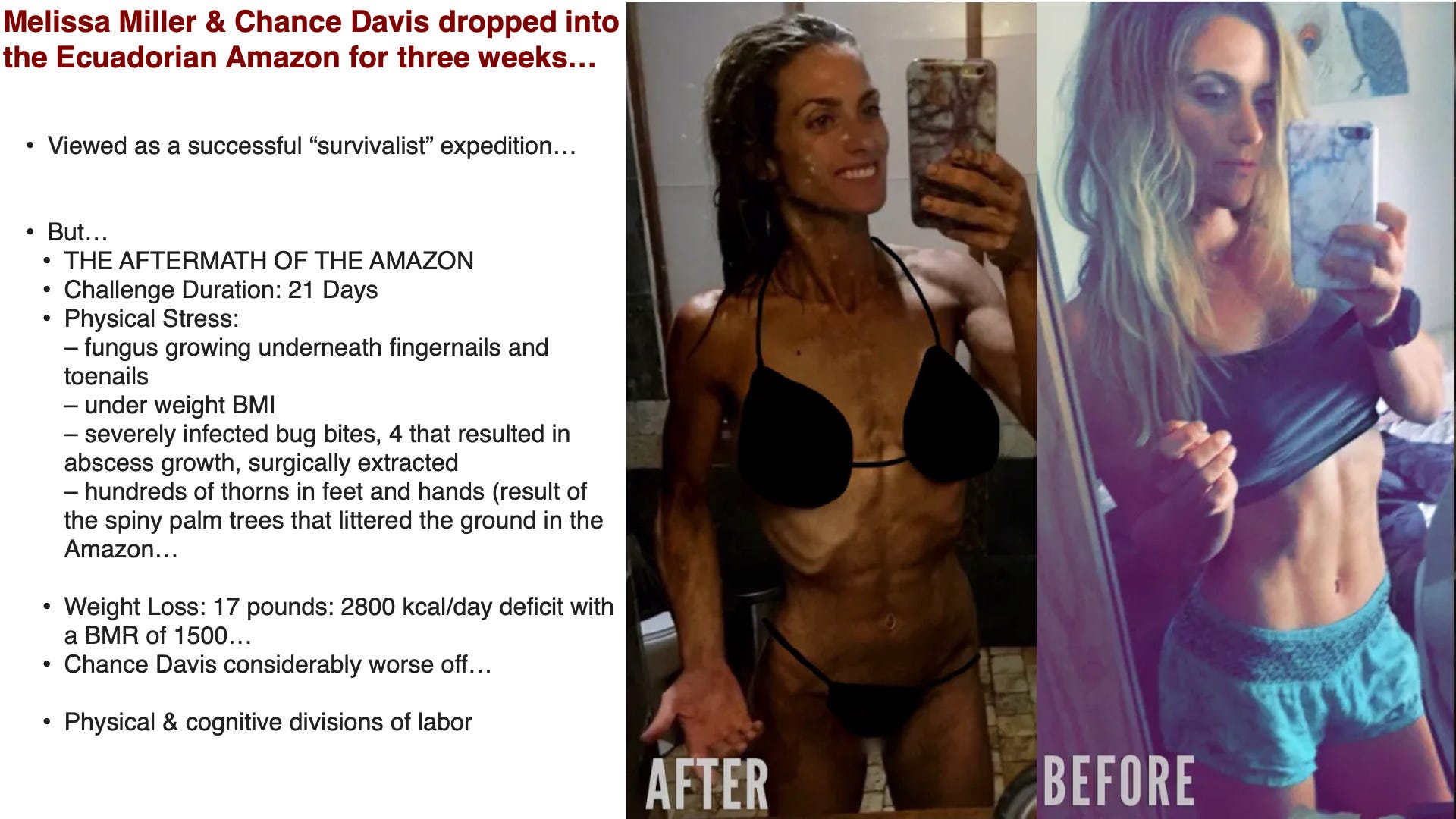
This is outdoorswoman Melissa Miller of Fenton, Michigan—Pure Michigan Melissa, Melissa Backwoods <https://melissabackwoods.com/>, across a time span of 21 days.
Melissa Miller is an expert on wilderness education and survival skills. She was dropped into the Ecuadorian Amazon with a fishing line and a partner, Chance Davis, with a knife. Over her 21 days in the jungle she lost 17 pounds: a daily metabolic deficit of about 2800 calories.
Given her likely BMR of 1500 calories, that is quite a feat of metabolic disaster. Had she simply hunkered down and fasted, we would have expected to see a nine-pound weight loss from burning fat. Trying to find food and avoid becoming food cost her an extra eight pounds, roughly plus or minus.
As she described the physical stress:
Melissa Miller (2018): Naked & Afraid Weight Loss & Health Effects <https://melissabackwoods.com/naked-afraid-effects/>: ‘My hands were riddled with thorns and burn marks. We kept the fire steady the entire trip, building a mo[a]t… around it to elevate it from heavy rainfall. We also utilized a technique in which we created an oven to continually burn wet dead logs as there was no dry wood available. In order to create fire I had to construct a platform to dry out palm fibers and palm grasses for two days before I could get a tinder bundle to ignite successfully. Before that we had to ward off mosquitoes at night by covering ourselves [with] clay and mud. We prevented ants from entering our shelter area by covering the ground with thick ash from the fire…
Back in civilization, Ms. Miller needed significant medical attention, as she rapidly regained her weight, to deal with the:
fungus growing underneath fingernails and toenails.
under weight BMI.
severely infected bug bites, 4 that resulted in abscess growth, surgically extracted.
hundreds of thorns in feet and hands (result of the spiny palm trees that littered the ground in the amazon)…
Moreover, the constestants are naked, and may well be afraid, but they are not alone. In post-show interviews, they report:
On‑site medics and IVs, with medics rehydrating contestants with IV saline for severe dehydration and food poisoning.
Field safety rangers and plant ID checks, with a ~20‑person crew plus rangers on location to confirm plant identifications to prevent poisoning.
Medical tent and controlled supplies, on site, with accounts of contestants obtaining (or stealing) food/electrolytes from crew/medic areas during extreme calorie deficits.
Rapid medevac, when injuries or infections surpass on‑site care.
And Melissa Miller’s partner, Chance Davis? He is a former US Army Ranger. He lost nearly twice as much weight as she did: 32 pounds over 21 days. He did not have the 17 pounds of fat to lose, and as a much bigger human he had a higher BMR.
You need to burn 3 lbs. of muscle to get the caloric energy you can get from burning 1 lb. of fat. The experience of caloric deprivation without sufficient fat resources seriously messed with his head. And not just in a “in life, we have support—friends, family, podcasts, coffee, sugar—without those, you’re outside yourself; when I get hungry, I get angry” way. Instead, in this way:
The worst part was being hungry. Long-term hunger plays with your psyche. After the show, hunger made me physically reactive and angry. I carried food stashes in my pockets and car. I gained 70 pounds in a month because I couldn’t stop eating—I didn’t want to be hungry. A big scoop of peanut butter sticks in your throat; you feel full—the taste, texture, sweetness. That’s what I wanted. Creamy or crunchy? Doesn’t matter—they’re all heaven…
As I said: the experience seriously messed with his head, and made his body and brain desperate to build up fat reserves just in case something like that were going to happen again. The body and the brain had learned: even with the knife and fishing line that kept them from being completely naked, individual brains, even knowledgeable ones, are not going to be enough against the daily caloric math of the wilderness.
