

Apple's Trajectory: Achieving Twin Hyperextraordinary Triumphs, Four Slow-Motion Failures
“It just works” no longer reliably working due to quality drift, but mastered chips and China-driven efficiency has allowed its massive success even though it has been free-riding on the fading...

“It just works” no longer reliably working due to quality drift, but mastered chips and China-driven efficiency has allowed its massive success even though it has been free-riding on the fading “it just works” reputation. Treating Apple as a stock ticker with a logo attached, not as a social technology for making computing humane, is a large discourse blind spot. Thus the discourse largely misses how a decade of quality drift, Siri failure, visual-design missteps, and rent-extracting “services” are termites in the walls of the house…
Too much of the focus on Apple Computer in THE DISCOURSE is about Apple Computer as a current profit-making and high stock-price operation; not enough on Apple as the “it just works” distributor of high-quality information technology and the translator of new information technology into a form that is actually useful to relatively normal people. Its run since Steve Jobs’s return to the firm is truly extraordinary. And even relative to the truly extraordinary, Apple Computer over the past decade has had two hyperextraordinary excellences of unbelievable accomplishment: its China-centered efficient supply value chain, and hardware in the form of Apple Silicon:
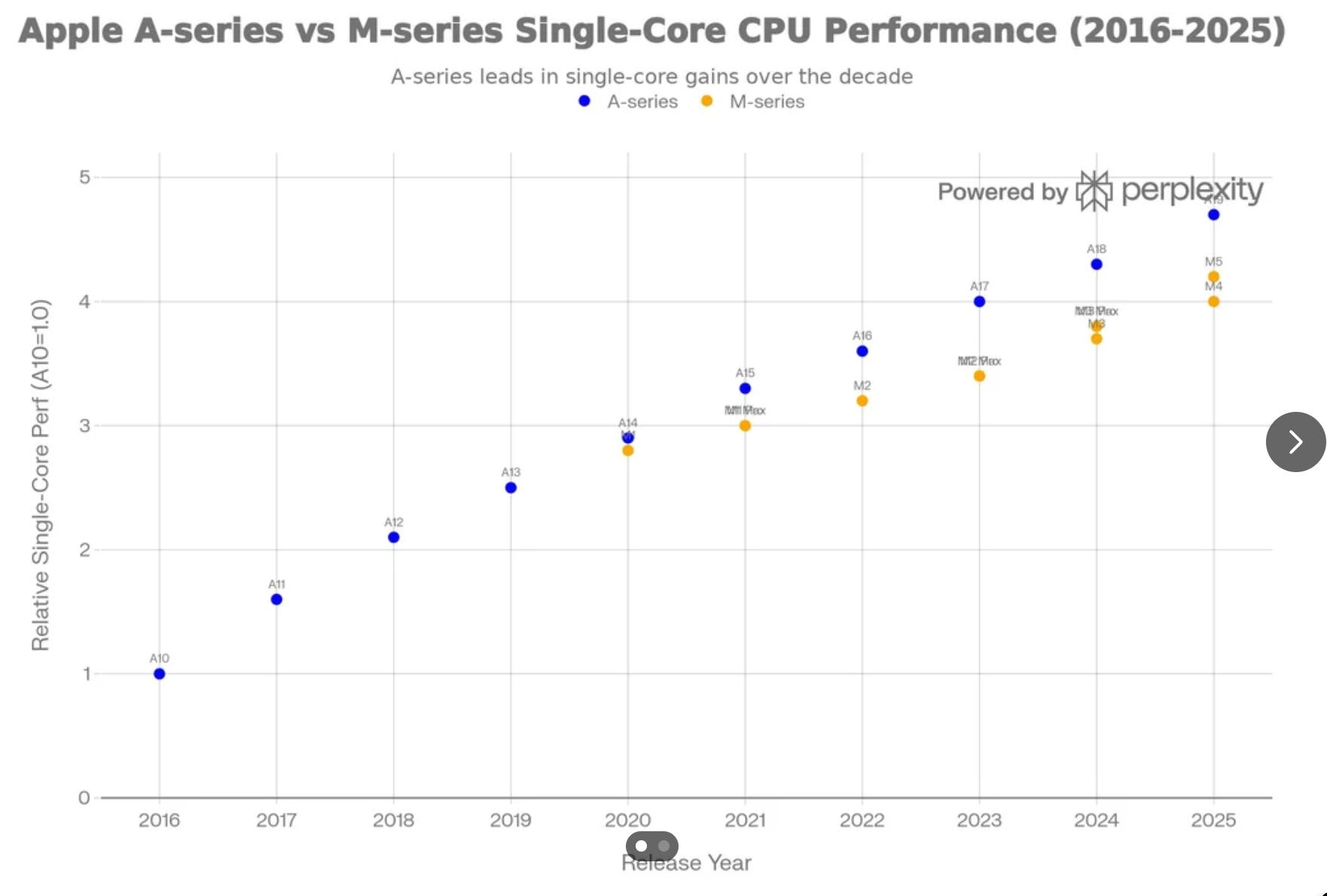
However, it has also has had four major deficiencies. about a couple of them here.
Now comes M.G. Siegler to talk about a couple of them:
M.G. Siegler: Apple’s Twin Suns <https://spyglass.org/apple-a-new-hope/?ref=email-me-everything-newsletter>: ‘John Ternus takes on design while Craig Federighi takes on AI as Apple prepares for a new CEO.… Aaron Tilley and Wayne Ma… [on] how Apple SVP Craig Federighi was recently tasked with overseeing… AI… [and] Mark Gurman… noting how… John Ternus… quietly tasked with overseeing… design efforts….
This could be a final “test” of sorts for Ternus…. Can he stabilize that ship[?]… And if he can’t in the next few months, does it in some way encumber his path to CEO?… Federighi… is getting the… more challenging and daunting task…. Federighi’s initial reluctance [back in 2018]…. Mike Rockwell… overseeing… Vision Pro… implor[ing] him to use AI more within iOS, which Federighi apparently rejected worried about the unpredictable and chaotic nature of the (still early) technology…
But there are more. Apple’s deficiencies are, I think, major enough that I believe that any of them would have been likely to sink pretty much any other company as a large profit-making institution, if not as a valuable and successful production network:
The political-social extraordinary vulnerabilities caused by an insufficiently robust China-centered supply value chain.
Its failure to understand what it should be doing in “AI”, and then to execute that, both with respect to the disaster that Siri has been and elsewhere.
Its failure to understand that software visual design is not just looking cool but, you know, actually producing a comfortable user interface.
Its extraordinary desire to treat its programmers and developers not as partners to be enabled but as suppliers to be squeezed.
These, however, have not yet had a negative impact on the bottom line or—with the exception of “AI”—the stock price. The organization got the message with respect to (1) a while ago. Now—perhaps—the organization has got the message with respect to (2) and (3). But is moving senior executives’ responsibilities around really the right response? Are the movings giving the responsibilities for fixing things to people who can? And why is Apple leaving (4) still unaddressed?
But it is not just with respect to “AI” that the shops under Federighi have also suffered from quality drift, with the associated user trust erosion. When you train hundreds of millions of people to expect “it just works,” then ship year after year of tiny regressions—more glitches around the edges, UIs that feel more ornamental than legible, features that land half‑baked and get rethought two releases later—you cash out that trust for short‑term roadmap theatrics as Federighi’s institution has shifted from “What problem are we solving?” to “What can we demo at WWDC?” Cumulative technical debt is generated by every compromise you ship—odd permissions edge cases, one‑off UI treatments, frameworks that aren’t quite ready—that then has to be carried forward.
I am probably not the person to opine on Apple and (1) supply-chain robustness or (2) what Apple should be doing in “AI” or what executives can oversee it. But it is clear to me that a competent new player dealing with (3) is unlikely to do anything other than good, and that (4) needs a very important course correction that the current executive team is completely unable to see as needed—they think they really deserve their 30% app-store tax, plus all the other “services” revenue they can hoover up.
Thus the summary recap: Looking past today’s stock price, try to evaluate Apple as an institution tasked with building the digital infrastructure of everyday life. On the plus side: two hyper-excellent achievements that any economic historian would call transformative—proprietary silicon and a ruthlessly efficient, China-centered manufacturing machine. On the minus side: strategic blindness on AI, cumulative quality drift in software design, dangerous political exposure in the supply chain, and a developer-relations model that resembles a monopsonist squeezing suppliers. Against the backdrop of M.G. Siegler’s “Twin Suns” on Federighi and Ternus, can executive reshuffles can fix structural failures the current leadership barely acknowledges?
I think you should include a third "extraordinary accomplishment." Apple's success at taxing the work of application developers. This should be considered by economists as one of the greatest and most egregious collections of "economic rent" in modern history. The idea that Apple has the right to impose a sales tax of 30% on applications developed by others is just only slightly less fantastical than the reality that so few people seemed concerned by this private tax.
Should Ford or Toyota be allowed to claim a 30% cut whenever their cars are rented? Should a supplier of coffee makers be allowed to tax the gross income of coffee shops? Should Microsoft tax its users 30% of the revenue generated by using Microsoft office? I don't think so.
The Apple tax, copied by many others, should be declared illegal.
Apple clearly has a group of people somewhere tasked with doing fundamental research, although they don't make noise about it the way IBM, AT&T Classic, and now Google do/did. I continue to think that group has dug very deeply into so-called "AI" and found that there is nothing there there that can be productized in a high quality way - but that the executive level can's admit that due to the need to generate Wall Street "AI" hype.