

Blame the Right-Wing Noise Machine, Not the Facts on the Ground, for Voters' Dismay About the Economy
No, our economic statistics were not painting us an unusually rosy picture last fall. Yes, the state of the American economy is very disappointing. But the gap between what the statistics tell us...

No, our economic statistics were not painting us an unusually rosy picture last fall. Yes, the state of the American economy is very disappointing. But the gap between what the statistics tell us and the amount of disappointment present in the actual reality—there was no sense in which that gap was unusually large last fall…
America’s economic data wasn’t hiding an unusual crisis—voters were just misled into believing one existed. The real distortion was in the narrative being fed to and believed by voters. Yes, America’s underemployment and inadequate wage rate is 24%, but that or worse has always been the case. And to say that there was an unusual gap between reality on the one hand and official statistical measures on the other is simply wrong…
A rather odd piece last week from the smart, thoughtful, and usually careful Gene Ludwig:
Gene Ludwig: Voters Were Right About the Economy. The Data Was Wrong: Here’s why unemployment is higher, wages are lower and growth less robust than government statistics suggest…. Many Democrats were puzzled by the seeming disconnect between “economic reality” as reflected in… statistics and the public’s perceptions…. They charged that right-wing echo chambers were conning voters into believing entirely preposterous narratives about America’s decline…. What they rarely considered was whether something else might be responsible for the disconnect — whether, for instance, government statistics were fundamentally flawed… <https://www.politico.com/news/magazine/2025/02/11/democrats-tricked-strong-economy-00203464?cid=apn>
And:
Gene Ludwig: Voters Were Right About the Economy. The Data Was Wrong: ‘The filters used to compute the headline statistics are flawed… paint a much rosier picture of reality than bears out on the ground. Take, as a particularly egregious example… unemployment. Known to experts as the U-3, the number misleads…. It counts as employed the millions of people who are unwillingly under-employed…. It does not take into account many Americans who have been so discouraged that they are no longer trying…. [It] does not account for the meagerness of any individual’s income…. I don’t believe those who went into this past election taking pride in the unemployment numbers understood that the near-record low unemployment figures — the figure was a mere 4.2 percent in November — counted homeless people doing occasional work as “employed”…. If you… include as unemployed people who can’t find anything but part-time work or who make a poverty wage (roughly $25,000), the percentage is actually 23.7 percent. In other words, nearly one of every four workers is functionally unemployed in America today — hardly something to celebrate… <https://www.politico.com/news/magazine/2025/02/11/democrats-tricked-strong-economy-00203464?cid=apn>
My first reaction is: This has always been the case. Always.
And the Bureau of Labor Statistics knows this.
The BLS calculates and reports:
U-1: Those who have had zero work and been constantly unemployed for a long time—15 weeks or more. (1.5%)
U-2: Those who are unemployed, and not because they quit: job losers and people who completed temporary jobs. (1.9%)
U-3 (Official Unemployment Rate): People without jobs who say they actively looked for work in the past four weeks and that they are available to work. (4.0%)
U-4: U-3 plus discouraged workers—people who want a job but have stopped looking because they believe no jobs are available. (4.3%)
U-5: U-4 plus marginally attached workers—people who want work and do sometimes look, but have not looked in the past four weeks. (4.9%)
U-6: U-5 plus underemployed workers, people who want full-time jobs but can't find them). (7.5%)
I agree, dropping into sociologist mode, that we need a U-7: We need the Current Population Survey interviewers to ask: "Are you earning enough from your job(s) to make ends meet?", and then to calculate those who say "no" by the labor force. And if I ever become Labor Secretary or BLS Director I will add such a question.
But the thing to focus on is that the labor market is, by all measures, better than it has been since the 1960s with the exception of the last Clinton year and the pre-plague Trump year. Those are the only moments in the past 55 years in which the U-6, indeed in which any of the unemployment measures, were rosier than they are now or were in the runup to the 2024 election.
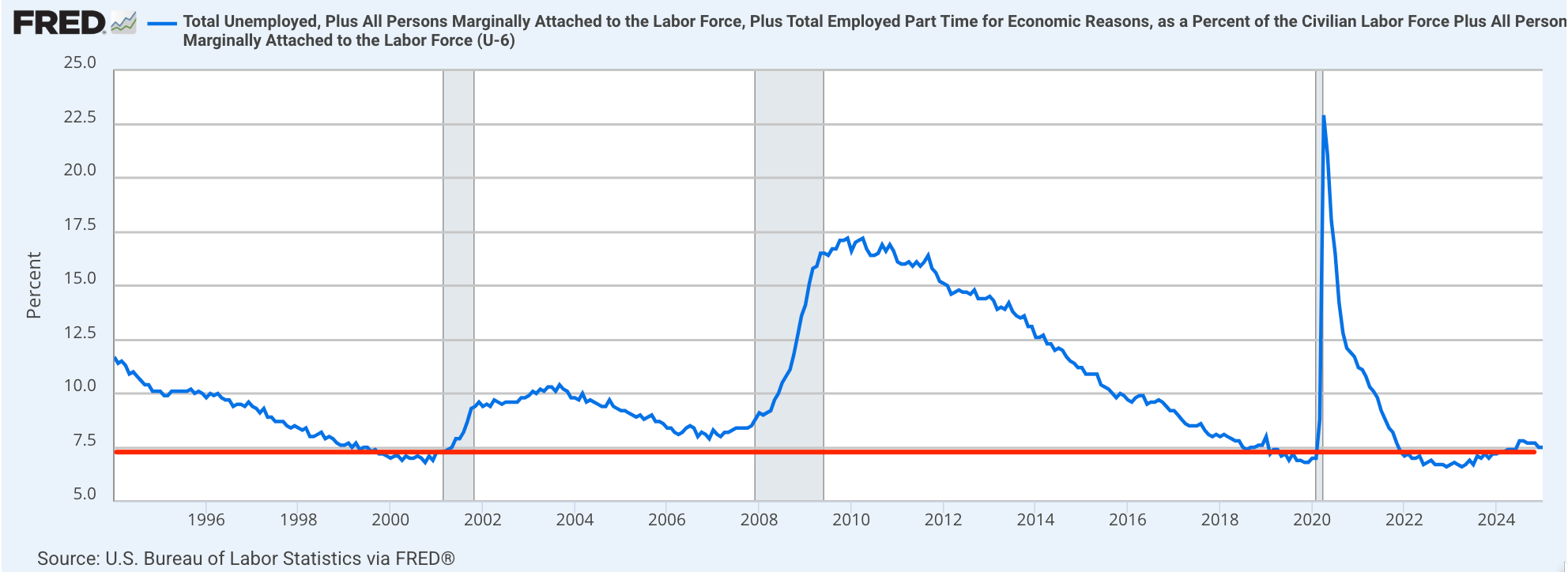
Thus I reject not Ludwig’s call for better economic statistics, but rather the framing narrative that he puts around it—that the economy was performing much more poorly for the working class in 2024 than it typically did, and that statistics were masking that relatively poor economic performance. That is just wrong. To claim that statistics that had more-or-less accurately gauged the economy in the past were mis-gauging it especially in 2024 fails.
Why, then, were the vibes of late 2024 different from those typical of a relative boom economic year?
Yes, one factor is that if you are a white (or Black) male with no college, your real income today is little greater than the income of your counterpart back in 1980, or even 2000. In modern society we believe that we are owed a clearly superior lifestyle to those of our predecessors in earlier generations. And, for white (or Black) males with no college, it has not happened.
Yes, a second factor is that our plutocrats are, absolutely and relatively, much richer than they were two generations ago. My grandfather was once the richest man between Tampa and Orlando. But his counterpart today is twelve times as rich as he was—a multiple five times greater than average income than my grandfather had. Moreover, we today see our plutocrats on the TV. And so we—even the most successful among we rest of us—tend to feel small.
But I do not think these are decisive.
My belief—though Gene Ludwig rejects it, with rather a slight sneer, by his claim that Democrats delude themselves with “charg[es] that right-wing echo chambers were conning voters into believing entirely preposterous narratives about America’s decline…”—is, that, in fact, right-wing echo chambers were conning voters into believing entirely preposterous narratives about America’s decline.
As I have said before, I find this from Dean Baker reporting polling results from Ipsos very striking and very important:
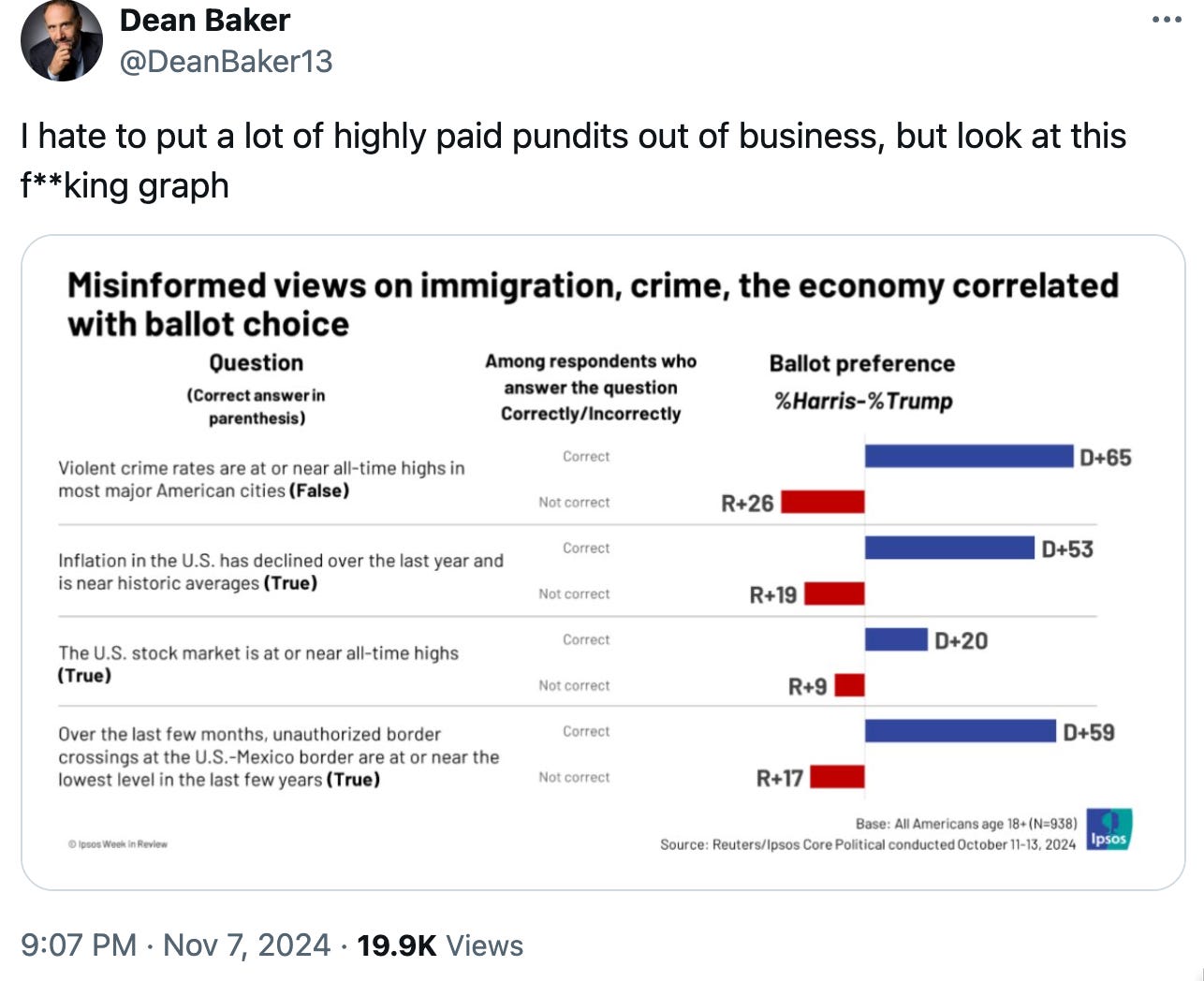
Fact: those with justified true beliefs about the state of issues like crime, inflation, immigration, and the state of the stock market overwhelmingly supported Harris.
So did Trump voters believe lies because Trump told them to, or were they Trump voters because they believed lies?
And are Republicans happy with this degree of misrepresentation and—it is worse than ignorance, it is grifter-created delusion? The answer is overwhelmingly “yes”. But surely Republicans who take the long view should be as dismayed as we Democrats, for they will not always be the sole masters of the disinformation machines. And such Republicans (if any)—for we Democrats cannot do it, as a key part of the structure of misinformation is that nothing we say can be believed—who want a better politics and a better future need badly to educate their masters on how to understand the world, and how to decide who to believe.
In the runup to the election everyone in America could look around and see that in their neighborhood the violent crime rates is about what it has been, and much lower than in the 1980s and 1990s; that their 401(k) or the 401(k)s of their friends who have them were doing well; that most of the people they know have jobs and were in fact having less trouble keeping income and outflow balanced than usual; and that they themselves had not seen Haitian immigrants in their neighborhood BBQing cats. And yet a crucial slice of voters believed that these things were going on elsewhere in the country.
Perhaps they believed this because they wanted to. Perhaps what tens of millions of Americans really want is a greenlight to hate their fellow citizens, the “Libs” who need to be owned. And if more than half of the American electorate wants to be misinformed, human civilization is in serious trouble.
But if we are confronting the work of cynical bad actors, we have hope. It means that the bulk of Trump supporters who have landed us in this chaos-monkey fix are good-hearted, well-meaning people who care about their fellow citizens. They believe what they see, and worry that the country is heading in the wrong direction, even though they themselves are doing fine. They do commit the disastrous mistake of voting for Trump. But they do not do so because they want a greenlight to hate their fellow citizens. They do so, rather, out of affection and concern for their fellow citizens. And in that there is great hope.
References:
Baker, Dean. 2024. ‘I hate to put a lot of highly paid pundits out of business…’ Twitter. November 7 <http://twitter.com/DeanBaker13/statu…>.
DeLong, J. Bradford. 2024. “Misinformation Decided the U.S. Election”. Project Syndicate. November 11. <https://braddelong.substack.com/p/project-syndicate-misinformation>.
DeLong, J. Bradford. 2024. “A Very Peculiar Kind of Triumph of the Will Indeed." Grasping Reality. November 8. <https://braddelong.substack.com/p/a-very-peculiar-kind-of-triumph-of>.
Ipsos. 2024. “The link between media consumption and public opinion”. October 18. <https://www.ipsos.com/en-us/link-between-media-consumption-and-public-opinion>.
Ipsos. 2024. “Media source affects Americans’ understanding of crime, immigration, the economy”. October 16. <https://www.ipsos.com/en-us/media-source-affects-americans-understanding-crime-immigration-economy>.
Ludwig, Eugene. 2025. "Voters Were Right About the Economy. The Data Was Wrong." Politico, February 11. <https://www.politico.com/news/magazine/2025/02/11/democrats-tricked-strong-economy-00203464>.
Patchett, Arthur Onslow. 1893. Life and Letters of the Right Honourable Robert Lowe, Viscount Sherbrooke, G.C.B., D.C.L., Etc. London: Longmans, Green, and Co. <https://archive.org/details/lifeandlettersr00patcgoog>.
If reading this gets you Value Above Replacement, then become a free subscriber to this newsletter. And forward it! And if your VAR from this newsletter is in the three digits or more each year, please become a paid subscriber! I am trying to make you readers—and myself—smarter. Please tell me if I succeed, or how I fail…
You are correct. As soon as the election was over all the news services, not just Fox and the other vixens, stopped talking about inflation. It was like the Immigrant Caravans conjured up before elections that vanished on the Wednesday following the first Monday in November
The problem it, that even before the Capitulation, the MSM were not conveying the truth.
Sanewashing, bothsiding, lede burying.
I think that Stan Oklobdzija was correct to say "our conceptualization of fascism in the US would be better if our model wasn't Nazi Germany or the USSR, but instead, any number of South American nations with decade+ experiences of fascist rule and whose fascist governments remain popular with broad swaths of the population to this day."
You may believe this is defeatist. I agree in principle that we should predicate our actions on assumptions that give some chance of saving America, even if we assess the probabilities of the assumptions themselves as low. I just don't agree that realistic assumptions are hopeless in this case. For one thing, Hitler has a positive valence for many Trump voters but Hugo Chavez does not.