

CROSSPOST: NOAH SMITH: Why I Didn't Sign the "We Must Act Now" Statement (Yet)
Noah' subheadline: "I'd like to know exactly what the actions are"...

My view: A deliberately fuzzy AI manifesto looks less like prudence and more like some kind of marketing funnel for one faction’s agenda. But which faction? And for what agenda? I agree with Noah Smith that before we sign up to “steer” AI, we should find out who wants to drive and where they really want to go...
Noah, it is the “Politician’s Syllogism” from Yes, Prime Minister <https://en.wikipedia.org/wiki/Politician%27s_syllogism>. And it has a corollary: Be profoundly suspicious of people who start a conversation by insisting that we first reach agreement on: “We must do something!”
Why being suspicious? Because those who gin up such as the first move in a conversation usually have a very definite something in their minds, but they do not believe that they can sell it initially. Once you have agreement that we must do something, however, you can then trot out your something and then invert:
We must do something!
This is something!
We must do this!
That is Noah Smith’s objection here. It is a very fair point:
CROSSPOST: NOAH SMITH: Why I Didn’t Sign the “We Must Act Now” Statement (Yet)
<http://noahpinion.blog> <https://www.noahpinion.blog/p/why-i-didnt-sign-the-we-must-act>

I’d like to know exactly what the actions are.
Noah Smith
Jul 15, 2026

“We must do something. This is something. Therefore, we must do this.” — the Politician’s Fallacy
The other day, a friend asked me to add my signature to a statement called “We Must Act Now: A Statement on AI’s Transformation of the Economy”. A bunch of economists, including many famous and influential ones, have been signing it. Here’s the text of the statement:
AI may become radically more powerful over the next 10 years.
This could drive an unprecedented transformation of our economy, larger than the Industrial Revolution, but unfolding over a vastly shorter time frame. It could bring risks, including large-scale job displacement, as well as opportunities such as major gains in living standards.
Economists, policymakers and technology leaders must act now to understand the economics of transformative AI and to build the incentives, guardrails, and institutions needed to steer AI in a direction that complements humans and benefits society.
That’s it. That’s all it is. It doesn’t say what our action ought to be, only that “we must act”. There’s no appendix, no longer manifesto attached below. It just says AI is getting good, AI could be economically important, AI could take people’s jobs and/or make us a lot richer, and that we have to do something to make sure the AI age turns out alright.
But what is that something? What actual policies would I be recommending by signing this statement? None that I can see. It’s completely vague and unspecific.
This might seem like it makes the statement innocuous and bland (so why not sign it?). At some point, however, the authors may decide to release a second statement, with policy specifics. I’ll inevitably be associated with those ideas, even if I don’t sign the second statement. Relatively few people will pay attention to the difference between who signed only the first statement and who signed both. So by signing this first statement, I would essentially be giving my imprimatur to unknown policy proposals. I don’t want to do that. So I didn’t sign.
In fact, the existing statement, vague as it is, does contain at least one clue as to the kind of ideas that the authors will eventually come up with. At the end, it calls for us to “steer AI in a direction that complements humans”. I recognize this as the main idea in the book Power & Progress, by Daron Acemoglu and Simon Johnson.
In fact, not only did Acemoglu sign the statement, but it appears that the authors changed the text in order to get him to sign! He writes:
Why did I sign this statement?…First, I had a hand in revising it, after the organizers reached out to me. I did not feel like I could sign the initial version…[M]ost importantly, I wholeheartedly agree with the ending: “to build the incentives, guardrails, and institutions needed to steer AI in a direction that complements humans and benefits society.”
This is what I have been arguing for over a decade now. Good AI needs to complement humans, and this requires a redirection, because the current focus on AGI is, in all but name, an agenda for displacing humans from meaningful work. That’s why steering AI must be a first priority…
So although Acemoglu doesn’t say which part of the final text he got to insert in exchange for his signature, it’s a pretty good bet that it’s the part about “steering” AI.
As it happens, I think “steering” AI is a bad policy idea. The first reason is that it’s basically impossible; no one actually knows how a technology will complement or substitute for human labor at the time they invent it. Inventors don’t know how their inventions will ultimately be used by businesses — and the more general-purpose a technology is, the less they know. Could James Watt, in 1765, have predicted most of the applications of steam power? Absolutely not. So he had no way of knowing whether the steam engine would ultimately create more jobs than it destroyed.
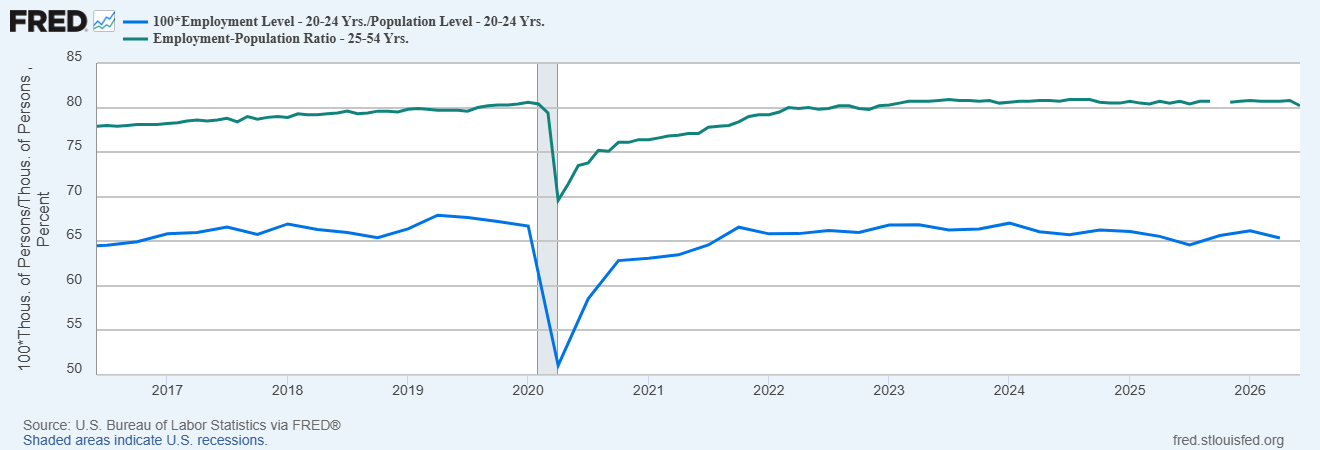
In fact, although AI might eventually be a big job-destroyer, right now it doesn’t seem to be. The employment rates for people age 20-24 and 25-54 are both just about the same as they were before ChatGPT ever existed:
And the employment rate for young college grads — the group everyone thinks is most likely to be hurt by AI — is also basically unchanged:
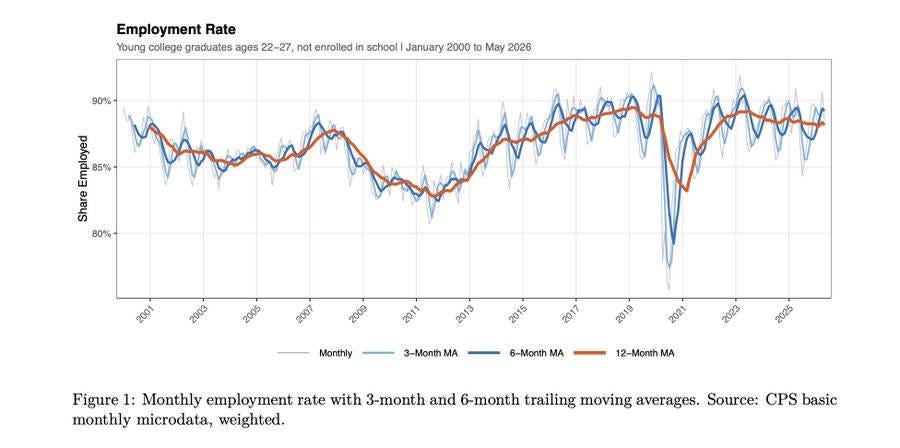
So if there’s any wave of AI job destruction, it’s not visible in the macro data yet. As for the micro data, there are a few studies that show companies reducing their hiring of certain kinds of workers when they adopt AI, but most don’t really find much. In fact, one recent study found that companies that adopt AI hire more workers than other companies in the same industry:
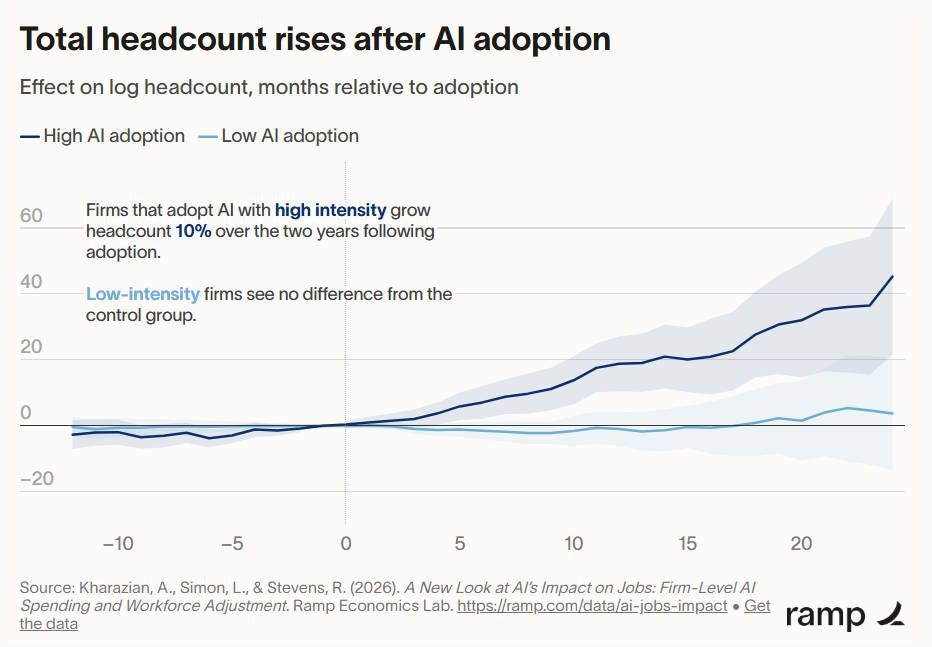
This is despite the fact that lots of people in the AI industry think their inventions are going to destroy jobs. So far they’ve just been wrong, and many of them are feeling pretty astonished right now.
Even when it comes to specific occupations, technologists are often startlingly wrong on the “complement or substitute” question. Geoffrey Hinton, one of the inventors of modern AI, famously predicted the end of human radiologists within a few years, only to see a boom in hiring and salaries for radiologists when it turned out that AI actually complemented their skills.
So how the heck are businesspeople and inventors supposed to “steer” AI toward being complementary to human workers? They obviously couldn’t predict the labor market effects of the last round of AI — at least, in the short term. So why should anyone believe that technologists have the ability to purposefully invent different forms of AI with different labor market effects?
The second problem with the idea of “steering” AI is the question of who does the “steering”. Acemoglu’s book, Power and Progress, never answers this question. Here’s what I wrote in my (very long) review of that disappointing book:
Acemoglu and Johnson admit that “redirecting” the path of technological innovation is going to be an incredibly tall order…[H]ow do we know in advance, before a technology is invented, whether it will increase or decrease the labor share?…Fundamentally, it still boils down to some sort of mandarins in a room somewhere — economists? government engineers? bloggers? — trying to assess the economic effects of a technology that doesn’t even exist yet…[T]his is probably an impossible task…
Acemoglu himself has certainly not had a better record than the technologists when it comes to predicting the effects of AI on jobs. He wrote an empirical paper claiming that companies that buy robots tend to hire fewer workers, but this paper was contradicted by a very large number of follow-up studies. And he wrote a theoretical paper claiming that AI wouldn’t do much to raise productivity, but that prediction was based on arbitrarily assuming away parts of his own model.
So any panel of wise mandarins that Acemoglu and his fellow-travelers assemble in order to “steer” AI technology is likely to have absolutely no idea what they’re doing. Here’s what I wrote about that idea back in 2023:
[I]f we were to set up a panel of experts and task them with deciding which lines of research and innovation to encourage and which to discourage in order to maximize jobs and wages, they would be operating purely on gut instinct and quasi-science-fictional supposition…. [I]n practice, any panel or commission set up to speed up and slow down various types of AI will be simply adding noise to the innovation process, offering rewards and punishments essentially at random. That’s not good for the development of technology as a whole, since it introduces uncertainty into the innovation equation. But it’ll also be ineffectual in terms of actually protecting human workers…
Three years later, having witnessed so many of the dire predictions of job destruction dashed on the rocks of reality, I see absolutely no reason to change my assessment. Acemoglu’s big idea — basically, to put him and his friends in charge of AI development — is not a good idea.
In fact, the surprisingly benign effect of AI on jobs so far calls into question the very notion that “We Must Act Now”. Yes, I agree that AI presents a very severe security threat, and we must act on that. But on the economic front, it’s possible that inaction is the right move.
Statistically speaking, we probably don’t live in the best of all possible worlds when it comes to AI’s economic effects. But we might be close enough that any large-scale attempt to interfere in AI development might leave average human workers worse off. There’s certainly plenty of historical precedent for that — collectivization of agriculture, Mao’s “backyard production”, and a bunch of other heavy-handed interventions in the development of an entire sector crashed and burned spectacularly.
It might be, in other words, that the AI we’re building now is already highly complementary to human workers, and that the best approach is not to “Act Now”, but to simply sit there and do nothing. Even the seemingly empty slogan of “We Must Act Now” might actually be wrong. Perhaps we mustn’t.
In any case, if the authors of the “We Must Act Now” statement add specificity to their policy proposals, I’ll consider signing it. But right now, the statement seems to hide some genuinely inadvisable Acemoglu-ism behind a screen of extreme vagueness.
<http://noahpinion.blog> <https://www.noahpinion.blog/p/why-i-didnt-sign-the-we-must-act>
Brad DeLong here: I did not see this before it went out. I am not sure that I would refuse to sign if someone had asked me to. It seems like such a slender thing. While I am not convinced that this wave of Schumpeterian creative-destruction is going to wash over the economy in 10 years rather than in the 30 years that has been standard since 1870, it might. I would have complained that “larger than the Industrial Revolution” is misleading, for compared to what has happened since 1775 to 1875 was not that large a deal. It stood out and stands out because it was the first time it had happened, but it has happened again and again and again and again and again since. and I would have complained that “must act now to understand” is self contradictory. ? We really should work to understand, and think to understand. But “act to understand”?
Thought first. Rough consensus second. Action third.
Indeed, we have already thought much about this. Much of the discussion was implicit in David Ricardo’s “On Machinery” chapter, written in the early 1800s. There are four important questions:
How elastic is demand for the outputs of the technology—how many more units are going to be sold as the cost of producing each unit falls?
How are the labor requirements for producing the average unit going to shift as jobs shift from doing to debugging the doing—and are those new jobs going to be interesting ones?
What is the scale of price decline that we anticipate for the outputs of the technology—how far is the price going to fall?
Is the potential loss of jobs by currently employed workers in the sector—or is the diversion of people who would have entered the pipeline—of any special concern?
My view is that the thing to worry about is a modern fast-moving equivalent of the slow-moving 1775-1850 crash of labor requirements in the world’s hand-textile sector.
I have been pointing out for quite a while.
For example:
J. Bradford DeLong (2017): Artificial Intelligence & Artificial Problems <https://www.project-syndicate.org/commentary/mnuchin-automation-low-skill-workers-by-j--bradford-delong-2017-04>: “[In] textiles in [the] eighteenth- and nineteenth-century… new machines made the exact same products that handloom weavers had been making…. Consumers were no longer willing to pay for what handloom weavers were producing [as[ he value of wares produced by this form of unskilled labor plummeted, but the prices of commodities that unskilled laborers bought did not. The lesson… is that we will need to confront the social-engineering and political problem of maintaining a fair balance of relative incomes across society. Toward that end, our task becomes threefold…. We need to make sure that governments… maintain… a stable, low-unemployment economy so that markets can function properly… redistribute wealth to maintain a proper distribution of income… correspond[ing] to our values and morals… [educate] workers… to use increasingly high-tech tools…”
And just hoisted:
Automation & Labor & Inclusive AI- HOISTED FROM THE ARCHIVES
From 2018: “The Future of Work: Technology & Policy for a Diverse Human Future”. I have always been proud of this, as saying the important things in a very compressed but effective form...
< https://braddelong.substack.com/p/automation-and-labor-and-inclusive >
2026-07-16
“AI” truly is potentially poised to liberate us from dehumanizing work—unless the market makes that potential liberation into a dystopian catastrophe for human equity. What I thought back in 2018 the big issues were going to be, with the real danger being not that AI takes all the jobs, but that it takes the wrong ones for the wrong reasons…
How big are the risks and opportunities? I think we have a pretty good framework for understanding this. The problem is we need to know much, much more about what these technologies will actually be able to do before we can reach judgments. And that is not something we know in the here and now.
For a slightly different perspective, I recommend Dave Karpf's essay "On the Strategic Function of Anodyne Statements": https://davekarpf.beehiiv.com/p/on-the-strategic-function-of-anodyne-statements
"... this economist letter is remarkably anodyne. What academic economist would disagree that (1) AI might keep improving, (2) this might have economic impacts, and (3) economists and policymakers ought to devote some quality brainpower to this sort of thing?
(The equivalent in my field, political science, would be a mass sign-on letter saying (1) American elections might become more polarized and less competitive over the next decade, (2) this could have implications for democracy, so (3) governments should fund a lot of political science research and listen to the recommendations of political scientists. Practically all political scientists would agree that there should be more research funding for political science, and that policymakers ought to listen to us.)
From a strategic comms perspective, the point of this letter isn’t the substance of the letter. It is substance-free. The point of the letter is to combine the title (We Must Act Now!) with the signatories (A bunch of Nobel laureates, several of whom are skeptics) ...."