

CROSSPOST: PATRICK WYMAN: The Human Sacrifices of the Shang Dynasty
13,000 names we’ll never know: the sacrificed victims of China’s first dynasty... China’s first literate state didn’t just practice human sacrifice. It industrialized it—and wrote down the numbers...

We used to think the sacrifice victims of the Shang Dynasty were prisoners sacrificed within days of reaching the capital. The isotopes locked in their bones tell a grimmer story: years of forced labor, then execution. For centuries, the captives called qiang were thought to be a single enemy people. The truth is worse: sheep-people 羌 qiang wasn’t an ethnicity, it was a status — anyone the Shang caught and marked for death:
“Sheep=people”. People who herd sheep? Or people whom we treat like sheep?
Patrick Wyman is one of my favorite podcasters. His book, The Verge: Reformation, Renaissance, & Forty Years that Shook the World <https://www.hachettebookgroup.com/titles/patrick-wyman/the-verge/9781538701171/>, is just about perfectly pitched for my undergraduate students. Moreover, it is a perfect capstone to the argument, which I buy, made by Patricia Crone, that it was the incompetence of Europe’s predatory élites at collective action to successfully run their version of an agrarian-age society-of-domination that opened the way to the cultural-economic-industrial explosion we have seen over the past half-millennium.
Here we have Patrick Wyman diving into the extraordinary culture of the extraordinary society of domination that was China’s Shang Dynasty 商朝 from -1600 to -1050
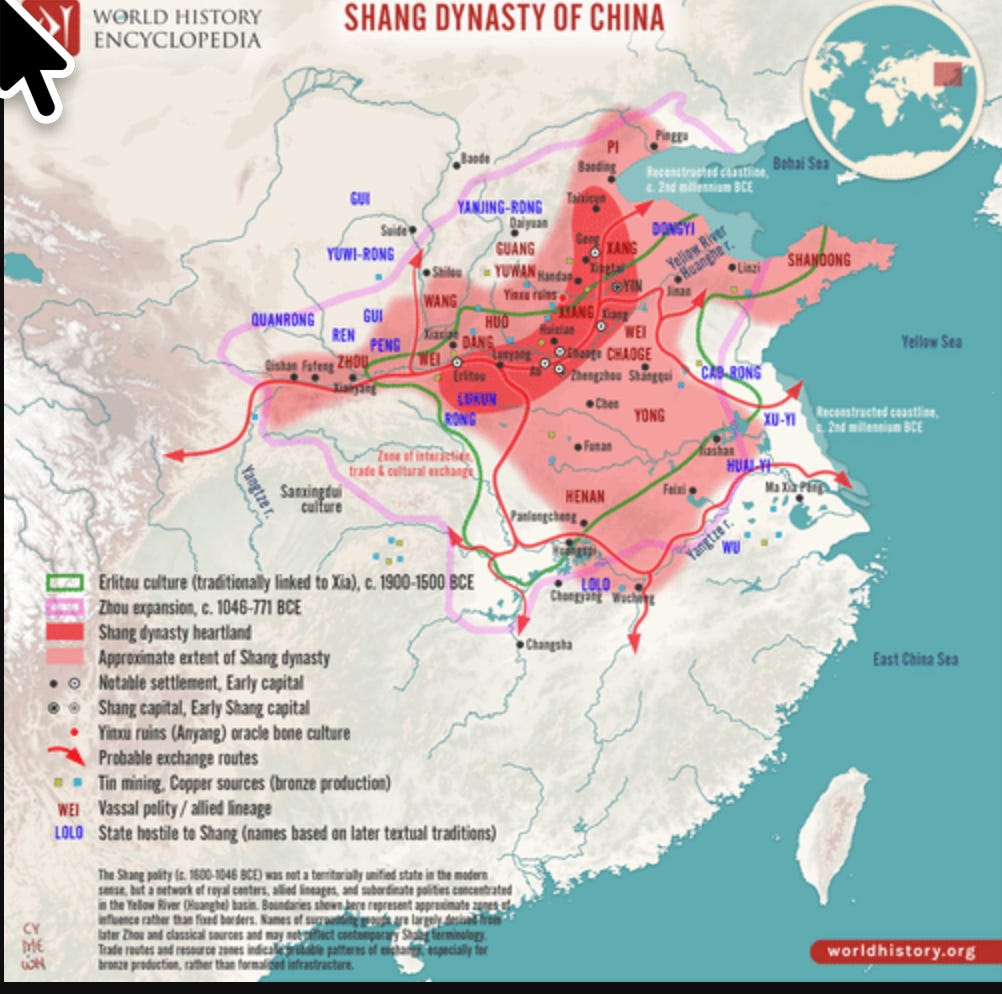
The Shang state appears to have run on an extraordinary self-reinforcing engine of war and sacrifice:
the army captured people at the periphery,
they were then used as forced labor at the center,
after which they were killed to please?, to appease?, to somehow feed? a bizarre conglomeration of ancestral spirits,
with sixteen sacrificed in the grave of Queen-General Hao 妇好,
with the largest mass sacrifice we have found amounting to some 350 people;
not a proto-bureaucratic empire of the kind we are used to from the Middle East;
rather, a sacred and sacrificing order of competing lineages commanding soliders and slaves, where the the scale of the human sacrifice your lineage could undertake was the principal way to gain lineage prestige via spectacle.
Let me stress scale. The population of the Shang capital of Anyang probably peaked in the low six figures, in an age where the entire population of China was perhaps 8 million.
Now we do see in early agrarian age China, all the way back to the year -4000, patterns that were to come to dominate in the Shang: ancestor worship, human sacrifice, and divination. The Shang Dynasty did not originate these. But it did undertake them at industrial scale.
The Shang appear to have run among the very worst of the many bad societies-of-domination we see over the long agrarian age.

CROSSPOST: PATRICK WYMAN: The Human Sacrifices of the Shang Dynasty
<https://patrickwyman.substack.com/p/the-human-sacrifices-of-the-shang> <https://patrickwyman.substack.com/>

Aug 13, 2026
Mei kept his head high as he ascended the steps of the platform, eyes forward and not on his bare feet scraping the compacted earth. The guard walking behind him didn’t have to use the sharp point of his polearm to prod Mei along. Despite knowing what awaited him at the top of the steps, he went there of his own volition, if not altogether willingly.
The ropes binding Mei’s wrists chafed at the old scars underneath. They’d healed poorly and bled constantly, layer after layer of healed tissue flaying open at the slightest friction. The joints themselves were weak and painfully thin. Back home in his village, Mei had been a strapping man, fond of (and good at) wrestling with his brothers and cousins; he was often chided for scooping more than his share of millet porridge out of the communal pot. His large size had made him one of the first choices to defend the village from raiders or to help rustle cattle from the pastoralists who lived in the dry grasslands beyond the hills.
Thanks for reading Perspectives: Past, Present, and Future, by Patrick Wyman! Subscribe for free to receive new posts and support my work.
Listen here and be sure to subscribe to Past Lives:
Mei supposed that made him an important man. His people, across villages up and down the valley, did look to him for leadership at times. Somebody had to do the rough jobs like leading the lads out to fight, and Mei didn’t mind if it meant having a bigger house and a few slaves to work in it. To his Shang captors, that made Mei a chief of sorts, a captive to be prized. These men hadn’t even taken him in battle, worst of all: He had been out in the fields, weeding and shooing away birds from the ripening millet, when the soldiers surrounded the village.
Now, after the months spent walking east through the mountains and the months spent here in the bronze foundry, there was little left on Mei’s bones but skin. Even that was peppered with wounds, lesions, burns, and calluses, his body a ruin from the blisters on his feet to the whipweals on his back.
This city was enormous, bigger than anywhere Mei could have ever imagined, filled with more people than he thought lived in the entire world. Their faces would be the last ones he saw in life. Weak, wounded, and alone, Mei knew there was no point in running now: With a guard behind him and two more at the top of the steps, plus the waiting executioner with his wide-bladed bronze axe, he knew he was doomed to die.
Still, Mei kept his head high, his steps assured. His captors could take his life, as they had taken his freedom and his labor, but he would choose the manner in which he left this world.
Break
Hello, my friends, and welcome to another episode of Past Lives. I’m your host, Patrick Wyman. Thanks so much for being here today.
The Shang Dynasty marked the beginning of recorded history in China. For the first time, we have contemporary written texts that can add depth, detail, and flavor to the mute testimonies of the archaeological record. There had been cities, states, and kings in China long before the Shang, going back deep into the Neolithic period more than a millennium earlier, but the 13th century BC marked the beginning of an unbroken literacy and an ideal of centralized rule, both of which have endured through the years to the present. The script used to inscribe the Shang oracle bones with records of divinations and sacrifices is the obvious ancestor of the characters that remain in use today, the language an early form of Chinese. The Shang ruled the largest state that had ever existed in East Asia, and set the template for every subsequent dynasty and ruler. In ways both large and small, the Shang are the beginning of China as we have come to understand it.
In our last episode, we discussed the Shang world from above, through the tomb of queen and general Fu Hao. You’ll remember the thousands of objects made from bone, jade, and bronze that were placed in the burial chamber with her: metal vessels used in elaborate ancestor-worship rituals, turtle shells recording past divinations, jades so old they were already antique, treasures far beyond what the average resident of the vast capital city of Anyang ever would have seen or held during their lives. The most telling inclusions in Fu Hao’s tomb, however, were the sixteen people who were executed and interred with her. Human sacrifice was a shockingly common practice at Anyang, and the Shang world revolved around a sacrificial economy in which prisoners taken in campaigns were brought back to the capital to perform hard labor until their eventual executions.
Today, we’ll turn our attention to the victims of this practice rather than the perpetrators. Thanks to reevaluations of the oracle bone inscriptions and cutting-edge archaeological science, we now have some idea of who these people were, where they came from, and what their lives were like. Shang political life and the power of the state depended on the military campaigns in which people were taken and enslaved. Their toil made the lavish lifestyles of Anyang’s elite possible. Their deaths were the currency that paid the spiritual tolls demanded by a baffling array of ancestral spirits. But these people weren’t curre ncy, or labor, or captives; they were people, with families, experiences, hopes, and dreams. The Shang deliberately and systematically destroyed their lives. The least we can do more than 3,000 years later is return them to the center of the story.
The Shang knew their capital city as Dayi Shang, “Great Settlement Shang,” and between its founding in 1300 BC and its abandonment 250 years later, it was almost certainly the largest, most populous urban site on the planet. It was a sprawling, rather loose city compared to its contemporaries, places like Pi-Ramesses in Egypt or Babylon in Mesopotamia, but it was much bigger: At its peak, Anyang covered nearly 14 square miles, 3600 hectares, with an estimated 100,000 residents. Even those numbers might be low, because Anyang wasn’t bounded by a circuit of city walls; it simply grew less and less dense at the edges, petering off into the surrounding pastures and fields of wheat and millet. There were certainly walls at Anyang - huge, thick structures made of rammed earth - but they enclosed individual districts of the city, namely those of the nobility and the royalty who ruled the Shang world. Anyang was essentially a collection of communities that aggregated into mile after mile of low-density sprawl: clusters of workshops surrounded by the homes of the laborers, many of whom were enslaved; walled compounds the size of a Neolithic city-state containing individual noble (but not royal) lineages and their hundreds or thousands of subordinates; and at the center, bigger and grander than the rest, the fortified palaces, gathering-halls, and tombs belonging to the Shang kings themselves.
Everything at Anyang was simply bigger, vastly greater in scale, than anything that had come before in Chinese history. The capital city was larger, of course - twice the size of the previous center of power at Zhengzhou - but so were the mountains of slag produced by industrial bronze-casting operations in the city. In fact, the largest known bronze artifact from anywhere in the ancient world was produced at Anyang: The Houmuwu ding - a three-legged bronze vessel - weighs 830 kilograms, more than 1800 pounds. That ding was among the copious treasures that accompanied Shang nobles and royalty into their graves. Fu Hao’s lavish tomb contained more than 1,000 individual artifacts, many of which had been purposely carved or cast for the occasion; that was a fraction of what a Shang king’s burial chamber might contain. Moreover, despite her military role, Fu Hao wasn’t buried with a chariot or horses, common accoutrements for the Shang elite. And while sixteen individuals lost their lives as human sacrifices to accompany Fu Hao into death, that too was a minuscule number compared to the blood spilled on many other occasions. If we add up all the people marked for death as sacrifices in the oracle bone texts discovered at Anyang, we arrive at a figure a bit north of 13,000. Since the texts we have are only a small portion of what once existed, and not all human sacrifices were recorded with divinations, the true number is surely far higher. Archaeologists have consistently found pits or groups of pits containing the remains of fifty or more victims. The largest concentration yet recorded involved 339 executions, all deposited in a single act of mass sacrifice. The textual and material evidence align: In a little over two centuries, thousands of people were killed at Anyang.
Why did the Shang do this? What was the logic behind sacrificing dozens or hundreds of captives at once? To answer these questions, we have to understand how the Shang saw the world. It would be easy to think of them as the forerunners of the bureaucratized, centralized empires of later Chinese history, with coteries of administrators, a standing army, and regular procedures for controlling a vast territory; but that’s not actually how the Shang state functioned or what its rulers valued. Its kings weren’t bureaucrats or cosseted emperors; they were equally spiritual and political animals, just as comfortable at a divination or presiding over a sacrifice as they were on a hunt or at a feast with their nobles. Even for more recent periods - the European Middle Ages, for example - we often overemphasize the pragmatic sides of kingship, like making beneficial marriages and starting wars, at the expense of the sacral aspects. The prevailing idea of a healing touch, or the king’s mythical two bodies - one physical, one eternal - indicates that there was more happening than just practical rulership. The further back we go in time and the wider we cast our geographic net for comparisons, the stranger kingship seems to become. We’ve talked at great length about the centrality of the king in ancient Egypt, the semi-divine aspects of his person and rule; the Shang, by comparison, took that concept in directions that seem even stranger to a modern eye.
At heart, the Shang didn’t imagine their state or the broader society around it as a singular entity. Instead, it was a collection of distinct lineages stretching back through time to honored ancestors. After death, these ancestors weren’t gone from the world; they remained active in the lives of their descendants, and it was incumbent on the living, particularly the most important among them, to provide sufficient sacrifice to their ancestral spirits. For the members of the Shang dynasty and their contemporaries in the Central Plains, spirits of all kinds were a dangerous and omnipresent force in their lives, causing all manner of calamities. A flood? There was a spirit to blame. A failed military campaign? An ancestor was angry about something. An imminent harvest? Best to avoid an ancestral spirit’s unhelpful interference by appeasing them with a sacrifice in advance. Everyone had ancestral spirits; the more elevated a lineage, the more important its ancestral spirits, and the Shang had the most illustrious of all. It was therefore their spirits who required the greatest and most consistent appeasement. When married to a state apparatus that could mobilize thousands of soldiers and control much of what is now present-day China, this became the basic logic underlying industrial-scale divination and sacrifice. I love the way the archaeologist Elizabeth Childs-Johnson sums up this dynamic, as “the fusion of ‘shamanic’ belief with the institution of rulership and its power mechanisms.”
The Shang didn’t invent ancestor worship. There are signs of this belief system dating back nearly 3,000 years before, in the archaeological cultures that eventually developed into the Bronze Age societies of the Central Plains. At the Neolithic village of Jiangzhai, dating to around 4000 BC, different residential portions of the settlement were oriented toward different cemeteries. Archaeologists have interpreted these segments as representing the living and dead members of lineage groups that persisted through time. The Shang didn’t invent sacrifice, even human sacrifice, as a mechanism of ancestral appeasement: Sacrifice is simply the deposition of something valuable as a gift to a spirit. In China, human life was a valued currency in this exchange dating well into the third or even fourth millennium BC. Divination too is far older than the Shang, with instances of drilled and cracked bones dating back centuries before them.
What changed with the Shang, in all of these aspects, was scale. Lineages seem to have been the fundamental building block of societies in China dating back deep into the Neolithic, but the competition between and accumulation of resources by these kin-groups also turned them into the building blocks of the Shang state. In fact, we should probably see the vastly increasing scale of sacrifice - dozens or hundreds of captives instead of a bare few buried underneath a new palace - as evidence of how powerful the kin-groups had become; they could afford to expend hundreds of cattle and people in rituals designed to glorify their ancestral spirits. Lesser lineages might sacrifice one or a few captives at the death of a valued family member, but that could never suffice for Shang royals. If their ancestors required such appeasement, then those who claimed descent from them must be equally prestigious and potent in the present.
This logic became the driving force behind the Shang state as a whole. Violence underpinned it all: Violence at the margins, where neighboring groups would be raided for captives and plunder or brought under the Shang yoke, and violence at the center, where the lives of those captives were expended to further the prestige of the Shang. As a much later text from the Spring and Autumn period, the Zuo Zhuan, puts it, “the great affairs of the polity are sacrifice and war.” More than that, it was a self-reinforcing cycle, and it peaked at precisely the time Fu Hao was buried with sixteen human sacrifices.
The Shang had a specific word for the captives they brought back to Anyang after a successful military campaign: qiang. For a very long time, scholars working on the oracle bone texts thought qiang was an ethnic designation, a name for one of the neighboring groups living at the edges of the Shang state. The truth is rather more prosaic and depressing. What made someone fall under the label qiang wasn’t their specific ethnic identity but the fact that they were a commodity destined for expenditure in the sacrificial market. One oracle bone inscription, for example, records the capture of a leader named Mei, plus 24 other people - presumably military-aged men - along with 100 captive women, 1,570 scalps, and assorted sets of weaponry and armor. Other inscriptions list the captives, labeled as qiang, alongside livestock. These same oracle bones also often record the specific ancestors to whom the cap tives were sacrificed: Mei was killed to appease Ancestor Ding; the 100 captive women were killed on behalf of a certain Ancestor Yi. Occasionally bits of human skull were used as oracle bones, but most captives were simply dumped into pits in groups of ten after their executions. Mei’s head was displayed as a trophy. Sacrificial deaths were gruesome: decapitation and dismemberment were standard, but other captives were cut in half at the waist or even buried alive. Through this activity, the king domesticated the people of enemy groups, reducing human beings to the same level as the livestock who were sacrificed alongside them. He was powerful, and they were weak. It was a brutal logic reinforced through systematized death.
And yet the people whose bodies were tossed into those pits ringing the burials of the Shang elite were human beings. They had lives before their capture and the long march to Anyang. They had lives at Anyang, sometimes for years, prior to their executions. Now, thanks to recent research, we can reconstruct their backgrounds with more depth and detail, and hopefully restore some of the humanity the Shang and their allies stole from them more than 3,000 years ago.
Our first order of business is to establish where, exactly, the people sacrificed at Anyang - and the non-elite inhabitants of the city more generally - came from. While the oracle bone texts suggest that sacrificial victims in particular were drawn from captives, the qiang label applied to them obscures their geographic and cultural origins. The scholars working on the cutting edge of this field would say that was an intentional act of dehumanization: Even in death, millennia later, we’re still trying to work past the Shang worldview to the underlying reality of who these people were. Luckily for us, recent studies have enabled us to do precisely that. If you think back to previous episodes in this season, you might remember stable isotope analysis. As living creatures grow, we absorb the distinct local isotopic signatures of the food we eat and water we drink, which are locked into our bones. We can then sample human bones and analyze it to determine those isotope values, the most commonly used of which are oxygen, strontium, nitrogen, and occasionally sulfur. These values tell us about geographic origins, since different regions have different background levels of isotopes, and also about the composition of an individual’s diet. Different bones lock in the isotopic signature from different times in our lives: Our tooth enamel is more or less set by adolescence, so the isotope values there tell us about childhood; the cortical bone of the ribs, by contrast, is constantly remodeling over the course of our lives, so values from that part of the body tell us about a person’s last years before death.
This is particularly useful for the study of the Anyang captives, because - assuming we have bone samples from different sites on the body - we can compare the values from different times in their lives. If the sacrificial victims were born near Anyang, then the isotopic ratios in their tooth enamel should match local values scientists calculate from the landscape. This may well have been the case for the high-status retainers who sometimes accompanied their kings and nobles into death, a type of sacrifice known as renxun, as opposed to the simple “human offerings,” renshen. If they came from elsewhere, however, those values will be different. If the values from their cortical bone match Anyang but their tooth enamel gives us a different number, then we’ll know that they came from elsewhere but lived at Anyang for some time before they died. If we’re lucky, then we might be able to match the differing values to other regions near the Shang heartland and provide a precise origin.
Archaeologist Christina Cheung, whom I had the pleasure of interviewing a few years ago on Tides of History - season 4, episode 85, if you want to check it out - has carried out extensive bioarchaeological research on the human victims from Anyang. One study she led examined 68 individuals who had been sacrificed. Some were represented only by portions of their bodies, specifically the skulls, which had been dumped in a pit near a royal burial, while other sets of remains lacked the skull altogether, for fairly obvious reasons; others were relatively intact. As a control, Cheung and her colleagues also examined 39 local residents of Anyang, commoners who had been buried in humble but normal graves, to compare the isotopic values.
The results were striking. Practically all of the sacrificial victims had isotopic values that pointed to origins far from Anyang; only one person who was sacrificed was determined to have been a probable local. This lone individual was almost certainly one of the more elevated retainer burials, renxun, rather than a brutal dismemberment of a human offering, renshen; the local sacrifice had also consumed a great deal more animal protein over the course of his life than the common victims, a likely sign of higher social status. The non-locals had eaten a slightly different diet: Both they and Anyang residents ate mostly millet, but Anyang natives supplemented that fare with wheat, rice, or local wildlife. Cheung’s most significant finding, however, is that the sacrificial victims’ diets had changed in the years immediately before their deaths. The most convincing explanation for this phenomenon is that prisoners of war, those labeled qiang in the oracle bone texts, weren’t killed immediately upon arrival in the Shang capital. Most scholars had previously believed that captives were marched to sacrificial platforms within days, but the isotopic evidence demonstrates beyond doubt that these victims had been kept alive and working for years before their deaths. We know that because bone from elsewhere in the body has different values than their tooth enamel, meaning that they lived long enough in Anyang to carry its distinct isotopic signature, including the local diet.
We can be more specific about the victims’ geographic origins than just saying they weren’t from Anyang. The bulk of the isotopic data suggests that they came from somewhere to the west, particularly the northwest. While the Shang dominated the Central Plains, they and their political allies and cultural relations were far from the only groups living in present-day China. It was a diverse place, with varying lifestyles, languages, material traditions, and genetic ancestries. Some of these groups were pastoralists, links to the dynamic world of the Eurasian steppe and the probable conduit of such innovations as domesticated horses and cattle, chariots, wheat, and not least, bronze-working itself. Scholars generally assumed that the Shang had a particular dislike for pastoralists and targeted them in their incessant wars and raids, but the isotopic data doesn’t support this conclusion; the people Cheung and her colleagues studied had all relied on agricultural products prior to their capture, rather than the dairy and meat common among pastoralist groups. There is variation among the sacrificial victims, however, suggesting that they weren’t necessarily members of the same cultural or ethnic group. That is revealing, because it reinforces the argument that the Shang didn’t particularly care who they were raiding or sacrificing. Anybody could be qiang; it was the fact of their capture and transportation to Anyang that made them so, not any specific origin.
Once they arrived at Anyang, some - but not all - captives were immediately sacrificed: perhaps in thanks for a victorious campaign, or to sate the anger of a spirit as revealed in a recent divination. There is some uncertainty as to where the captives lived in Anyang, and under whose control: They might have been held in prisons controlled by the royal dynasty, or kept in the compounds of the noble lineages that towered over the commoners’ districts. Wherever they lived, it’s certain that they were put to work. The Shang weren’t ones to let labor sit around unutilized, and there was nothing sacred about the human beings or livestock destined for sacrifice. Life at Anyang was hard for everyone who wasn’t among the ruling elite: Studies show extraordinarily high rates, over 80 percent, of dental enamel hypoplasia among the residents, indicating astronomical levels of childhood stress. Forty percent of adults had osteoperiostitis, a generalized stress reaction visible in the skeleton. For women, those general stresses and workloads continued throughout their lives; adult men were more likely to show signs of backbreaking labor, particularly in the upper body. To my knowledge, these paleopathological studies haven’t been carried out on sacrificial victims, but there’s no reason to think they labored under better conditions after their arrival at Anyang. If anything, they were probably treated worse, and worked harder, before their executions.
Most of the sacrificial victims we know from the archaeological record were adolescent and young adult males, aged between about 15 and 35 at the time of death. Oracle bone inscriptions tell us that female captives were sometimes killed as well, but excavations have yet to find them in significant numbers. It seems that adult men were preferred as sacrifices, though exactly why is unclear: They may have had the most value to the spirits, or perhaps it was considered unwise to keep large numbers of military-age men hanging around the capital in captivity. If the general point of the executions was dehumanization and dominance, however, then picking men of fighting age was the strongest way to demonstrate strength: Watch as we turn men who were once warriors or who could have been warriors, and thus a potential threat to us, into livestock under the blade. Watch as we throw their bodies into pits, denying them funeral rites and the offerings of their descendants. See, from that, how strong we are.
We don’t have to accept the Shang framing of these people. They came from agricultural villages and pastoralists’ camps. They fought among themselves, and surely raided lands the Shang considered theirs, but mostly they farmed and herded, made pottery and tools, grew up and raised families. Then, one day, the Shang armies arrived on their doorstep, led by highly competent generals like Fu Hao. Perhaps the men were taken in battle, but it’s more likely that the Shang simply swept up whomever they found. The survivors witnessed the deaths of friends and kin, the taking of scalps and heads, and all the other diligently recorded atrocities we find in the oracle bone inscriptions. Such was the scale of the Shang state that these outlying territories were weeks or even months of walking away from Anyang and the Shang heartland. These captives survived that trek across arid grasslands and over mountain passes, while many others surely died along the way. At least some survived through years of imprisonment and forced labor in Anyang before their executions. Whatever the circumstances of their deaths, they hadn’t given up. They persisted through conditions and traumas that would have finished others. And no matter how the Shang treated them or where their bones were left for archaeologists to find millennia later, they were people. We can’t undo what the Shang and its sacrificial war machine did to thousands of people at Anyang over the course of more than 200 years, but we can decide who we remember first.
Next time on Past Lives, we’ll be moving to the opposite side of Eurasia, where distinctly unique preserved human remains - and the questions that stem from them - can be found in marshy northwestern Europe: bog bodies. What are they, and what can we learn from them?
<https://patrickwyman.substack.com/p/the-human-sacrifices-of-the-shang> <>
Brad DeLong here: Isotope analysis is the methodological hero here. the isotopes in tooth enamel on the one hand and in rib bones on the other tell us (a) where the sacrificed victims were when children and (b) how long they had been slave-captives. It shows how bad an agrarian-age state can be. And such could be very bad. The immediate competitors for the badness crown seem to me to be:
the Aztecs (Mexica) at their height, with the “flower wars” (xochiyaoyotl), tribute in captives, temple-top heart extraction at Tenochtitlan, all organized around feeding the gods with human victims to keep the sun from disappearing.
The Moche of the Andes who also practiced ritualized combat and captive sacrifice at Sipán and Huaca de la Luna, and appear to have undertaken mass sacrifices in response to El Niño flooding.
The death-pit royal burials at Ur around year -2600.
The Kingdom of Dahomey around 1800 with war-captive mass-sacrifice “annual customs” to serve deceased kings in the afterlife.
Slightly lower, in my estimation, on the pointless-death and -torment scale, are Assyrian boasts of flaying, impaling, and mass deportation, Spartan terrorization of the helot population via the krypteia, Roman spectacles of crucifixion and arena mass death. Domination
The Shang provide a correction to my standard take on agrarian-age states as proto-bureaucracies.
Now domination and extraction were the normal condition of agrarian states. Coercion, enslavement, and belief that the élites were both the favored of but also needed to appease the spirits were load-bearing institutions of “civilization.” Élites everywhere lived off coerced peasant surplus. The ruling classes were armed and fast-talking parasites on the primary producers.
But the idiom of domination by force and fraud varies. And the tropism toward not domination-as-a-tool-of-resource-extraction but domination-and-death-for-its-own-sake is horrible and strange to me, whether the idiom of pointless violence is sacrificial (Shang, Aztec), terroristic (Assyria), spectacular (Rome), or caste (Spartan).
Question: to what degree was the captive-and-sacrifice flywheel and machine the result of Shang success at chariot warfare, or the cause in supplying the civilizational energy by making aggressive war not just a tool of élite resource extraction but a holy spiritual duty?
References
Crone, Patricia. 1989. Pre-Industrial Societies: Anatomy of the Pre-Modern World. Oxford: Basil Blackwell. <https://oneworld-publications.com/work/pre-industrial-societies/>.
Wyman, Patrick. 2026. “The Human Sacrifices of the Shang Dynasty.” Perspectives: Past, Present, and Future, by Patrick Wyman (Substack). August 13.<https://patrickwyman.substack.com/p/the-human-sacrifices-of-the-shang>.
Wyman, Patrick. 2021. The Verge: Reformation, Renaissance, & Forty Years that Shook the World. New York: Twelve. <https://www.twelvebooks.com/titles/patrick-wyman/the-verge/9781538701171/>.
It would make for an interesting, but macabre, "compare and contrast" essay question to compare per capita human sacrifice by the Shang dynasty with the human sacrifice conducted by the Aztecs. Which empire was the worst? Maybe ask ChatGPT.
Later. So here's the short answer from ChatGPT: If we compare human sacrifice as a proportion of the population, rather than simply counting victims, the Aztec/Mexica appear to have been considerably more extreme than the Shang. But there is an important caveat: the numbers for both civilizations are uncertain, and the Aztec numbers in particular have been exaggerated in some historical accounts.
This makes me wonder about the much-later Six Dynasties China (ce 222-589), which somewhat resembled Europe ca 1500 with "incompetence of . . . predatory élites at collective action to successfully run their version of an agrarian-age society-of-domination"--witness its inextricably tangled political history--but also a brought about great artistic and intellectual flowering. ??