

Do Those Dominating a Situation Truly Bluff & Then Back Down?: Misreadings from Melos to Davos, & Beyond
Did Trump “dominate” Davos—or just do his chaos-monkey routine in other people’s Common European (& Atlantic-Arctic) Home? Or how not to read Thoukydides in the context of Trump’s grapples with the...

Did Trump “dominate” Davos—or just do his chaos-monkey routine in other people’s Common European (& Atlantic-Arctic) Home; or how not to read Thoukydides in the context of Trump’s grapples with the Greenland Defense Force…
This morning my feed brings me something that strikes me as extremely weird:
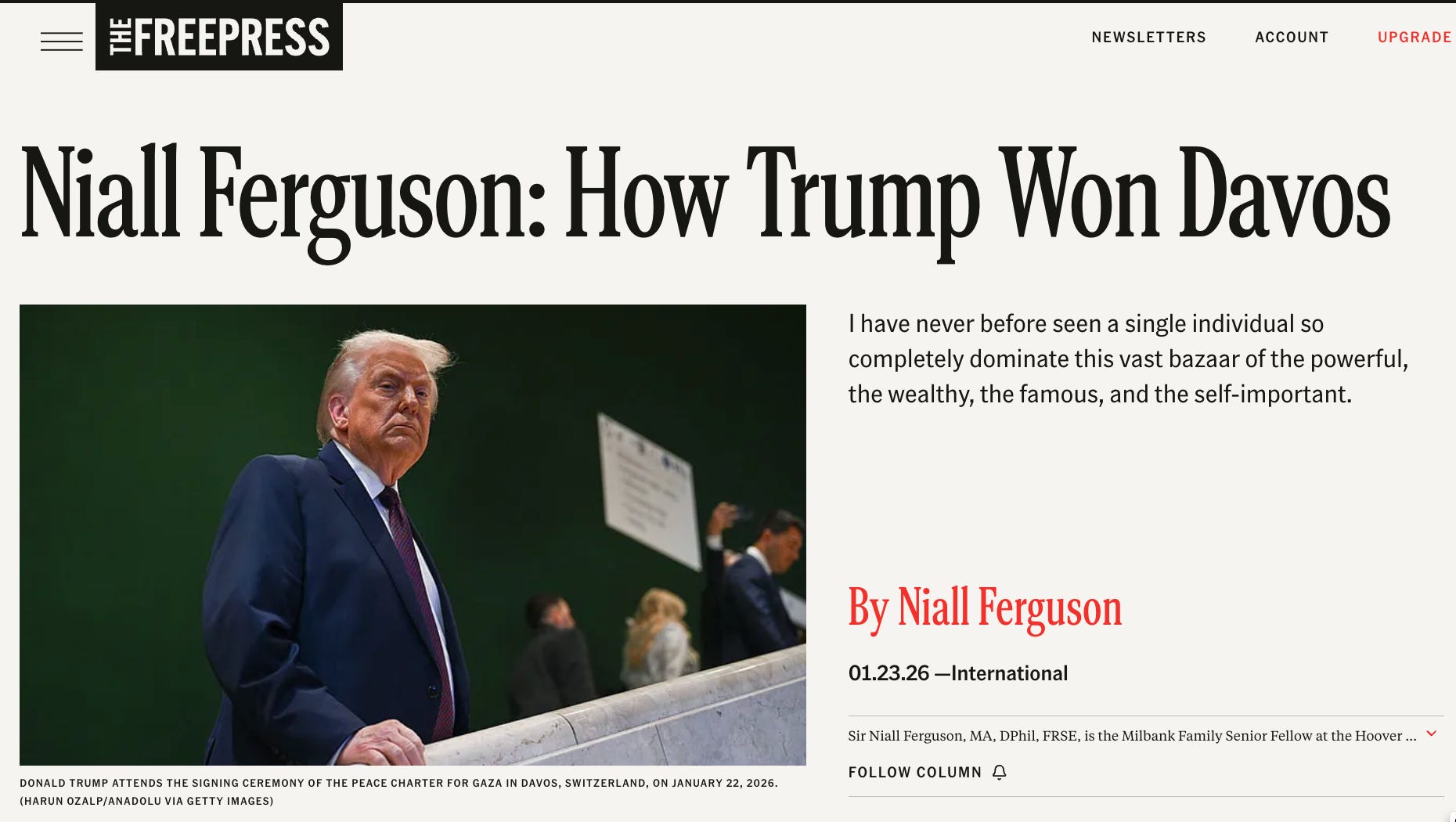
Niall Ferguson: How Trump Won Davos <https://www.thefp.com/p/niall-ferguson-how-trump-won-davos>: ‘I have never before seen a single individual so completely dominate this vast bazaar of the powerful, the wealthy, the famous, and the self-important…
This is—to say the least—a definite outlier in my feed. Otherwise, it has the vibe that Trump went to Davos to make himself look ridiculous and incompetent.
The dominant general reaction is things like:
accompanied by some frantic backpedaling by those hoping to become rich and powerful through going all-in on the Trump grift and supporting the Greenland-annexation idea:
Henry Farrell: Bessent and Lutnick: a Farce <https://www.programmablemutter.com/p/europe-has-more-bargaining-strength>: ‘Act One: Europe Can’t Do Nothing to Stop Us!…. “‘I imagine they will form the dreaded European working group first, which seems to be their most forceful weapon’, Bessent told a small group of reporters.”… Act Two: Actually, Europe, We Don’t Want You to Escalate!… “;I’m urging everyone here to do is sit back…. I would urge all countries to stick with their trade deals we have agreed on them’, Bessent added.”… Act Four: Exit, Stage Right, Pursued by Bears…. “Howard Lutnick was heckled…. Christine Lagarde walk[ed] out….Lutnick… [met] with widespread jeering amid appeals for calm from … Larry Fink...”
So what gives here?
Well, my first reaction is that this once again fits my rule-of-thumb:
Brad DeLong: A $140,000/Year Poverty Line? I: Stewarding & Utilizing Resources <https://braddelong.substack.com/p/a-140000year-poverty-line-i-stewarding>: ‘It continues to be the case that, every time something from the Free Press <http://thefp.com> brushes past my awareness, it almost invariably turns out to be wrong—usually deeply, often ignorantly, and also frequently making a choice to be stupidly wrong…
The rule-of-thumb is that whatever the underlying truth may be, it is definitely not what it says on the tin at the The Free Press, which is not a “press”, at least not as we conventionally think of that human social practice.
But I dove deeper into what “Trump Won Davos” and “dominate[d]” it in a way Naill had “never before seen a single individual so completely” do meant. And by the end I discovered that the argument is that Trump dominated Davos by not dominating it.
You see, Trump went to Davos:
insist[ing] that… “Greenland has to be acquired. Denmark and its European allies have to DO THE RIGHT THING.” He did not rule out military action. He threatened to impose new 10 percent tariffs on all countries that resisted. And he posted memes of maps of Denmark (and Canada) cloaked in the Stars and Stripes and an AI-generated image of himself planting an American flag on “Greenland—U.S. Territory Est. 2026…”
But by the end of the meeting Trump had:
called the whole Greenland thing off. “We never ask[ed] for anything,” he rambled, “and we never got anything. We probably won’t…. Later that evening…Trump announced… he would not impose the additional tariffs on European countries he had threatened. He and Rutte had “formed the framework of a future deal with respect to Greenland and, in fact, the entire Arctic Region…”
So how is—this starting out with a declaration of what must happen, a declaration that then goes nowhere—“dominating” the meeting?
Because, Niall explains:
Trump [n]ever seriously meant to annex Greenland or to impose new tariffs on the Europeans…. Half the time [Trump] is bluffing…. [But] that Trump carries out only around half the threats he makes… is certainly not a sign of weakness. It is a deliberate tactic designed to leave counterparties uncertain…. Trump was bluffing…. The administration never had the remotest intention of imposing new tariffs… much less taking military action to annex Greenland.
But why did he threaten it? Just for the lolz? Certainly, there was much hilarity among U.S. government staffers at Davos as they watched the president’s speech in the USA House at Promenade 95. They certainly were in on the joke.
Trump forced Greenland to be the No. 1 topic at Davos… to keep European leaders from meddling in America’s Middle Eastern and Eastern European policy…. How little the president said about Iran and Ukraine. That is because his administration has plans afoot…. The fuss about Greenland was a classic example of Trumpian maskirovka—a distraction similar to his claim that peace negotiations with Iran were continuing, just one day before the U.S. air strike on the Fordow nuclear facility. That kind of ruse was also known to the ancient Athenians. But probably not to the Melians…
Ummmm. Maybe? It would have been a very screwy thing to do. But Trump and his coterie of grifters do many screwy things. Many of them are damaging and destructive and deadly.
But what is the evidence that this is what Trump’s Master Plan for Davos was? And how is this “dominating” the meaning? Where to start?
Start with this: etymology often helps keep you grounded.
When the political and media classes drift off into free-floating narratives about personality and “vibes,” the history of words can quietly tug us back toward structure and substance. Words encode social relations, institutional arrangements, and long-forgotten hierarchies. Following their trails, you can see how power presented itself to itself. So when we find ourselves talking about whether someone “dominated” a room or was “in command” of a space, it is useful, I think, to remember where those words came from.
Latin domus—“house.” From domus we get dominus, the lord and master of the house. From dominus we eventually get the modern “dominate”. To dominate is not to posture or to bluster or command at home. It is to be the one who is at home, the one whose will is presumed to set the terms to which others must adapt—or leave. The dominus is the figure for whom the walls, the servants, the rules, and the rituals all exist already and automatically.
When we talk about whether someone “dominated” an international gathering, that is the background resonance. Is someone one of many enacting a performance in a contested situation? Or are they truly the one whose purposes the house as it stands currently exists to serve?
With that in mind, does it really seem like Donald Trump was comfortable “in his own house” at Davos?
One can, I guess, storm through the lobby and attract cameras. But that is not the same thing as moving through the space one has had built to one’s specifications, and within which one has arranged the furniture.
Being fearful that the Europeans might band together to disrupt your plans for getting Ukraine and Iran to knuckle under? It that the posture of someone truly at home in his own house? A genuine dominus does not fret that the guests might unexpectedly organize a tenants’ association. If you are worried that a coalition of medium-sized powers will frustrate your schemes, what you are signaling is not mastery but fragility: you know that you do not control the institutional plumbing, the coalition arithmetic, the bureaucratic follow-through. You suspect—rightly—that others have more veto points than you have levers.
Moreover, there are no visible signs that there is any coherent method or plan for Ukraine or Iran behind the bluster. To dominate in the meaningful sense would require a strategy that aligns means and ends, a theory of victory, and a plausible account of how today’s threats and photo-ops translate into tomorrow’s outcomes. What we have instead, as far as one can tell, is a mixture of improvisation, personal grievance, and performative toughness that never quite congeals into policy. The absence of a strategy is a rather large hole in any story about geopolitical “domination.”
And one thing of which we can be reasonably sure is that figures like Scott Bessent and Howard Lutnick were not party to any hidden master plan.
You do not sequester your supposed financial and political master whisperers in the cheap seats if they are integral co-authors of a cunning design. You do that when their function is decorative rather than strategic, and when your “strategy” consists largely of keeping options open until the next impulse strikes.
If Niall were to be right, Bessent and Lutnick were, from all available evidence, kept far outside whatever passes for the inner circle of deciders and advisers. If such a circle even exists. If there are advisers. If there are deciders.
Thus if I had to bet, I would bet that Niall before the meeting wanted to write a “Trump Dominated Davos” column, but the raw material of the event refused to cooperate. The facts would not sustain outright triumphalism. So he resorted to a familiar television trope: the Xanatos Gambit <https://tvtropes.org/pmwiki/pmwiki.php/Main/XanatosGambit>, in which even the most catastrophic defeats are retrospectively redescribed as and retconned into steps in a deeper, more cunning plan. Heads, the protagonist wins; tails, it turns out that losing this particular coin toss was all part of the script.
It is, I think, a convenient way to never concede that the would-be master of the house might actually be flailing.
Far more credible, to me at least, is Henry Farrell’s account of Davos. Farrell takes seriously the institutional context, the preferences and constraints of the various actors, and the ways in which Trump’s behavior is bounded by structures he neither fully understands nor controls. Rather than retrofitting a 4D-chess narrative onto a sequence of ad hoc moves, Farrell reads the episode as an illustration of how a chaotic presidency collides with a still-functioning—if fraying—network of allied states, corporate interests, and international organizations. That story may be less flattering to Trump and less thrilling for those in search of master strategists, but it fits both the etymology and the observable reality rather better.
But before I turn to Henry, that last line I quoted from Niall— “that kind of ruse was also known to the ancient Athenians. But probably not to the Melians” —seriously annoys me as a gross and ignorant misreading of Thoukydides of the Athenai and his great book Thoukydides of the Athenai wrote the history of the war between the Peloponnesians and the Athenians…, the one we call The Peloponnesian War.
Niall, in his paragraph eight, writes:
The Melian Dialogue is the most famous passage in Thucydides’s History of the Peloponnesian War…. Melos… like Greenland… had a relatively small population…. It was independent—and indeed wished to remain neutral…. But in 416 BCE the Athenians invaded Melos…. The Melians defied the Athenians. “We are just men fighting against unjust. . .we put our trust in the fortune by which the gods have preserved it until now.” The Athenians gave an immortal reply. “You know as well as we do,” they said, “that right, as the world goes, is only in question between equals in power, while the strong do what they can and the weak suffer what they must.” This passage has long been seen as the origin of the dichotomy in international relations between idealism and realism…
“Immortal reply”, “the origin of the dichotomy… between idealism and realism”.
The Athenians’ reply is indeed immortal, but not in the sense that Niall gives it.
For it turns out, in Thoukydides’s narrative of the Peloponnesian War and in the empirical reality of that war that the Athenians’ “realism” was not very realistic at all.
Athens lost the Peloponnesian War. Athens lost the Peloponnesian War in large part because those who ought to have been their allies defected to the Spartan and to the Haksamanishya cause. Pointing out that might-overrides-right arrogance is the opposite of a realistic means-ends policy is the reason that Thoukydides put the Melian Dialogue into his book.
Why? Because a rogue power that thinks and acts as though it is strong and able to “do what it can” was seen as much more of a threat than the rather insular Spartans or Persian satraps who spent much more time looking east than west. And so Athens’s imperial arrogance called into being a Grand Alliance against it. And, in the end, as Xenophon writes in his Hellenica: the Spartan commander
Lysandros sailed into the Peiraieus, the [aristocratic] exiles returned [to Athens], and the Long Walls were pulled down among scenes of great enthusiasm and to the music of flute girls. It was thought that this day was the beginning of the freedom for Greece…
from the tyranny of the Athenian Empire. Afterwards history went in very unexpected directions, but not to the benefit of any of the projects of Athens as a great power.
Thoukydides writes that his history
will be judged useful by those who want to see clearly what happened and what, humans being of the same kind, will happen again in the future. My work is meant as a treasure for all time…
But that requires that you actually read and understand what Thoukydides is saying, and understand how much and how fatally Athens harmed itself via being not a benevolent hegemon trusted to be just and fair but rather the Athens of the Mytilene Decree, the Syracusa Expedition, and the Melian Dialogue.
There. I have gotten that off my chest.
Now Henry Farrell, whom I think gets the Davos Meeting right with the Right Grand Narrative of what went down. Henry says:
Henry Farrell: Davos is a rational ritual <https://www.programmablemutter.com/p/davos-is-a-rational-ritual>: ‘How Europe and Carney disrupted Trump’s ceremony of self-anointment…. You could see this shift happening in real time in the public statements of Trump administration officials…. What we have seen at Davos over the last few days was an effort by the Trump administration to create new common knowledge in the world, an agreement that Trump was in charge, and that politics revolved around him. That effort has failed because of pushback from politicians, both Europeans who were furious at Trump, and Canada’s prime minister, Mark Carney who gave a quite extraordinary speech. However, the result is most certainly not a decisive victory for Europe, Canada, and the other forces allied with them. Instead, it is one significant moment in a longer story of struggle and contention. Chwe argues that rituals are about creating coordinated expectations, and that this is why they are often an exercise in power…
And to back up his Grand Narrative, Henry Farrell points out that it is what Trump Administration officials thought happened at Davos, and exhibits reciepts in the chaning tenor of the statements from Trump officials:
Henry Farrell: Europe has more bargaining strength than it thinks <https://www.programmablemutter.com/p/europe-has-more-bargaining-strength>: ‘Bessent and Lutnick: a Farce in Four Acts: Act One: Europe Can’t Do Nothing to Stop Us!…. “‘I imagine they will form the dreaded European working group first, which seems to be their most forceful weapon’, Bessent told a small group of reporters.”… Act Two: Actually, Europe, We Don’t Want You to Escalate!… “;I’m urging everyone here to do is sit back, take a deep breath, and let things play out…. I would urge all countries to stick with their trade deals we have agreed on them’, Bessent added.”… Act Three: Europe is Escalating But It Will All Work Out for America: “Howard Lutnick… projected calm, saying… “‘If we’re going to have a kerfuffle, so be it. But we know where it’s going to end. It’s going to end in a reasonable manner’.” Act Four: Exit, Stage Right, Pursued by Bears…. “Howard Lutnick was heckled at a… dinner… with… Christine Lagarde walking out…. Combative remarks from Lutnick… [were met] with widespread jeering amid appeals for calm from BlackRock’s Larry Fink.”… If we think about this in terms of escalation dominance, Europe has more options than it might initially seem to have. And this morning’s more conciliatory speech suggests that that Trump knows it…. It is clear… Trump… backed down in part because of how markets were reacting… (even if he confused “Iceland” for “Greenland” when he was talking)…
But we are not done. What could it mean to get the Davos meeting right, anyway?
Two months after Waterloo a correspondent asked Arthur Wellesley, Duke of Wellington, commander of the victorious British-Dutch-Hanoverian army, to recount his understanding of the battle. Arthur Wellesley demurred:
Arthur Wellesley (1815): Letter to John Wilson Croker 1815-08-15 <https://archive.org/details/macaulayhistoryofengland01/mode/1up>: ‘The history of a battle is not unlike the history of a ball. Some individuals may recollect all the little events of which the great result is the battle won or lost; but no individual can recollect the order in which, or the exact moment at which, they occurred, which makes all the difference as to their value or importance…. It is impossible to say when each important occurrence took place, nor in what order…
He demurred in spite of his having written, two months earlier in the immediate aftermath of the battle, just such a recounting of his understanding of the battle to the Secretary of State for War and the Colonies:
Arthu Wellesley (1815): Waterloo Dispatch <https://en.wikisource.org/wiki/Wellingon%27s_Waterloo_dispatch_to_Lord_Bathurst,_19_June_1815#:~:text=The%20enemy%20repeatedly%20attacked%20us,a%20numerous%20and%20powerful%20artillery.>: ‘To Earl Bathurst. Waterloo, 19th June, 1815: My Lord, Buonaparte, having collected the 1st, 2nd, 3rd, 4th, and 6th corps of the French army, and the Imperial Guards, and nearly all the cavalry, on the Sambre, and between that river and the Meuse, between the 10th and 14th of the month, advanced on the 15th and attacked the Prussian posts at Thuin and Lobbes, on the Sambre, at day-light in the morning…
Earl Bathurst was expecting that Arthur Wellesley would deliver to him just such an understanding as Arthur Wellesley would later say could not be done. And on the basis of Wellesley’s public Waterloo Dispatch would be constructed the public meaning of the battle. It served Wellesley’s purposes in his dispatch to highlight three things:
that even though the Horse Guards command in London had failed to do its job—had given him “an infamous army”, nevertheless “there is no officer nor description of troops that did not behave well” in the campaign.
that the casualty roll was enormous: for “such a desperate action could not be fought, and such advantages could not be gained, without great loss; and I am sorry to add that ours has been immense”.
that the decisive element was the appearance of the Prussian allies under Blücher and Bulow on Napoleon’s right flank, for the “successful result of this arduous day [was due] to the cordial and timely assistance I received from them… [which] would have forced the enemy to retire if his [final] attacks should have failed, and would have prevented him from taking advantage of them if they should unfortunately have succeeded”, even if Wellington’s army had at the end of the day been unable “to make the attack which produced the final result” of the first end-of-the-day French retreat.
That is the story that Arthur Wellesley told in his June 19 letter to Lord Bathurst. But while it is not a false story, is not the true story. There are many true or tru-ish stories in the the sense of being a not-incredible Grand Narrative, and we need Grand Narratives as hooks on which to hang ideas if we are to think at all, we East African Plains Apes are, you must admit, bears of very little brain.
But all Grand Narratives are also false: the map can never be the territory. What Arthur Wellesley’s three-point Grand Narrative of Waterloo is, above everything else, a useful narrative for him, with his affinities, his allegiances, and his goals. It did indeed become, for English-speakers, the core of the public meaning of the Battle of Waterloo.
Often, however, later public meaning can become only loosely moored, or completely unmoored, from any tru-ish recount of the actual history, especially since a wise person understands that no single “as it actually happened” can ever be written down.
Consider the public meaning of Ronald Reagan, especially in his second term. Was he the Mighty Colossus Leader of the Revivified Neoliberal West? Or was he a“poor dear: he means well, but not very much between the ears”, as Margaret Thatcher judged him? And was U.S. policy toward Gorbachev after his accesion to the Hammer-&-Sickle Throne shaped by rational analysis? Or was it the result of a back-corridors palace fight between George Shultz and the cold warriors on the one hand and Nancy Reagan and her astrologer on the other, in which Nancy gave a surprisingly good account of herself? The Decision of History is that the public meaning is the first: Mighty Colossus Leader of the Revivified Neoliberal West. But any digging into the details makes that very hard to sustain. Nevertheless, the public meaning remains what it is.
So when Niall Ferguson says that he thinks Davos worked for Trump as a progress and demonstration of royal power, his statement is also a move in a game to establish the future public meaning of Davos 2026. The stakes for Trump and his posse of grifters are relatively high in portraying Trump as dominating the meeting, as a winner, as his defeat being a Xanatos Gambit victory, in some sense.
It is always true that the Mighty Dragon does not know each individual mountain as well as the local snake. But it is also true that as long as the Mighty Dragon can convince all local snakes that he can stomp any one snake among them, the Mighty Dragon does not have to know the mountain. The Mighty Dragon then threatens to stomp the snake that most annoys him, and so all the snakes compete in a race to the bottom not to be the most annoying.
That’s how imperial power works.
But you have to actually show yourself successfully stomping a snake, at least occasionally.
And so we get Ferguson: Denmark was actually not the designated snake-to-be-stomped! Trump outsmarted all of you! The designated snake-to-be-stomped is actually Ukraine! Or Iran! Or something else in the future!
Stranger social facts with respect to public meaning have been willed into being by mere words in the past, and will, humans being of the same kind, be willed into being in the future.
Re: Niall Ferguson
He is a fringe persona in the tDrumpf circle of grifters. He writes these confident assertions about what tDrumpf's intentions were at Davos hoping to get his attention and be invited into the charmed inner circle of grifters.
May I depart from my usual negativity to say that I really liked Farrell's "island of the green eyes" reading of Carney's speech? I think it is both unusual and insightful.
But since you brought up Melos, I must mention Seva Gunitsky, who also liked Carney's speech and expressed a general irritation with the misuse of the Melian dialogue in his Substack review of it:
"The failure of self-knowledge, and the inability to see your own limits — or worse, seeing yourself as exempt from these limits — is what destroys great powers. If there’s one timeless lesson of history we can extract from the Peloponnesian War, that would be it. But it’s not the lesson Trump or Miller have internalized."
Gunitsky puts more weight on the Sicilian Expedition than you do, but you both agree that Athens played a critical role in its own defeat.