

Feminist Impulses
An outttake from "Slouching Towards Utopia", to be repurposed for "The Enlarging of the Human Empire...

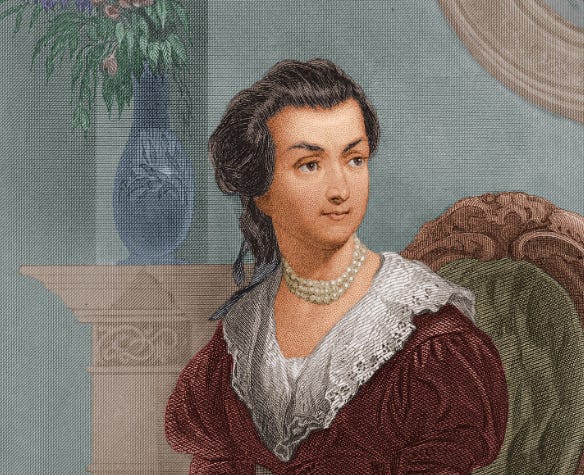
Abigail Smith Adams
In 1764 in Britain’s Massachusetts colony Abigail Smith was 20, and had had no formal education at all: girls weren’t worth it.
In that year married a man she had known for five years: the up-and-coming 30-year-old lawyer John Adams. Their daughter Nabby was born the following year, in 1765. There followed John Quincy (1767), Suky (1768, who died at the age of 2), Charles (1770, who died at the age of 10), Thomas (1772), then with high probability a couple of (very early) miscarriages from 1774-6, then the stillborn Elizabeth (1777), and (perhaps) another miscarriage afterwards—but I suspect not. I suspect then they stopped.
What was her social role? She ran her and John Adams’s (but in law John Adams’s) Boston-Braintree household and property operations while he played his role on the large political-intellectual stage, becoming second president of the United States.
Death and disease were, as was the case in the Agrarian Age, omnipresent. Her most famous letter to her husband was written in 1776. A part of it that is rarely—I would say never—excerpted contains these: “our Neighbour Trot whose affliction I most sensibly feel but cannot discribe, striped of two lovely children in one week…”, “Betsy Cranch has been very bad…”, “Becky Peck they do not expect will live out the day…”, “The Mumps… Isaac is now confined with it…”, and “your Brothers youngest child lies bad with convulsion fitts…”
Her letters tell us that she badly wanted to know what was going on in the world outside her household and the Boston-Braintree circle:
I wish you would ever write me a Letter half as long as I write you; and tell me if you may: Where your Fleet are gone? What sort of Defence Virginia can make against our common Enemy? Whether it is so situated as to make an able Defence? Are not the Gentery Lords and the common people vassals? Are they not like the uncivilized Natives Brittain represents us to be?…” and “I have sometimes been ready to think that the passion for Liberty cannot be Eaquelly Strong in the Breasts of those who have been accustomed to deprive their fellow Creatures of theirs…”
And note how she cannot say "I think...", even to her ten-years-older husband: she has to say "I have sometimes been ready to think..."
Abigail Smith Adams was not happy about the position of women in society:
By the way in the new Code of Laws which I suppose it will be necessary for you to make I desire you would Remember the Ladies, and be more generous and favourable to them than your ancestors. Do not put such unlimited power into the hands of the Husbands. Remember all Men would be tyrants if they could. If perticuliar care and attention is not paid to the Laidies we are determined to foment a Rebelion, and will not hold ourselves bound by any Laws in which we have no voice, or Representation.
That your Sex are Naturally Tyrannical is a Truth so thoroughly established as to admit of no dispute, but such of you as wish to be happy willingly give up the harsh title of Master for the more tender and endearing one of Friend. Why then, not put it out of the power of the vicious and the Lawless to use us with cruelty and indignity with impunity? Men of Sense in all Ages abhor those customs which treat us only as the vassals of your Sex. Regard us then as Beings placed by providence under your protection and in immitation of the Supreem Being make use of that power only for our happiness…
Her husband, though, thought this was a great joke:
As to your extraordinary code of laws, I cannot but laugh. We have been told that our struggle has loosened the bonds of government everywhere; that children and apprentices were disobedient; that schools and colleges were grown turbulent; that Indians slighted their guardians, and negroes grew insolent to their masters. But your letter was the first intimation that another tribe, more numerous and powerful than all the rest, were grown discontented.
This is rather too coarse a compliment, but you are so saucy, I won't blot it out.
Depend upon it, we know better than to repeal our masculine systems. Although they are in full force, you know they are little more than theory. We dare not exert our power in its full latitude. We are obliged to go fair and softly, and, in practice, you know we are the subjects. We have only the name of masters, and rather than give up this, which would completely subject us to the despotism of the petticoat, I hope General Washington and all our brave heroes would fight…
In some ways Abigail Smith Adams was not typical: literate, smart as a whip, upwardly mobile, upper-class, married to a husband she could talk to.
In other ways she was very typical: subordinated to her husband (and to other male relatives), many of her concerns given little weight, embedded in a social network in which aiding other mothers as they watched and desperately tried to stop their children get sick and die, pregnant (5 years; I don’t know whether she nursed or not, but somebody or somebodies nursed her children for perhaps fourteen years), and, of course, desperate concern for “our own little flock… My Heart trembles with anxiety for them…”
Being female in the Agrarian Age, back before the Long 20th Century, was not for sissies.
The Puzzle of Patriarchy
Why male supremacy was so firmly established back in the Agrarian Age is something that is not obvious to me. Yes, it was very important that people who wished to survive should they reach old age—especially women who did not want to be burned as witches—to have surviving descendants. The pressure at all levels of society was immense: Queen Anne I Stuart (1665–1714), the last British monarch of the Stuart dynasty, was pregnant eighteen times: eight miscarriages, five stillbirths, George (who lived only minutes), Mary (premature: lived only two hours), Anne Sophia (who lived only nine months), Mary (died of smallpox before she would have turned two), and William (died at 11 of strep throat).
Anne survived all eighteen pregnancies. Many of her fellow-queens were not so lucky. Of the 45 queens and female heirs-apparent of England from the Norman Conquest through Victoria, seven died in childbed: 15.5%, more than one in seven, among the most cosseted and best-nourished women in England. In the horrible run from Isabelle de Valois in 1409 through Anne Hyde in 1671, six of twenty died in childbed. The last to die in childbed was Crown Princess Charlotte Augusta of Wales in 1817.
Yes, back in the Agrarian Age the biological requirements of obtaining a reasonable chance of having surviving descendants to take care of one in one’s old age meant that the typical woman spent 20 years eating for two: 20 years pregnant and breastfeeding. Yes, eating for two is an enormous energy drain, especially in populations near subsistence. Yes, Agrarian Age populations were near subsistence—my great-grandmother Eleanor Lawton Carter’s maxim was “have a baby, lose a tooth” as the child-to-be leached calcium out of the mother to build her or his own bones, and she was an upper class Bostonian born in the mid-1870s.
Yes, breastfeeding kept women very close to their children, and impelled a concentration of female labor on activities that made that easy: gardening and other forms of within-and-near-the-dwelling labor, especially textiles.
Yes, there were benefits to men as a group from oppressing women—especially if women could be convinced that they deserved it: “Unto the woman he said, ‘I will greatly multiply thy sorrow and thy conception; in sorrow thou shalt bring forth children; and thy desire shall be to thy husband; and he shall rule over thee’…”
But surely even in the Agrarian Age a shift to a society with less male supremacy would have been a positive-sum change? Women who are not kept unlettered, barefoot, and pregnant as a matter of course can do more, and we—optimistic—economists have a strong bias toward believing that people in groups will find ways to become, collectively, more productive and then to distribute the fruits of higher productivity in a way that makes such a more productive social order sustainable.
But not.
Bio-Demographic Underpinnings Eroding
There were signs of erosion in the bio-demographic underpinnings of high male supremacy even before the Long 20th Century began. But it was over 1870-2016 that these underpinnings dissolved. The number of years the typical woman spent eating for two fell from twenty—if she survived her childbed—down to four, as better sanitation, much better nutrition, and more knowledge about disease made many pregnancies less necessary for leaving surviving descendants and as birth control technology made it easier to plan families. The number of babies per potential mother dropped by about two-thirds.
Thus reductions in infant mortality, the advancing average age of marriage, and the increasing costs of child raising together drove a decrease in fertility. And, after exploding in the Industrial Age, rate of population growth in the industrial core slowed drastically. The population explosion turned out to be a relatively short run thing. And so human population growth went from an approximate doubling each generation to a rate approximately consistent with zero long-run population growth in the advanced industrial economies, with the rest of the world now following along behind. I world that had had perhaps 750 million people in 1800, 1.1 billion in 1870, and 7.4 billion in 2016 now appears headed for a stable population of about 9.5 billion come 2050. The path of within-the-household technological advance worked to the benefit of the typical woman in the Long 205h Century: dishwashers, dryers, vacuum cleaners, improved chemical cleansing products, other electrical and natural gas appliances, and so on, especially clothes-washing machines—all these made the tasks of keeping the household clean, ordered, and functioning much easier. Maintaining a nineteenth century, high-fertility household was a much more than fulltime job. Maintaining a late twentieth century household could become more like a part-time job. And so much female female labor that had been tied to full-time work within the household because of the backward state of household technology became a reserve that could now be used for other purposes.
My great-great grandmother Florence Wyman Richardson was born in 1855 in St. Louis, MO, a privileged scion of what then qualified as St. Louis’s upper class. Unlike Abigail Smith Adams, she received an education—but not a college degree. Unlike Abigail Smith Adams, she was not limited to writing private letters to her husband asking him to please “Remember the Ladies”. 1882 finds her lobbying for raising the age of consent in Missouri, then 12. 1908 finds her on the executive board of the St. Louis Woman's Trade Union League. 1910 finds her, with her daughter and my great-grandmother Florence (“Fonnie”) Richardson Usher, organizing the St. Louis Women’s Suffrage League. And the system… responded: the 19th Women’s Suffrage Amendment, which had first been introduced back in 1878, was ratified on August 20, 1920.
Patriarchy Eroding?
In response to the declining time demands of within household work and the expanding set of outside opportunities, female participation in the paid labor force surged. In the United States female levels of formal education are now poised to soon surpass male levels.
The move of women from largely within-the-household, unpaid to largely outside-the-household, paid work catalyzed an increase in women’s material welfare and social status. As Betty Friedan wrote in the early 1960s, women could advance toward something like equal status only if they found “identity…in work… for which, usually, our society pays.” As long as women were confined to separate, domestic, occupations which the market did not reward with cash, it was easy for men to denigrate and minimize their competence and accomplishments. As the labor requirements of running a household fell, the wide separation of men’s from women’s roles became harder to maintain—and with it the belief that biology imposed a different, lower status on the female half of the human race.
Institutions and practices derived under the assumption that the overwhelming bulk of the labor force is male, attached to employment full-time over the long term, and has minimal child care and household-maintenance responsibilities held back progress toward something like full economic equality between men and women. Nothing like full equality has yet been established. Male wages and earnings still appeared higher than female wages and earnings by more than could be easily accounted for by differences in education, training, and degree of labor force attachment. There is still substantial discrimination visible, especially in the form of a “break in labor force participation” penalty. Today in Denmark—one of the most gender-equal countries in the world, mothers have a 7%-point lower chance of being employed, work an average of 7% fewer hours conditional on being employed, and receive an average of 7% less in compensation conditional on being employed and on working their hours.
In my intellectual discipline, economics, and in my labor market status group, tenured professors, we are now grappling with one of these institutions and practices: that, in the word of my friend and teacher ex-Harvard President Larry Summers, people deciding whether you are going to receive tenure expect that candidate professors in their 20s and 30s have “near total commitments to their work… a large number of hours in the office… a flexibility of schedules to respond to contingency… a continuity of effort through the life cycle, and… the mind is always working on the problems that are in the job”. These are, as Claudia Goldin characterizes them, “greedy jobs”. This is, Larry said, not a problem that can be solved by talking about how we are all people of goodwill here, singing "Kumbayah", and offering free childcare.
Requiring such a near-total commitment work spurt up through one’s 30s does not fit easily or well with female parenthood. The response of universities was to give mothers extra time—extra years to prepare their portfolios for the tenure review. And then gender equality seemed to demand that universities give fathers—especially those who would certify that they had been primary caregivers—extra years on their tenure clocks as well. First-world problem, I know. But a powerful indicator that gender inequality shadows the life of every single woman and girl on this planet.
The effect of this facially-neutral pro-parent policy? It appears to have been that men whose wives gave birth and so got extra time on their tenure clocks saw their chances of getting academic tenure increase by 20% . Women who gave birth and so got extra time on their tenure clocks saw their chances of getting academic tenure decrease by 20%. The men had spent the extra time writing more articles. The women had spent the extra time eating for two under the heavy biological load of mammalian motherhood.
Economics Should Be Much More Feminist Economics
I see the centrality of the economic and the extraordinary upward leap in prosperity as the principal news that the future will remember from the history of the Long 20th Century. But I am male. If I were female, would I see the demographic transition—the shift of the typical woman’s experience from one of eating for two for twenty years (and of having one chance in seven of dying in childbed) to eating for two for four years—and the rise of feminism as the biggest news?
Quite possibly.
Perhaps we move from “possibly” to “probably” when we reflect on the connections between the rise of feminism and the demographic transition. As the world became richer—and as knowledge about how to manage public health was slowly and painfully developed—the world saw first a population explosion: The world had grown from 170 million in the year 1 to 425 million in 1500—growth at the very slow walking pace of 0.06% per year that corresponded to the very slow pace of pre-Commercial Revolution technological development. The Commercial Revolution era of 1500-1800 saw population more than double and grow to 900 million. The British Industrial Revolution era of 1800-1870 saw population increase half again to 1.3 billion. And the Long 20th Century saw human population nearly sextuple to 7.5 billion. By and large, even as mortality fell men still wanted many, many children. Women, first, did not have the knowledge that changing public health meant that many pregnancies were no longer necessary to give at least some confidence of great-grandchildren. And women, second, did not have the social power to set their fertility at levels that seemed good to them. Feminism gave them both the knowledge and the social power.
Thus we now appear to be on track to a world with its population peaking at between 9.5 and 10 billion around 2050.
That feminism came late to the initially-poorer regions of the world has been a major cause of the Long 20th Century’s global divergence in living standards and productivity levels. It was not the most important cause: the most important cause was communist central planning—Vladimir Lenin’s belief that one should run an entire economy by generalizing what he saw and guessed about German mobilization for World War I was not the brightest light on the tree of humanity’s good ideas. It was not the second most important cause: that was the slowness with which modern industrial technologies were diffused around the world. But that feminism came late, and so the demographic transition came late, to the poorer regions of the world was the third most important cause: the demographic burdens placed on poor countries by the continued population explosion were heavy—but they are now ebbing, as we now see the demographic transition to not just extended lifespan but to low fertility finish its spread around the globe...
> we—optimistic—economists have a strong bias toward believing that people in groups will find ways to become, collectively, more productive and then to distribute the fruits of higher productivity in a way that makes such a more productive social order sustainable.
Isn't much of the lesson of political history that high relative status is as valuable to those who have it as most other goods and will therefore prefer lower economic productivity hierarchies as long as they are above as many people as possible? (In other words, social orders are engines to generate local relative status as much as engines of agriculture or military power, and perhaps we apes are more natural at building high-productivity status engines than steam engines, which is why the long 20th century took so long to start). Much of your description of the Jim Crow US South reads more or less that way.
> Economics Should Be Much More Feminist Economics
Along the lines of that argument, there's a by-now obvious argument that fair (and functional) AI building also *has* to be feminist AI building for more or less similar reasons, e.g. (self-link disclaimer) https://blog.rinesi.com/2017/10/what-makes-an-algorithm-feminist-and-why-we-need-them-to-be/ .
Thank you for this thoughtful post. I've been trying to create a diagram to show leakages and injections into "traditional gender roles" for women. I'll have to add household appliances (along with feminism, sexual and gender minorities, reproductive rights, higher education access, no-fault divorce laws, service economy, etc.) as a leakage. LOL. I especially wish laundry appliances came labelled as "gender neutral appliance."