


Is þe "Wilhelmine China" Analogy Useful, or Useless?
Is þe "Wilhelmine China" Analogy Useful, or Useless?
BRIEFLY NOTED: For 2021-12-19 Su

First: On the Usefulness of the “Wilhelmine China” Analogy as a Tool for Thought

Apparently contra the super-brilliant Adam Tooze, I have long thought—because history rhymes—that the analogy between pre-World War I Germany and contemporary China is an interesting one to think about. Wilhelmine China—a rising industrial power with a parasitic upper class, unsure if it truly has and anxious to demonstrate meaningful social role, and a leadership striving for national self-assertion both for its own psychological reasons and to unify a country that might otherwise be riven by economic and egalitarian pressures:
Adam Tooze: 1914, the Urkatastrophe of the 20th Century: ‘1914 is in the news again today as a way of understanding the mounting tension between China and the United States. In this historical analogy, the United States, the incumbent, is allotted the role of the British Empire, seeking to resist the challenger, China, which is placed in the position of the Kaiser’s Germany. (Btw: Apart from the weirdness of this analogy, it also assumes a pretty strong and contentious thesis on what actually happened in 1914. More on this another time.)…
LINK: <https://adamtooze.substack.com/p/chartbook-57-1914-the-urkatastrophe>
There is a lot more in Adam’s newsletter, which I strongly urge all of you to read…
But let me make the very brief case for considering this “Wilhelmine China” analogy as not “weird”, but rather natural—always taking into account that this is the early 2000s with nuclear weapons, value chain globalization, and social media; and not the early 1900s with battleships, the second industrial revolution, and broadsheets and pamphlets.
From the international-relations perspective, we have a rising superpower, with all of the readjustments of the balance of opportunity and threat in the anarchy that is international relations that that brings.
From the China domestic-political perspective, we have a ruling elite with the historical memory and a founding myth—that of military-bureaucratic service to the Hohenzollern monarchy’s long-run territorial expansion on the German hand, and of the Long March and the overthrow of Chinese feudalism and capitalism on the Chinese hand—that leaves it with no valid domestic role at all going forward.
From the China domestic-prosperity perspective, we have overwhelming majorities—industrial and agrarian proletariats and agrarian landlords and regions in the German case, the billion people in China's interior with an average lifestyle of Peru who are not part of the 21st-century global transpacific economy in the Chinese case—who are not in perceive themselves as not receiving their fair share of growing prosperity.
And from the fading-superpower perspective, we have a great deal of anxiety over the rise in Britain's case then and in America's case now that may lead to some very unwise actions.
All of this, of course, is history rhyming, not repeating: there is no implication either that the United States should move military units into Taiwan (if you think that it was Britain’s failure to make it clear that invasion of Belgium would trigger intervention back in 1914 that led to the greater catastrophe) or that the United States should remove Taiwan (and the Ryukys?) from its sphere of concern (if you think Britain’s entering WWI that led to the greater catastrophe).
But there is, I think, profound value in the compare-and-contrast exercise that focuses our attention on rising and fading superpowers, on the implications of having a domestic ruling élite with no plausible functional social role in the present, and on fragile authoritarian political systems tempted to busy giddy minds with foreign quarrels.
There are also, of course, Weimar Muscovy and National Hinduist India to think about…
One Video:
Gillian Tett & al.: Anthro-Vision: A New Way to See in Business & Life: ’Amid severe digital disruption, economic upheaval, and political flux, how can we make sense of the world? Leaders today typically look for answers in economic models, Big Data, or artificial intelligence platforms. Gillian Tett discusses her new book that points to anthropology—the study of human culture. Anthropologists learn to get inside the minds of other people, helping them not only to understand other cultures but also to appraise their own environment with fresh perspective as an insider-outsider, gaining lateral vision. Moderated by Brad DeLong (Economics) with Julia Sizek (Anthropology) as discussant… <https://n2pe.berkeley.edu/events/gillian-tett-discusses-anthro-vision-a-new-way-to-see-in-business-and-life/> <https://www.youtube.com/watch?v=GzaWiBFsLN0>:
One Picture:
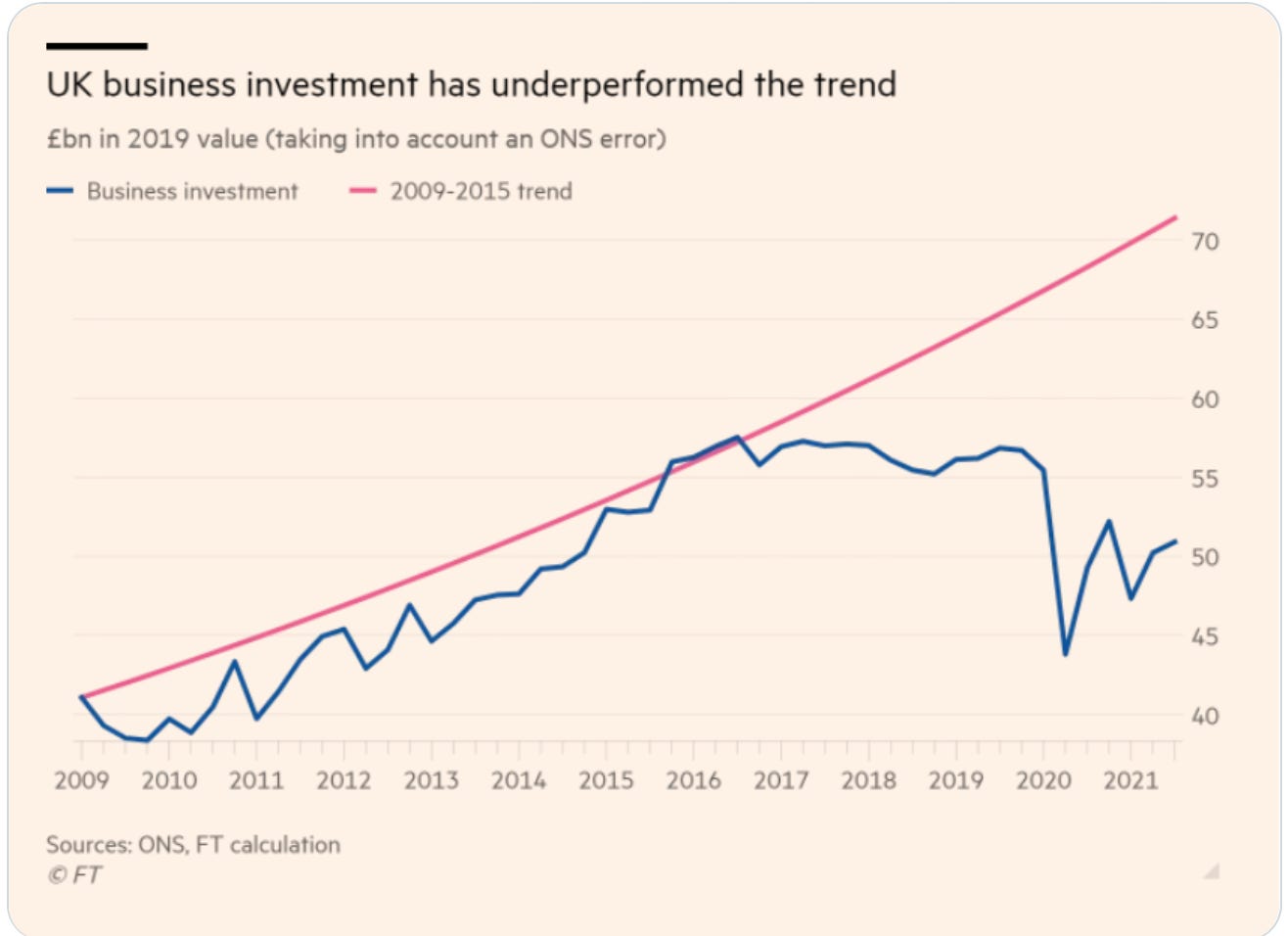
What do you think happened at the start of the second half of the 2010s to make investment in Britain go into reverse, and so inflict substantial material damage on the long-run growth prospects of the British economy? Anyone? Anyone? Bueller?


Very Briefly Noted:
David Atkins: Fox News Hosts Thought January 6 Would Destroy the Conservative Movement. Here’s Why It Didn’t: ‘The GOP has had the opportunity to minimize the shock of a failed insurrection—just as they plot a successful one the next time… <https://washingtonmonthly.com/2021/12/16/fox-news-hosts-thought-january-6-would-destroy-the-conservative-movement-heres-why-it-didnt/>
Duncan Black: Nobody Could Have Predicted: ‘Whocouldanode. “We didn’t see Delta coming. I think most scientists did not…. We didn’t see Omicron coming…. This awful virus has… it turns out, has mutations and variants.” Variants were not a surprising development. And certainly not after Delta. Entering the ugly phase of this administration… <https://www.eschatonblog.com/2021/12/nobody-could-have-predicted.html>
Brad DeLong: ’Have you seen Jay Hamilton: All the News That’s Fit to Sell: How the Market Transforms Information into News? https://t.co/2u5IYj6SG3…

Ken White: ’“The problem of the preferred first speaker” is the tendency to impose norms of civility, openness, productiveness, and dialogue-encouraging on a RESPONSE to expression that we do not impose on the expression itself… <

Paragraphs:
Martin Sandbu: Shortages, What shortages? Global Markets Are Delivering: ‘Take durable goods. Headlines about shortages are the only thing that seem in ample supply, and everyone is experiencing delays in obtaining items, such as cars, that could previously be had with instant gratification. But the actual supply of durable goods is at record highs. Since the summer of last year, American consumers have been obtaining them in volumes much larger than the pre-pandemic trend. Many EU economies, including Germany, Italy and the Netherlands, have also matched or exceeded 2019 levels of durable goods consumption. What about semiconductors? In a short paper published a month ago, Daniel Rees and Phurichai Rungcharoenkitkul of the Bank for International Settlements showed that semiconductor exports from Taiwan and Korea in 2020 exceeded the volumes recorded in 2019, and 2021 exceeded 2020. Exports currently appear to be running at a good 30 per cent above two years ago. The BIS’s Hyun Song Shin has added that semiconductor sales in the US are much higher than in the years before the pandemic…. Even these remarkable increases have not always been enough to satisfy soaring demand. But far from failing us, the globalised capitalist production system has delivered, ramping up supplies in record time in response to one unexpected demand surge after another…
LINK: <https://www.ft.com/content/ea89a152-ca34-4c01-8986-0d019f3cae74>
Paul Krugman: What Would a Hard Landing Look Like?: ‘The Fed has been wrong about inflation so far. What if it’s wrong again?… Although we talk a lot about inflation in the 1970s, the real pain came in the 1980s, as Paul Volcker’s Fed tried to bring inflation down. It succeeded, but at an enormous price…. It’s not totally clear whether this huge wave of unemployment was necessary. Influential research using state-level data argues that the main factor in the Volcker disinflation was a big change in public expectations that could conceivably have happened without such a severe recession. But for now the working hypothesis for most economists is still that it took a nasty, sustained slump to end the inflation of the 1970s. Are we looking at something similar in our future? Probably not, for several reasons…. Underlying inflation by the end of 2022 isn’t likely to be anywhere near 1980 levels…. The current inflation looks more like 1946–48 than like the 1970s…. The Fed’s 2 percent inflation target was set a couple of decades ago, based to a large extent on economic analyses that have turned out to be wrong…. Right now the Fed is betting that… dilemma[s] won’t arise. Let’s hope it’s right…
LINK: <https://messaging-custom-newsletters.nytimes.com/template/oakv2>
Célia Pedroso: Garum: An Ancient Condiment Brought Back to Life: ‘Garum eventually lost its place in the kitchens of the Mediterranean and other parts of the former Roman Empire. Iterations of the pungent sauce exist today, like Colatura di Alici in Italy, but its original recipe and method of production are no more than ancient relics. A rather smelly experiment at an archeological site in Portugal is trying to change that, though…. Victor Vicente and Pedro Almeida… are the brains behind this operation. In May 2021, they placed 400 kilos of locally caught and gutted sardines, 129 kilos of salt and 320 liters of spring water in one of Tróia’s ancient Roman stone tanks, where archeologists and researchers allowed the ingredients to ferment for six months…. The resounding positivity from chefs and researchers around the project and its results has everyone excited about its possibilities. “It tastes really good and the experiment was great,” Victor says, telling us this batch of garum is much more balanced than the ones they attempted at their restaurant—perhaps because the tanks absorb heat during the day, keeping the ingredients warm even at night, which helps maintain the fermentation process…
LINK: <https://culinarybackstreets.com/cities-category/lisbon/2021/garum/>
Ryan Avent: The Big Picture on Inflation: ‘Looking at bond markets, it strikes me as difficult to conclude that the Fed has lost credibility…. Breakeven rates of inflation aren’t flying upward…. In November, the figures on consumer price inflation came in very hot, well above consensus. In response, the five-year breakeven rate ticked up, but did not soar, while fed fund futures increased the outlook for interest-rate hikes in 2022, but not dramatically. Indeed, it seems to me that movements in breakevens in recent months overwhelmingly reflect shifts in realized inflation, and not some growing skepticism of the Fed. Indeed, one could argue that an overreaction to inflation now, under unusual circumstances and while the economy remains well short of pre-pandemic employment levels, could undermine the Fed’s long-run effort to persuade markets that it can boost a depressed economy in a pinch…
LINK:
Worth noting that Imperial Prussia did pretty well while it had competent administrators like Bismarck, and started losing its mind when the incompetent Wilhelm II took over.
Similarly, China did pretty well under Deng and the generations of his successors, and started losing its mind when the incompetent Xi Jinping took over...
The historical parallel I see is that autocracy is a weakness for a country because idiots can get into power too easily and are too hard to remove. You don't notice the weakness as long as a competent autocrat is in power, but when Wilhelm dismisses Bismarck as Chancellor and decides to rule personally, or Xi Jinping eliminates term limits and turns the Central Committee into sycophants, the governmental errors start happening immediately....
Seems to me the Wilhelmine China analogy really ought to be focused on the British response rather than the German one. That is, the tragedy of WWI was that a fading power elected to duke it out with a rising power and the fight just went on far too long. Had Britain sat it out, the whole affair would have been (probably) nothing more than another Franco-Prussian war. Therefore, to pursue the analogy, we ought to consider more the British calculations and see whether there are parallels to present-day American strategic thinking. I've always thought the biggest blunder for Britain was the Anglo-French naval agreement of November, 1912. By that agreement Britain moved its Mediterranean fleet to the North Sea, to bottle up Germany, and France moved its Atlantic fleet into the Mediterranean to protect British interests there. Effectively, this committed Britain to a joint defense pact against Germany without securing a British voice in French policy. It's generally accepted that Britain did this to avoid the great expense of outgunning a rising power in Germany. My view is that the motivation to save money was because of the great pressures being put upon the old elite (the Liberal Imperialists) to adopt social programs to improve the lot of the lower classes in order to bridge divides within the Cabinet with the Radicals. (The theme of my undergraduate honors thesis from 40 years ago). Therefore, I am asking myself whether the current divisions within the US, and the urgent need to restore employment, renew infrastructure, avoid a turn to authoritarianism (and kleptocracy), etc., will egg us on to adopting strategic policies that will push us into unwinnable conflicts either to bridge internal divides or make resources available for domestic programs. At the moment, I'm thinking maybe not. I do not see how we will loose autonomy of action in East Asia. Are the players there who are important to us (Japan, Australia, Indonesia) going to trap us into conflict with China? (Maybe India, but we never treat India as a serious player, do we?) Will the defense of Taiwan (that is what we are actually talking about, right?), bear a meaningful relationship to our domestic troubles? Only if we make the decision to unequivocally dominate the Formosa Straits, as that decision would require either lots of debt or lots of taxes (both doable in theory but politically impossible). But that decision seems to be ours alone, not one thrust upon us. That is, I think we will either blunder or not based on purely "strategic" considerations, whether or not China is rising or waning. The non-kinetic conflicts (technology pirating and mercantilism), are ones for which we have broad coalitions to oppose China, and given time they should work out without bullets or nuclear weapons. I seem to be coming down on the side that while China may be Wilhelmine (a rising power with a parasitic leadership class looking to impress the peasants with nationalistic bluster), and the US may be (no...is) a fading power trying to avoid the inevitable, I am not sure that dynamic is prescriptive in present circumstances.