

(PARTIAL-)CROSSPOST: MIKE BROCK: The House of Ellison is on the Brink
Mike Brock's subheadline: "Everything the world’s briefly richest man built is failing at once"; the worry is that Oracle is in a box: heads, no product anyone will buy; tails, no pricing power...

I would not say “on the brink”, quite. But I think the text of the piece is quite good. Oracle is going to survive: The database business still throws off steady billions. That floor is real. But by the time your bonds are rated BBB-minus, your debt is now your equity, and your equity are now out-of-the-money call options. But the equity market has not (or not yet) accepted that bond-rating judgment on Oracle. Right now it looks to me as if the current market capitalization of Oracle is $500 billion: $375 billion equity plus $125 billion debt with fiscal 2026 EBITDA of $30 billion (with $20 billion of revenue from selling databases); with a market-to-book equity valuation ratio of 10. Plus there is the political economy: Ellison is a prominent Trump and Netanyahu ally, which is another major source of risk as long as elections in the United States are honest ones:
The dot-com bubble of the late 1990s was actually more of a telecom infrastructure build-out bubble than an internet software service delivery bubble. The current bubble is much more a data center infrastructure bubble than an “AI”—or, as I prefer, a CIP (Complex Information-Processing) or an MAMLM (Modern Advanced Machine-Learning Model) bubble. And right now it is CoreWeave and Oracle that are at the frothy top edge of the wave, dependent not just on the likes of OpenAI, Anthropic, Google, Facebook, Amazon, SpaceXAI, Microsoft, Mistral, Cohere; plus SalesForce, ServiceNow, Adobe, Workday, Snowflake, DataBricks; plus Cursor, Perplexity, Palantir, Sierra, Glean, Harvey; plus all the others not just rapidly becoming able to profitably sell AI-software services to end users, but on their ability to do so at sufficient scale that their own cloud datacenter infrastructure investments are redlined.
There is a remaining bull or semi-bull case not mentioned by Brock here. It is that Amazon with AWS is substantially in this same business as Oracle and CoreWeave, and Amazon is continuing to push it forward. Jassy as well as Ellison and Intrator believe that their best strategy is to build massively in advance of when the money will start to flow in. And nobody thinks Jassy is a deluded fool hypnotized by dreams of ASI.
Alternatively there is a strong bear case not mentioned by Brock here: Facebook. Mark Zuckerberg is spending Oracle-scale money on AI while reporting no separable AI revenue at all. Zuckerberg’s line is that AI is “accelerating our core [advertising] business today”. Perhaps. But it is unfalsifiable on the financials, which means that it is what Mark Zuckerberg would say. And opinions of Mark Zuckerberg are various.
Mike Brock’s central argument here is that “bubble” is too generous a word for the AI economy, because a bubble requires outside buyers rather than circular money flows. The remaining bull case is that the models get so good the revenue has to arrive. Brock argues both branches fail. A large language model maps between representations of things humans have already written, and the fluency gets mistaken for understanding. But even granting AGI, the story needs monopoly pricing — and Hangzhou has decided otherwise:
(PARTIAL-)CROSSPOST: MIKE BROCK: The House of Ellison is on the Brink
<https://www.notesfromthecircus.com/p/the-house-of-ellison-is-on-the-brink> <https://www.notesfromthecircus.com/>

Everything the world’s briefly richest man built is failing at once
Mike Brock
Jul 28, 2026
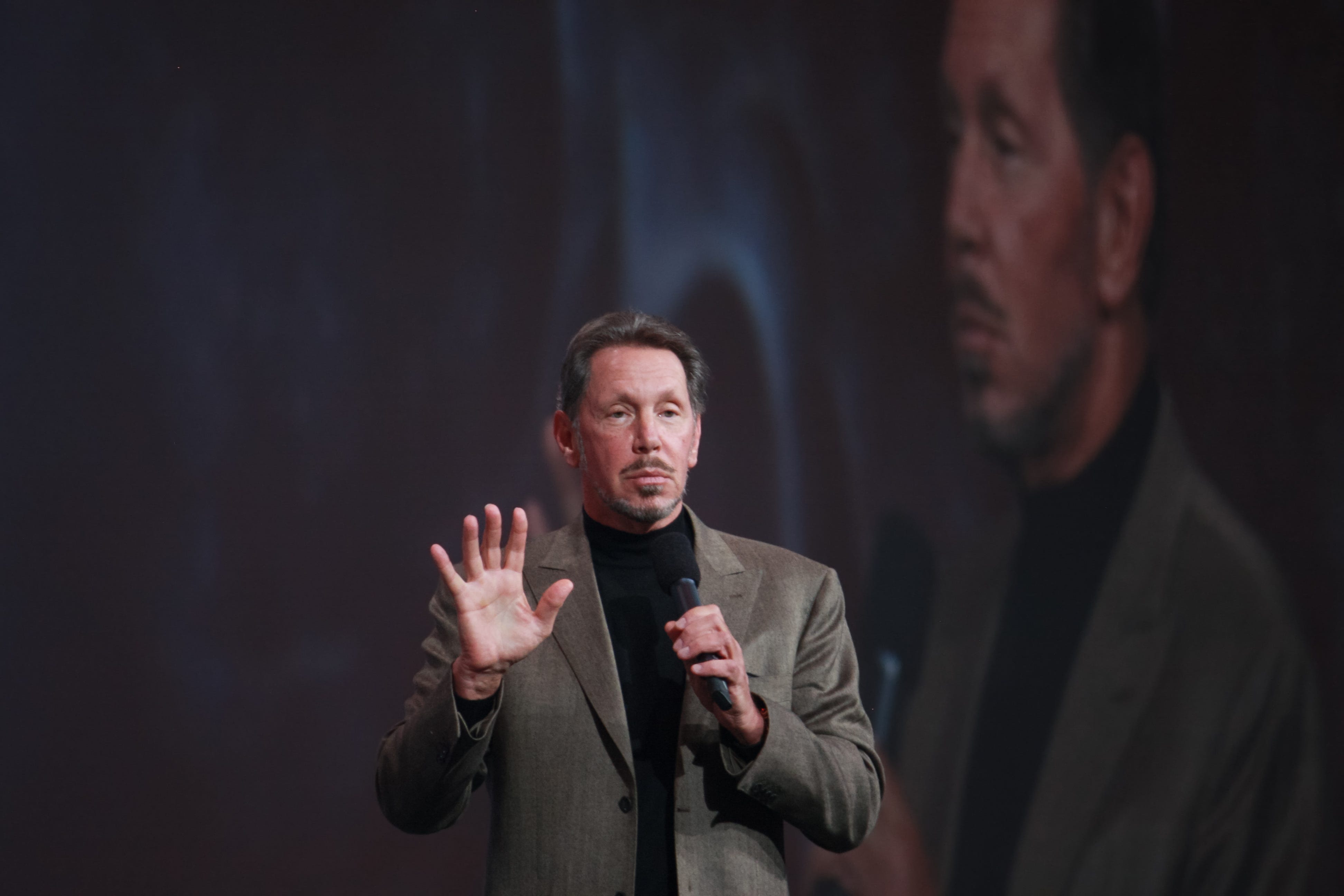
On the morning of September 10, 2025, Larry Ellison was the richest man alive… his net worth cresting at $393 billion. He was eighty-one years old, and every bet he had ever placed appeared to pay off on the same morning…. OpenAI [had entered into a] contract… [for] three hundred billion dollars of computing capacity [from Oracle] over roughly five years…. Ten months later, the ledger reads like a curse working its way through everything the man owns. Oracle‘s credit rating sits one notch above junk. Its credit default swaps trade at prices last seen eighteen years ago. The stock has collapsed from $345.72 to a fifty-two-week low under $115…. His son’s $110.9 billion conquest of Warner Bros. Discovery is frozen by a federal judge, and twelve state attorneys general are suing to kill it. The news network his family bought is posting the worst ratings in its history…. One disclosure before anything else: I am short Oracle….
AI is a bubble. Everybody knows it’s a bubble. The market is running on magical thinking. AGI is a fever dream. And LLMs shouldn’t even really be considered AI. Calling it a bubble, though, flatters it. A bubble at least requires… outside buyers chasing an asset they don’t understand. The AI economy stopped depending on strangers some time ago. Its largest transactions now run between a handful of related parties who invest in one another, sell to one another, and book one another’s money as growth…. Walk the circle once. In September 2025, Nvidia pledged up to $100 billion to OpenAI, its own largest customer, and CNBC reported the cash would mostly be used to lease Nvidia‘s own hardware. Nvidia books the sale as revenue. Its own money, returned one accounting cycle later, arriving at a valuation its own investment helped set. The $100 billion headline did its work on the stock price and then quietly evaporated: negotiations broke down in January, and by February the figure had shrunk to $30 billion. The market repriced trillions of dollars of equity around a number that was never executed at scale.
Oracle signed the $300 billion contract that crowned Ellison in September. Microsoft holds 27 percent of OpenAI, a stake valued around $135 billion, while selling it compute and competing against it for the same customers. AMD went further than any of them: per its own SEC filing, it granted OpenAI warrants on 160 million shares — roughly a tenth of the company — exercisable at one cent apiece, vesting as OpenAI buys its chips. A chipmaker paying its customer, in equity, for the privilege of the customer’s business.
Then there is CoreWeave, the cleanest loop in the pile. Nvidia holds an equity stake in CoreWeave that it has kept topping up. CoreWeave raises debt collateralized by the GPUs themselves and spends the majority of everything it raises buying Nvidia hardware. And Nvidia has agreed, per CoreWeave‘s 8-K, to buy back $6.3 billion of whatever capacity CoreWeave fails to sell, through April 2032. Vendor, investor, and buyer of last resort: one company, all three seats. And who rents the capacity? Microsoft alone accounted for about two-thirds of CoreWeave‘s revenue — the same Microsoft that owns 27 percent of OpenAI, which holds its own $11.9 billion CoreWeave contract. Four companies, and every dollar visits all four before it rests. Morgan Stanley added it up last October: contracts linked to OpenAI — one unprofitable startup — account for more than $330 billion of the $880 billion in combined booked future revenue at Microsoft, Oracle, and CoreWeave, including two-thirds of Oracle‘s entire backlog…. Jim Chanos, who saw Enron before anyone else did, calls the AI financing complex, with its generous GPU depreciation schedules at CoreWeave and Oracle, a confidence game….
On July 9, S&P Global cut Oracle‘s credit rating from BBB to BBB-minus…. The agency named the concentration plainly: OpenAI accounts for roughly half of Oracle‘s $638 billion backlog. Half the order book of one of America’s flagship enterprise-software companies now depends on a single money-losing startup honoring a $300 billion contract…. The cost of insuring Oracle bonds against default has climbed to levels last seen in 2008…. Oracle chose to bet the company, and the bet now trades one wobble from junk…. The database business that built the house still throws off steady billions.… The company survives even if OpenAI stumbles. The floor is real….
In September, the equity market handed Ellison $101 billion in a single day for projected revenue from a contract that runs through 2032. No company in this cycle books unrealized contract revenue as earnings the way Enron did; the stock market does the booking on their behalf, pricing the projections into the shares the day the press release goes out. What the equity market booked in an afternoon, the credit market has spent this summer unwinding line by line. It marked the same contract to a different model — one that asks where the cash comes from — and the answer came back BBB-minus….
The remaining bull case fits in one sentence: the models will get so good that the revenue has to arrive. It deserves its strongest form: these systems are the fastest-adopted technology in living memory, hundreds of millions of people use them every day, enterprises are writing real checks rather than running pilots, and the people making the trillion-dollar commitments include the most sophisticated capital allocators alive….
A large language model is a translation engine: it maps between representations of things humans have already written, and it does this so fluently that the fluency gets mistaken for understanding. That mistake is the entire equity story….
Suppose the fever dream is real and the machines learn to think. The loop still fails, because the AGI story has a second load-bearing assumption hiding under the first: that whoever builds the thinking machine gets to charge monopoly prices for it. Beijing has decided that nobody will. In May, DeepSeek made permanent a 75 percent price cut on its flagship model, fixing output at 87 cents per million tokens. OpenAI‘s comparable list price is $30 — a thirty-four-fold spread for work that most paying customers cannot tell apart. The models ship with open weights on Hugging Face, and the newest ones ship optimized for Huawei‘s silicon. On July 16, Moonshot released Kimi K3, the largest open-weight model ever published, benchmarking alongside the best American closed models; one independent leaderboard ranked it first outright….
The AGI story requires scarcity rents — monopoly prices for a product nobody else can make. If the models plateau, the projected revenue never arrives. If the models keep improving, the improvement is replicated in Hangzhou within weeks and given away at 87 cents per million tokens. That is the whole decision tree, and the industry is standing under it. Heads, no product. Tails, no pricing power. The $300 billion does not pencil in either world, and Oracle borrowed $160 billion against the world where it did….
⁂
The man at the center spent the paper while it was still worth something. In August 2025, his son David’s Skydance completed its merger with Paramount, the Ellison trust as controlling owner. In December, David went hostile for Warner Bros. Discovery — CNN, HBO, the Warner film library — and his father backed the bid with an irrevocable personal guarantee of $40.4 billion. The definitive agreement, signed in February, came to $110.9 billion in cash…. The guarantee is Oracle paper. Before the Warner bid, 346 million of his shares were already pledged as collateral for personal ventures — about 30 percent of his stake — and those pledged shares have lost roughly half their value since. Alongside the family money: $24 billion from the sovereign wealth funds of Saudi Arabia, Abu Dhabi, and Qatar, which would hold 38.5 percent of the combined company in non-voting shares. The DOJ approved the deal in June with zero conditions. The sitting president had already said out loud that he wanted CNN in the Ellisons’ hands…. The paper is deflating…. Had the deal closed in the spring, the House of Ellison would hold real assets, immune to whatever happens to a cloud backlog. Instead a judge froze the conversion mid-transaction. The guarantee is signed and irrevocable; the assets are undelivered; the collateral loses value every week the courts deliberate. He is holding the obligation without the prize, which is the exact position a man who owns forty percent of a BBB-minus company cannot afford to hold. Margin calls do not read narrative strategy….
Add up the ledger. Every wing of the House rests on one column: Oracle equity. The equity rests on the OpenAI contract. The contract rests on the AGI story, and the story is being repriced out of Hangzhou at 87 cents per million tokens. A federal judge holds the Warner deal; twelve attorneys general hold the lawsuit; S&P Global holds the rating one notch off the floor. Underneath all of it, an eighty-one-year-old man holds a $40.4 billion promise, irrevocable by its own terms, written against a stock that has lost two-thirds of its value since the morning the promise became imaginable.
The exposure extends past him. The Magnificent Seven make up about 35 percent of the S&P 500; a standard index fund now holds more than 7 percent Nvidia whether its owner has ever heard of a GPU or not… The House of Ellison was assembled at the top of a circuit, out of paper, against collateral that reprices by the week. Karma is what a margin call feels like when you had it coming.
<https://www.notesfromthecircus.com/p/the-house-of-ellison-is-on-the-brink> <https://www.notesfromthecircus.com/>
Brad DeLong back again: And what are the implications of this circular financing flow plus bond-rating pessimism for the macro outlook? Or, rather not for the outlook, bur rather for tail scenarios for the economy as a whole?
I know who paid for Larry's nose job!!!!