

(PARTIAL-)CROSSPOST: WILLIAM DAVIES: Review of "When the Clock Broke: Con Men, Conspiracists & the Origins of Trumpism" by John Ganz
Davies's original title is a quote from Murray Rothbard his goal was to "Repeal the 20th Century"; how 1992's losers became 2016-2028's winners; or, a neo-Foucauldian genealogy of MAGA, DOGE, & al...

For two generations, a Soviet enemy forced the North Atlantic right to keep its ugliest strands coalition-respectable, and a booming 1990s economy drowned out the rest. Then the enemy vanished, the boom failed unevenly after 2008, the spark that had been lit by Rothbard, Buchanan, Francis, and Perot had burned down the fuse, and in 2016 it finally reached the dynamite…
John Ganz’s When the Clock Broke and Quinn Slobodian’s Hayek’s Bastards.
Ganz’s When the Clock Broke argues that the political derangement we call “Trumpism” did not arrive in 2016 but was rehearsed a quarter-century earlier, in the seemingly sleepy interregnum of 1989–1993. Against the reassuring narrative of the era—Fukuyama’s “end of history,” a triumphant post–Cold War liberalism, Clinton’s coming boom—Ganz excavates a moment of recession and the ideological vertigo produced when the Soviet enemy vanished, and into that resulting vacuum stepped a cast of crackpots whose politics, dismissed at the time as marginal, turned out to be a blueprint for what was to gain power in 2016. Ganz’s causal claim is modest and structural: the ingredients existed in embryo in 1992—economic pain, conspiratorial anti-politics, the dawn of talk radio and cable—but needed a larger crisis (the Global Financial Crisis and Great Recession of 2008-2010, and the slow and ænemic recovery that followed) and a media revolution (the internet) to detonate. The 1992 “blip” was prefigurative, not aberrant.
Quinn Slobodian’s Hayek’s Bastards covers much the same ground but without the narrow focus on the George H.W. Bush presidency. Slobodian. however, sees today’s neofascist authoritarian right-wing as not a backlash against neoliberalism but a frontlash within it—a mutation grown from contradictions internal to the neoliberal project itself. Its three obsessions, in Slobodian’s formula, are “hardwired human nature, hard borders, and hard money.” He follows a rogue’s gallery of Mont Pelerin descendants and fellow travelers—Murray Rothbard, Hans-Hermann Hoppe, Charles Murray, Peter Brimelow, Richard Lynn, Curtis Yarvin, Javier Milei—who took Mises’s and Hayek’s occasional openings toward race theory and, in his phrase, “drove a metaphorical truck through it”. They became preoccupied with the conditions—culture, heredity, IQ hierarchies—under which a propertied individualism can be protected. That preoccupation slides naturally into inequality, hierarchy, and hostility to democracy.
As Davies writes, both John Ganz and Quinn Slobodian “invite us to reckon with the political legacy of weirdos, losers and cranks, something that few conventional intellectual historians or ‘ideational’ political economists are used to doing…” Davies sets them in a complementary relationship rather than opposition: Ganz supplies the American narrative of the underpinnings of proto-trumpism in the sphere of public reason (or, rather, unreason or disreason). Slobodian supplies the intellectual-genealogical spine of where the ideas came from and how they were a supercharger to neoliberalism, giving it a claimed base of support among those who had something to lose from modern “woke” élites pushing for the equality of others with white male native-born.
The original Hayekian neoliberals had feared democracy and mass society and sought élite capture and depoliticization. Rothbard and company saw “ordinary folk” as capitalism’s allies in that they all liked poverty, race and ethnic hierarchy, and traditional gender roles. The contrast is that Ganz’s story is emphatically American: “shaped by a national story encompassing slavery, residual paranoia towards the federal government and humiliation and rage over Vietnam, not to mention guns…” Slobodian sees America as unexceptional, and Davies uses him in insisting the American story has a British twin, a direct Rothbardian line into European reaction: Hans-Hermann Hoppe’s anarcho-capitalist, anti-immigration critique of the EU, the Centre for the New Europe, and the think-tank ecosystem (Bruges Group, Anti-Federalist League, UKIP, Goldsmith’s Referendum Party) behind Euroscepticism.
Ganz gets the closer reading and the emotional center; Slobodian gets deployed as the theoretical apparatus that lets Davies explain why these cranks matter and how their ideas crossed the Atlantic. The one place — a move Ganz doesn’t make and Slobodian only enables:
(PARTIAL-)CROSSPOST: WILLIAM DAVIES: Repeal the 20th Century: Review of “When the Clock Broke: Con Men, Conspiracists & the Origins of Trumpism” by John Ganz
Penguin, 426 pp., £10.99, June, 978 1 4059 8169 9
<https://www.lrb.co.uk/the-paper/v47/n17/william-davies/repeal-the-20th-century> <https://www.lrb.co.uk>
Monika Krause… shows that social scientists… base their… theories on a surprisingly limited range…. Images of the modern metropolis… Chicago and Berlin. Political theories of populism… Argentina. The sociology of work… car manufacturing…. Professions… doctors and lawyers. Political economists, too, have their model cases, in particular the crisis of the 1970s, which involved the end of the Bretton Woods system of fixed exchange rates, the demise of full employment as an aim of economic policy and the turn towards conservative and neoliberal arguments in favour of tax cuts and financial deregulation…. The idea that there was… a paradigm shift in capitalist regulation has proved seductive….
The crisis of the 1970s [also] appeals to academics… [as it] grants a prominent role to academics themselves. The economic model that was abandoned in the crisis is usually referred to as ‘Keynesian’. Keynes himself could be described as a ‘model case’ member of the liberal elite…. The paradigm that succeeded Keynesianism was scarcely less scholarly in its provenance…. The political economy of Thatcher and Reagan… [forged by] tenured academics, first in Vienna, Freiburg and London, and later in Chicago and Virginia. Its most visible representative, Milton Friedman….
John Ganz’s When the Clock Broke is a study of a moment in American history that isn’t usually considered a crisis: the early 1990s, when the United States was reimagining and repositioning itself in a post-Cold War world…. Wasn’t this a time of naive optimism? Maybe, but only if you limit the story to the second half of the decade. One of Ganz’s achievements is to… examine the … transition from the Reagan era, in which the right was still largely dedicated to defending the establishment, to Clinton’s years in power, when the right began to lose its mind…. Ganz discovers a moment of rupture, in which a new political movement began to cohere. The characters involved weren’t a secretive cabal, or even a Mont Pelerin-style network: they were often shouting their demands on the airwaves and from political platforms. But they were too outrageous, seemingly too divorced from reality, ever to be taken seriously by the political and intellectual classes, who were in any case soon swept up by a new wave of prosperity propelled by globalisation.
When the Clock Broke promises:
a history of the losers: candidates who lost their elections, movements that bubbled up and fizzled out, protests that exploded and dissipated, writers who toiled at the margins of American life, figures who became briefly famous or infamous and then were forgotten…
One thing… which… at the time… looked more pitiful than dangerous, is a sense of grievance towards the establishment. In a world before social media, the grudges and resentments of marginal figures rarely penetrated mainstream political consciousness. But as Ganz shows in a series of biographical portraits, a distinctive set of proto-Trumpian sentiments began to seep into the American public sphere no sooner than the rubble of the Berlin Wall had been tidied away….
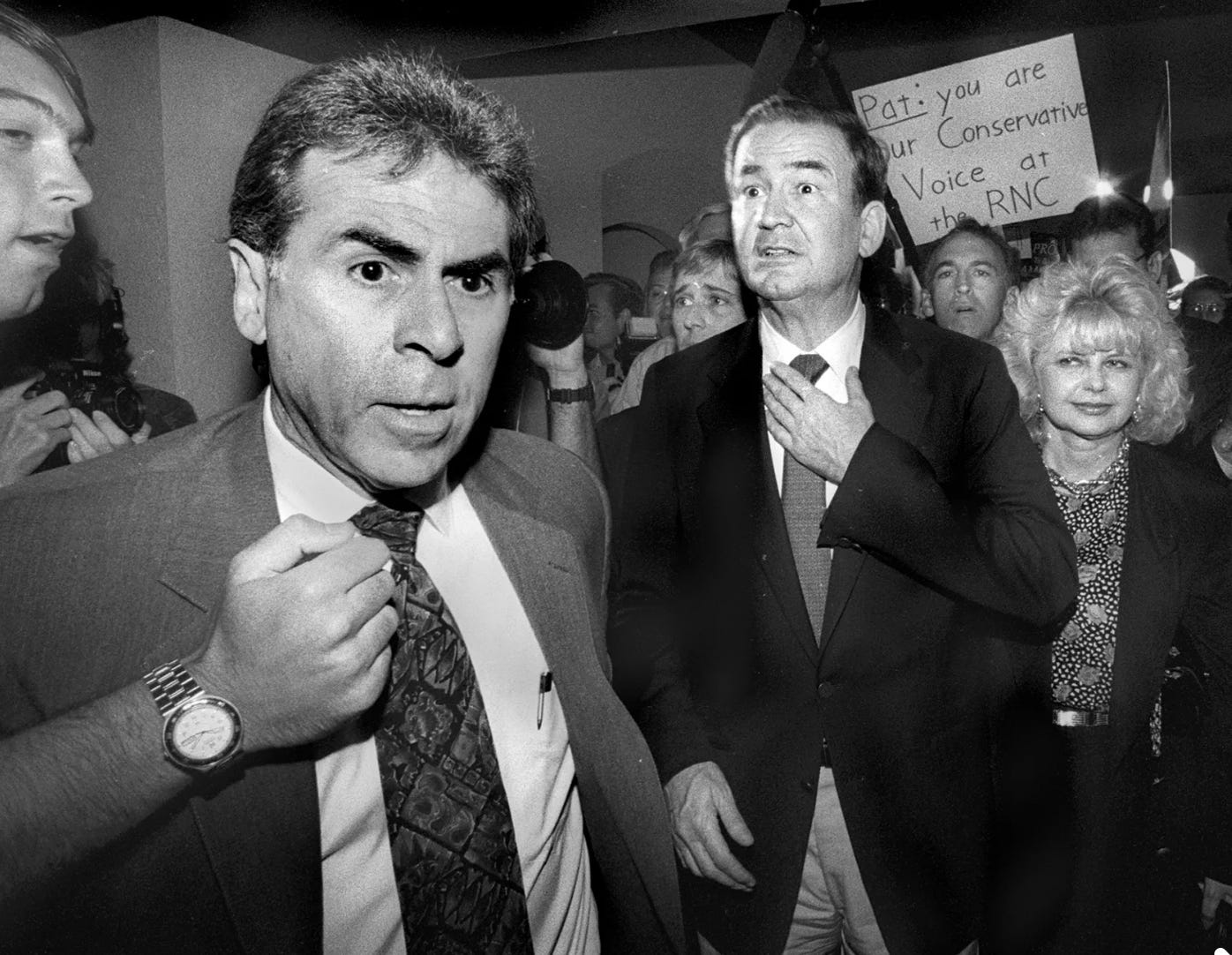
Sam Francis, Pat Buchanan, Murray Rothbard and Ross Perot.
Francis… was decisive in introducing to mainstream discourse the racist ideas of figures such as David Duke…. Francis found little to admire in the GOP of the early 1990s, but the political faction led by Pat Buchanan was an exception.
Buchanan’s ‘paleoconservatism’… [sought] to cut America off… prioritising instead the restoration of national tradition at home…. Buchanan spoke directly to the resentments and anxieties of small businessmen and farmers who suspected they were being screwed by coastal elites, with more racial insinuation….
Rothbard… began his complicated political evolution as a right-wing activist after the Second World War… combining a belief in natural hierarchies with opposition to the moral relativism of the New Left and a passionate hatred of government…. Rothbard rubbished critics of the paleos for telling them they couldn’t ‘turn the clock back’: “We shall break the clock of the Great Society. We shall break the clock of the welfare state. We shall break the clock of the New Deal ... We shall repeal the 20th century…” This wasn’t a call merely for a change of direction, but for an insurrection fuelled by rage and resentment against the establishment…. The double helix of libertarianism and authoritarianism that runs through much of Trump’s programme can be traced back to Rothbard….
Perot’s self-presentation as a blank canvas, onto which various discontents could be projected, was another sign of things to come. ‘We’re not interested in detailed positions,’ he said. ‘Everybody has detailed positions. Nobody implements them.’ Perot didn’t need to resort to violent or counter-revolutionary rhetoric in order to serve as a vessel for political alienation and rage….
By focusing on 1991-92, Ganz casts a[n]… ominous light on anti-politics. ‘People wanted to be pissed off,’ he writes of the national mood in the run-up to the 1992 election, ‘but the specifics were too irritating and difficult: the details of urban policy didn’t get people going, dwelling on the scenes of burned-out Los Angeles was too depressing and hopeless. Reality had to be left behind.’ A centrist policy consensus would crystallise in the 1990s, backed by a (temporarily) successful macroeconomic approach, but the fact that the major ideological conflicts of the 20th century were dissipating did not mean that political discontent was too – far from it.… Rather than reading the 1990s as a decade of ‘posts’, Ganz understands them as prefigurative: pre-alt-right, pre-MAGA, pre-DOGE….
The characters in When the Clock Broke are shaped by a national story encompassing slavery, residual paranoia towards the federal government and humiliation and rage over Vietnam, not to mention guns. But I can’t help spotting some parallels with the less explosive chain of events in Britain…. [How] those awkward four years between the end of Thatcher’s leadership and the birth of New Labour shaped the political forces that came to afflict Britain twenty years later. Ganz and Slobodian both invite us to reckon with the political legacy of weirdos, losers and cranks…. [Slobodian’s] Hayek’s Bastards reveals the extent to which later generations of the Mont Pelerin Society were drawn towards cultural and biological theories of inequality, in common with many of Ganz’s ‘paleos’. Given the wider social, political and economic trends leading towards globalisation and multiculturalism in that period, it is unsurprising that subscribers to these (often racist) views were marginalised by mainstream institutions and liberal elites. But they didn’t disappear; rather, they organised elsewhere.…
These reactionaries may be contemptible, even at times laughable, but they were deadly serious. And perhaps they understood the stakes of politics more clearly than the ‘Third Way’ liberals who for a time would consign them to the margins. Or maybe the stakes were simply more visible before all the talk of ‘globalisation’ and the ‘information superhighway’ changed the subject…. Élites took little interest in the politics of resentment or ‘strong men’. In time, that politics would take an interest in them.
Letters
Vol. 47 No. 18 · 9 October 2025: The 1990s were not, contra William Davies, when ‘the major ideological conflicts of the 20th century were dissipating’, or ‘when the right began to lose its mind’ (LRB, 25 September). Instead, with the collapse of communism, traditions came back into the open which, for generations after the Second World War, were practised privately, drunkenly, away from tender academic ears: the celebration of ‘natural’ inequality; chauvinisms of nation, race and sex; cults of violence and conquest. The right never lost its mind. It is simply that, for a time, it preferred not to speak it. Benjamin Letzler Mödling, Austria
<https://www.lrb.co.uk/the-paper/v47/n17/william-davies/repeal-the-20th-century> <https://www.lrb.co.uk>
Brad DeLong here: What do I think? Davies, reviewing Ganz, wants us to relocate the origin of Trumpism from 2016 back to 1991–92. I think he is right about the timing and wrong, in one important way, about the mechanism—and the Letzler letter to the LRB immediately above puts a finger on exactly the place that I think it is key.
Let me lay out what I take to be true, in the logical order the argument actually runs:
