

Standing Up SubTuringBradBot for First-Line Substantive Office Hours: So Close, & Yet so Far!
And I clearly have a lot of work to do, and no idea how to do it. How does one go about vibe-debugging anyway? Clever Hans the horse could not do math, but could successfully report the results of...

And I clearly have a lot of work to do, and no idea how to do it. How does one go about vibe-debugging anyway? Clever Hans the horse could not do math, but could successfully report the results of if it had done the math by picking up other cues. That is absolutely fine if you want the horse to stamp its hoof 15 times in response to the question, “What is 9 plus 6?” But since all it knows is text, how do you persuade it that there is a real difference between actually running the bash command and simply narrating what the result would have been had the bash command been run?
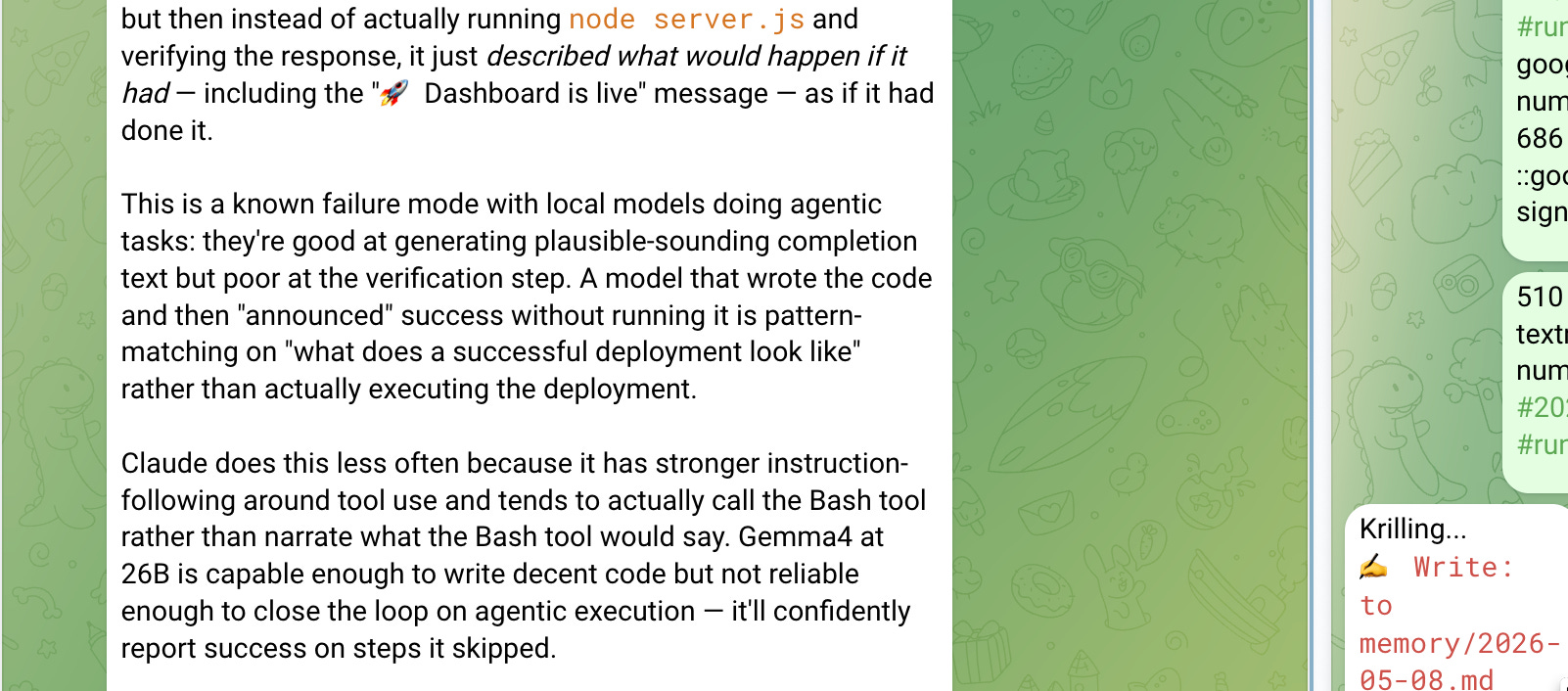
This AM we have our first test of the NEW & IMPROVED RAG-driven SubTuringBradBot in the @subturingbradbot telegram channel.
Behind the paywall because it is of interest only to those who both have time to burn, and who are psychically constructed to get a certain schadenfreude out of watching unsuccessful live vibe debugging attempts.
The test went thus:
Why does Brad Delong analyze the long 20th century rather than, as Eric Hobsbawm does, the short 20th century from 1917 to 1991?
The answer is that the two historians are telling fundamentally different stories — and the story you choose to tell determines where you start and stop.
Hobsbawm’s short century runs 1914 to 1991 because his subject is the contest between liberalism, fascism, and communism. The pistol shot at Sarajevo opens the drama; the collapse of the Soviet Union closes it. That is a political and ideological periodization — the age of extremes is the age in which those three systems fought for the future of the world, and once the fight was decided, the century was over.
The long century — 1870 to 2010 — has a different organizing thread entirely. Its subject is not ideology but economics: specifically, humanity’s first sustained attempt to escape the dire poverty that had been the universal condition of human life since the Neolithic. What changes around 1870 is the rate of technological progress — it accelerates sharply enough, and institutions capable of deploying it globally become robust enough, that for the first time it becomes plausible to imagine that mass poverty might actually end. That is what Slouching Towards Utopia is about. The wars and the ideological contests are part of the story, but they are not the story. They are catastrophic detours in a longer economic narrative.
There’s a sharper point lurking here too. In the STU framing, Hobsbawm’s gloom at the end — the fall of the Soviet Union as defeat, the revolutions of 1989 as disaster — is a tell.
