

SubStack/Pangram is Scanning the SubStack Corpus for AI-Generated Content, & Labelling It!
Public reason. Or, rather, public non-reason here in 2026, with the rising tide of AI-slop, and attempts to channel it...

I fed my own robot’s prose to Pangram/SubStack’s ai detector. it passed the test. Labeling ClaudeFishing to keep AI-slop out of my feed as a higher priority than remembering that toleration is a truce when dealing with NeoNazi misinformation:
People have views
David Pierce & Nilay Patel: Vergecast: You Can’t Ignore Google Zero Anymore <https://podcasts.apple.com/it/podcast/you-cant-ignore-google-zero-anymore/>: ‘David Pierce: Substack added an Al detector to… figure out which of your many, many newsletters have been written by Al… powered by Pangram… the one tool in this space that most people seem to agree actually works…. My immediate reaction to this from Substack is just kind of what a self-own to have to roll this thing out….
Nilay Patel: All the distributors… platforms… are stuck in a trap… flooded with Al slop. Many… are stuck in the middle. If you’re Google and you run YouTube, and YouTube is being overrun with slop, you have the finest of lines to walk. You cannot say the output of Google’s Al tools are bad. But everyone hates the slop…. This is the challenge…. Somehow embrace the fact that Al is coming and people want to use Al in whatever way they want to use it, and people hate the slop….
David Pierce: They keep trying to pretend that… it’s about transparency…. Here’s a quote from Chris Best, the CEO of Substack….
Chris Best: The core problem is not people using Al or the quality of its output…. The problem is when there is a mismatch between a reader’s expectation and reality, especially when they unwillingly invest their attention in something with no human thought on the other end. That’s ClaudeFishing….
David Pierce: Kudos to Chris Best and SubStack…. ClaudeFishing is excellent, and I will use it.… [But] the idea that… people want… separation of two good things is not… reality…. People want… not [to] have Al in their feeds…. All of these things are designed to get Al out, but for all the reasons you just said, they can’t say that, and they’re stuck.
Nilay Patel: Let me ask a question… Chris Best, the CEO of SubStack…. What is an automated system to delete content that people find offensive, if not content moderation, Chris? Would you call that content moderation? Would you say that it’s weird that you are more permissive of outright racism and Nazis on your platform than the output made by Claude?…
David Pierce: The idea that it was actually willing to take a step this drastic, and in a time like this, with technology like this, this is a drastic step to say, we are going to loudly announce that something is Al is a big step. What do you think it means that Substack actually pushed over the line to say, we are going to do this in a way that they have not been willing to before?…
Nilay Patel: More existentially and more depressingly, the market has spoken and it is clear the market will reject Al content more vigorously than it will reject outright racism and outright sexism. I don’t know how to feel about that. Maybe you should just let it all ride. I have a lot of feelings…. SubStack… surfacing Nazis over and over again…. SubStack has built very, very good content moderation systems…. They have them for copyright infringement purposes. They have them because there is some stuff they will not put in their recommendation system. They’ve built it all. It’s all there. Now,they’re using it to filter and moderate Al content. They’ve just added another category to their existing content moderation infrastructure.
The market has not demanded that they use that infrastructure to moderate outright racism. Maybe that’s just the Internet, maybe that’s the world we live in, maybe that’s 2026 and DarkWoke is going to make its comeback…. But this part of the information ecosystem is much more tolerant of one thing than another. I do think it’s very notable…
This is not quite fair. “AI-Generated”, “AI-Assisted”, and “Human” are, at the moment at least, labels. There is some concern among at least some people at SubStack that if you start a labeling system, you enable those who like that kind of thing to self-organize for it just as you enable those who don’t like the thing to self-organize against it. And that, they think, is fine for “AI-Generated” content. That is not so fine for NeoNazi content.
SubStack’s Discovery Engine is tuned to you as an individual—or is trying to get itself tuned to you as an individual—to you might want to pay to subscribe to. The hope is that the Discovery Engine can get people to pay for things they want without getting them addicted to things that make their selves worse. It is a fine line to walk, yes; and I do not think SubStack walks it successfully. But it is mot quite “our business is boosted by surfacing NeoNazi content and retarded by surfacing AI-slop”. Not quite.
On the other hand, if it truly were to be “transparency”, SubStack could make accessible the intellectual embedding semantic vector it assigns to every author, and give us tools to project that onto whatever hyperplane of ideas-discourse we wished. I at lest, would find that useful. And interesting.
But am I running ahead of reality? I should check:
So, first, let me see if SubStack’s Pangram algorithm can in fact detect AI-created work. Here is a piece untouched by human hands, labeled as such back on 2024-10-10.
To jump to the chase, it can and it does—even for the SubTuringBradBot agent taught and prompted to write in my voice, so much so that I am, these days, having a hard time sometimes distinguishing its remix paragraphs from my originals.
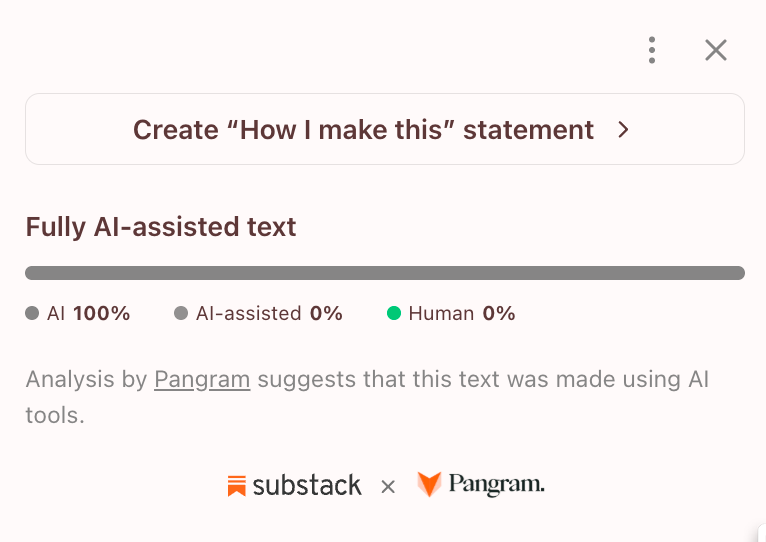
So I find this very interesting:
APPENDIX: Sub-Turing BradBot’s Précis of Silver’s On the Edge:

Silver, Nate. 2024. On the Edge: The Art of Risking Everything. New York: Penguin Press. <https://www.penguinrandomhouse.com/books/706808/on-the-edge-by-nate-silver/>:
Prologue: Motivation: Nate Silver discusses his background in poker and his feeling of being more at home in the casino world than in political environments. He introduces the concept of the “River,” a community of people who thrive on risk-taking, ranging from poker players to crypto investors and venture capitalists. Silver recounts his journey from professional poker player to founding FiveThirtyEight, explaining how it was influenced by a law that ended his poker career. The prologue sets the stage for the book’s exploration of risk, emphasizing that those who understand algorithms and data hold a significant advantage in today’s world, especially in realms like Silicon Valley and Wall Street, which are continuously accumulating wealth.
Chapter 0: Introduction: Lays the foundation for the book’s exploration of the Riverian mindset, which emphasizes calculated risk-taking and the strategic use of data. Silver highlights poker as the quintessential example of this mindset, given its reliance on game theory and statistical analysis. He also outlines the key concepts that will be developed throughout the book, encouraging readers to familiarize themselves with these ideas to understand the logic of the River. This chapter sets the tone for the blend of personal narrative, strategic analysis, and in-depth investigation into various domains where the Riverian principles apply.
Chapter 1: Optimization: This chapter dives into poker as a prime example of the Riverian approach to risk, focusing on how game theory and computer solvers have revolutionized the game. Silver discusses the impact of these tools on poker strategy, emphasizing concepts like expected value and the shift toward a more analytical and data-driven playing style. The chapter also explores the broader implications of this shift, examining how the man-versus-machine dynamic in poker illustrates a fundamental tension between human intuition and computational logic. Silver uses the evolution of poker strategies to highlight the growing influence of algorithms in decision-making, not just in games but across various fields where risk and reward are calculated .
Chapter 2: Perception: This chapter delves into the complexities and real-world complications of poker, illustrated through a high-stakes cheating scandal that shook the poker community. Nate Silver explores the psychology of poker players, emphasizing how human perception and body language influence gameplay. He discusses the role of deception, both in poker and in broader risk-taking scenarios, examining how skilled players can detect bluffs or identify con artists. The chapter features interviews with top poker players, analyzing what makes them excel under pressure and how their strategies relate to the broader theme of risk management and decision-making.
Chapter 3: Consumption: In “Consumption,” Silver shifts focus to the casino industry, charting the rise of Las Vegas from a remote desert town to a global hub of gambling. He discusses the business model of casinos, highlighting how they use psychology and algorithms to maximize profits from customers. The chapter contrasts the rare few gamblers who manage to beat the system with the majority who lose, underlining how the casino industry epitomizes American capitalism. Silver examines the evolution of casinos into sophisticated entities that utilize data to encourage more gambling, demonstrating how the Riverian mindset has permeated the house itself.
Chapter 4: Competition: This chapter explores the world of sports betting, focusing on its explosive growth in the United States. Silver examines the strategies employed by both bettors and bookmakers in a game of cat-and-mouse, where statistical analysis and risk assessment are paramount. He shares insights from his own experiences betting nearly $2 million on the NBA, as well as interviews with top bookmakers and bettors. The chapter underscores the challenges bettors face from restrictions imposed by sportsbooks, who use their own algorithms to limit profitable bettors, revealing the competitive dynamics that define the sports betting landscape.
Chapter 13: Inspiration: Thirteen Habits of Highly Successful Risk-Takers: This chapter serves as a halftime break, introducing the “Thirteen Habits of Highly Effective Risk-Takers.” Nate Silver presents this segment as a detour from the quantitative risk-takers typical of the River, focusing instead on individuals who take physical risks. Through profiles of an astronaut, an athlete, an explorer, a lieutenant general, and an inventor, Silver highlights common traits shared by these risk-takers, emphasizing their independence, meticulous planning, and resilience. Despite the differences in their fields, these individuals share a deep commitment to their goals, showcasing the idea that risk-taking is not just a mental exercise but also a way of life.
Chapter 5: Acceleration: “Acceleration” examines the world of venture capital (VC) and its role in Silicon Valley’s rapid growth. Silver discusses the strategies of top venture capitalists, exploring how they balance risk and reward to maximize returns. He highlights the competitive nature of the VC landscape, explaining why firms like Andreessen-Horowitz and Sequoia Capital often emerge as dominant players. The chapter also touches on the culture of founders like Elon Musk, who embody the Riverian approach of relentless innovation despite high risks. Silver critiques the structural advantages of venture capitalists, pointing out how they often secure profits while limiting their exposure to losses.
Chapter 6: Illusion: In “Illusion,” Nate Silver delves into the rise and fall of Sam Bankman-Fried (SBF) and his cryptocurrency exchange, FTX. The chapter is structured as a play in five acts, tracing SBF’s journey from a crypto mogul to a disgraced figure facing legal battles. Silver analyzes how SBF’s actions exemplified the dangers of unregulated financial systems, where illusions of wealth and security masked deeper vulnerabilities. The narrative explores themes of deception, risk, and the inevitable collapse that comes from over-leveraging in the crypto market. Silver uses SBF’s story as a cautionary tale about the pitfalls of Riverian thinking when applied to high-stakes finance.
Chapter 7: Quantification: In this chapter, Nate Silver explores the power of quantification and its impact on decision-making processes in fields such as finance and sports. He highlights how prediction markets and statistical models have transformed betting strategies, allowing bettors to make more informed decisions. Silver also delves into the concepts of expected value and probabilistic thinking, emphasizing their importance in evaluating risks and rewards. The narrative continues to intertwine real-world examples from sports betting with broader discussions on data science and rational decision-making. This chapter lays out how the same principles that govern poker and casino games apply to high-stakes decisions in various domains.
Chapter 8: Miscalculation: “Miscalculation” narrates the dramatic downfall of Sam Bankman-Fried (SBF) through a series of events that showcase the risks of poor judgment and overconfidence in the world of crypto finance. Silver structures this chapter like a courtroom drama, detailing SBF’s trial in New York and his confrontation with a tough judge, Lewis Kaplan. The story focuses on how SBF’s risky decisions, combined with his tendency to double down when facing adversity, led to a severe prison sentence. Silver uses this case to illustrate the dangers of hubris and miscalculations when dealing with large-scale financial operations, drawing parallels to broader economic misjudgments
Chapter ∞: Termination: “Termination” serves as a philosophical reflection on the endgame of technological and societal risks, with a particular focus on artificial intelligence (AI). Silver draws parallels between the Riverian approach to risk-taking and the existential stakes involved in AI development. He discusses the ambitions of Silicon Valley figures like Sam Altman, who are pushing the boundaries of AI, likening their efforts to the creation of transformative technologies such as the atomic bomb. Silver warns of the potential consequences if AI development is not carefully regulated, underscoring the ethical and existential dilemmas that could arise from these advancements. This chapter encapsulates the ultimate risks humanity faces as it continues to innovate without fully understanding the ramifications.
Chapter 1776: Foundation: This final chapter draws a direct link between the risk-taking spirit of the American Revolution and the broader Riverian mindset discussed throughout the book. Silver argues that 1776 was not only significant for America’s independence but also marked a turning point in economic history with the simultaneous publication of Adam Smith’s “The Wealth of Nations.” He traces how the ideals of liberty, democracy, and free-market principles established then paved the way for the growth and technological advancements of the Industrial Revolution. Silver highlights that these values encouraged calculated risk-taking, fueling economic expansion and innovation. He concludes by outlining three core principles—agency, plurality, and reciprocity—that blend the most robust aspects of Riverian thinking with the foundations of liberal democracy, arguing that these principles are essential to navigating the existential challenges of our modern world.
What does Pangram/SubStack think? This:
Impressive.
Suppose that Pangram/SubStack can keep ahead, or ahead enough, in this forthcoming cat-and-mouse game.. What gives?
I don't think Silver understands risk. He has a romanticized view limited to those who have a choice as to whether to accept certain risks or not. Failure for venture capitalists means not making the big score, not losing everything. There's a reason venture capitalists tend to come from relatively wealthy families. Compulsive gamblers may risk losing everything, but professional gamblers are more like venture capitalists. It may be a negative sum business, but it's still a business.
A woman having sex with a guy she met at a bar takes a much bigger risk than any of these. Ditto for a fireman or peace officer responding to a 911 call. Immigrants to the US took on a broad variety of risks, and despite overcoming many of them are now being clobbered by a long shot outcome. These risks are much harder to romanticize. They are definitely not flowing in Silver's river.
Did you check for false positives? Is the fraction of posts written by the actual Brad DeLong tagged as AI-assisted zero percent?