

The Nearly Ultimate Tolkien Magic-System Explanation
Bret Devereaux attempts to make sense of "magic" in Tolkien's "The Lord of the Rings". I think what he says is mostly true. And he gives it a very good try. But I also think that Tolkien is not...

Bret Devereaux attempts to make sense of "magic" in Tolkien's The Lord of the Rings. I think what he says is mostly true. And he gives it a very good try. But I also think that Tolkien is not completely consistent here...
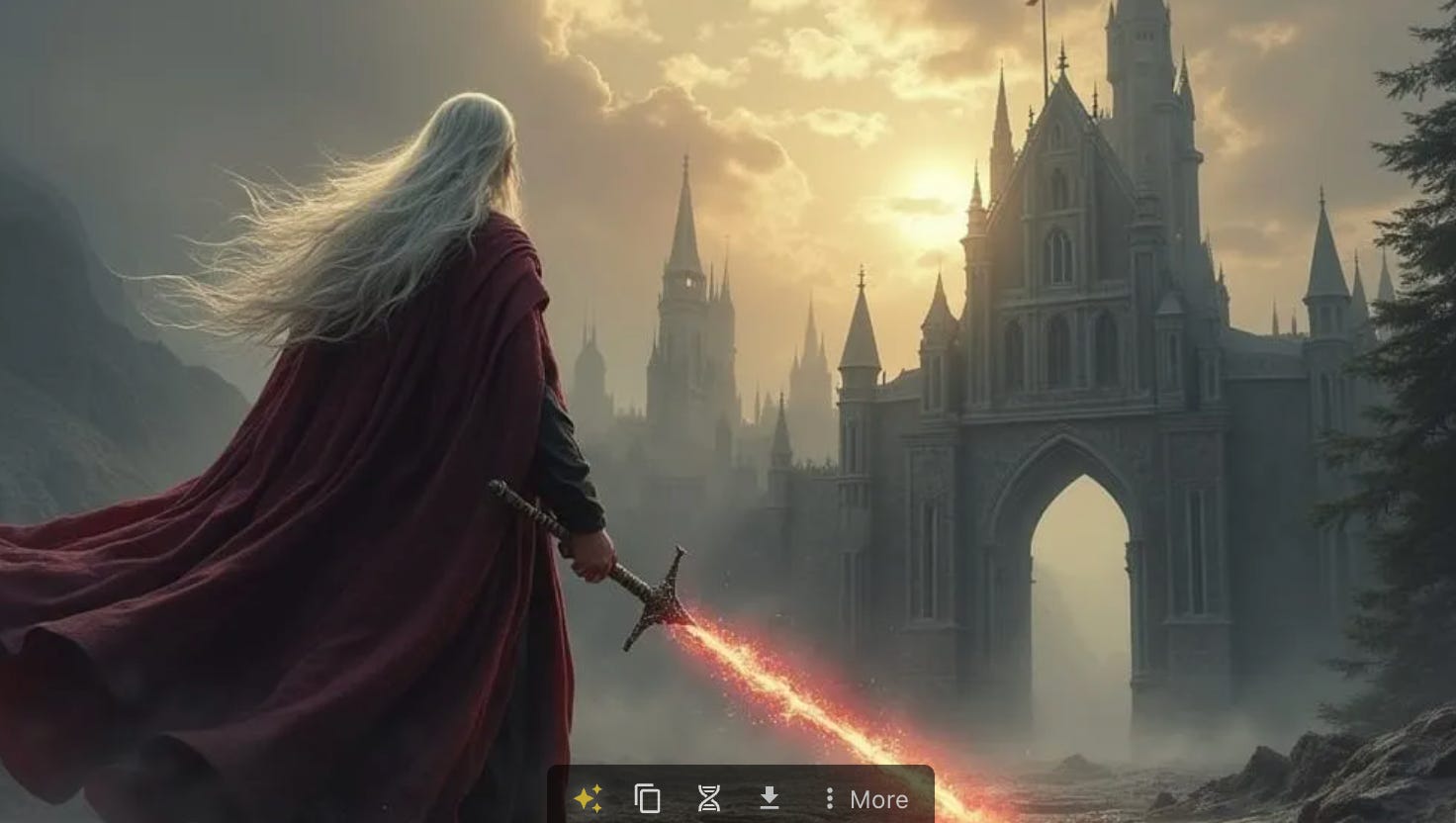
And now I am thinking about Gandalf’s declarations—commands—observations in The Lord of the Rings that: “you cannot enter here” and the metaphysics and spiritual mechanics of Middle-earth. And after thinking, I am almost convinced that there is a strange coherence to magic as practiced by Gandalf the Grey and by Gandalf the White. In this coherence, Gandalf doesn’t win magic duels with fireballs and such. He wins with Truth. Tolkien’s magic system is not “Dungeons & Dragons”: it is Neoplatonism.
When Gandalf says “you cannot enter here”, he is performing a mix of (a) obsserving the state of the true, real world; (b) using his mental powers to constrain the actions of an evil villain, and also (c) changing the world via performing certain ritual actions—with much more weight on (a) than on (b) or (c), but with ultimately they all coming to converge in the same Reality as created by and in the mind of Eru Iluvatar.
It is almost convincing
I want Bret Devereaux to sing of arms and men, but instead we get a different treat—the ultimate Tolkien magic-system explanation:
Bret Devereaux: How Gandalf Proved Mightiest: Spiritual Power in Tolkien <https://acoup.blog/2025/04/25/collections-how-gandalf-proved-mightiest-spiritual-power-in-tolkien/>: ‘Treebeard says to… Gandalf…. “You have proved mightiest, and all your labours have gone well.” (RotK, 287)…. I would argue that what Treebeard is saying is that Gandalf has… been measured against and “proved”… mightier than Sauron and thus the “mightiest” creature in Middle-earth. And no one corrects him – because there is nothing to correct…. We need to distinguish… craft-magic, spiritual power and then a subset of spiritual power, dark magic….
Craft-magic: Elves and Dwarves sometimes produce objects or effects which are marvelous out of their deep knowledge and connection to parts of Arda…. These are… technology: wondrous, magical-seeming results borne of the tremendous skill and deep knowledge of the crafters….
Spiritual power:… An expression of the primacy of the Unseen over the Seen and in a sense as a result such spiritual power does not effect or perform but rather reveals: the true, Unseen nature of the world is revealed by the exertion of a supernatural being and that revelation reshapes physical reality (the Seen) which is necessarily less real and less fundamental than the Unseen…. Note those moments where Gandalf’s manner suddenly changes and a character glimpses, however briefly, his true being as an angelic Maia of tremendous power…. in those moments characters who normally can only observe the Seen world momentarily glimpse the deeper truth of the Unseen world: “Denethor looked indeed much more like a great wizard than Gandalf did, more kingly, beautiful, and powerful; and older. Yet by a sense other than sight, Pippin perceived that Gandalf had the greater power and the deeper wisdom, and a majesty that was veiled. And he was older, far older. (RotK, 30, emphasis mine)…”
‘Dark magic:’: … The Mouth of Sauron “learned great sorcery,” for instance…. Such ‘dark magic’ is actually spiritual power, one step removed…. Mortal magic users command[ing]… the… remains of Morgoth’s spiritual power, diffused through Middle-earth… manipulat[ing] elements of this ‘Morgoth-stuff’ to produce magical-seeming effects….
The power of the [three Eleven] Rings introduces some complexity…. They do not seem to corrupt their wearers on their own, which might suggest they are close – or at least closer – to pure ‘craft-magic.’ My own suspicion is that in their design, drawn from the Seven and the Nine, there is some part of Sauron’s spiritual power reflected in them (included unintentionally by Celebrimbor), but that they are mostly ‘craft-magic’….
Spiritual power follows a clear pattern in Tolkien. What makes it tricky to assess as a ‘magic system’ is instead that spiritual power works at a very profound level, making it easy to mistake the most important uses of it as ‘chance’ or ‘happenstance’ when in fact we are observing the surface emanations of something much deeper. But in most cases – arguably all of the, – this spiritual power does follow a system, if we are attentive enough to detect it….
Our pattern for ‘magic’…. Characters exert their spiritual power through plain language assertions about the current state of the world – the spiritual power – works, the world alters itself to accommodate their statement, to make it true or perhaps more correctly… make it always have been true, because what is being made ‘true’ is really a ‘truth’ derived from the more fundamental, more real reality of the Unseen. And because the Unseen is more profound and fundamental than the Seen, when its nature is revealed the Seen world, as if snapping to a reality that has already existed immediately conforms….
Underneath the Gate of Minas Tirith…. This is one of my favorite moments… the entire reason I decided to write this nearly 7,000 word post…. It can only be overweening, staggering hubris that the Witch King even imagines he has any shot at winning this spiritual confrontation…. He is up against – he calls Gandalf “Old fool!” and one wonders if he has mistaken Gandalf for an aged lore-master and magic user rather than the far more powerful Maia he is…. [And] he very clearly doesn’t win this confrontation. Instead, what we get is an expression of supernatural power…. “You cannot enter here,’ said Gandalf, and the huge shadow halted. ‘Go back to the abyss prepared for you! Go back! Fall into the nothingness that awaits you and your master. Go!’ (RotK 113)…”. A present tense plain language statement of the state of the world…. The WItch King, of course, dismisses this as words, mocks Gandalf, reveals his iron crown, raises his sword and with dark magic sets it alight (RotK, 113). But you know what he doesn’t do? He doesn’t enter. Because he cannot…. Gandalf… here he states a cold reality: the Lord of the Nazgûl cannot enter here….
A reality about the Unseen world is being expressed. And then, of course, the Seen world conforms to the deeper reality of the Unseen world: “And as if in answer there came from far away another note. Horns, horns, horns. In dark Mindolluin’s sides they dimly echoed. Great horns of the North wildly blowing. Rohan had come at last […] the darkness was breaking too soon, before the date that his Master had set for it: fortune had betrayed him for the moment, and the world had turned against him; victory was slipping from his grasp even as he stretched out his hand to seize it[…] King, Ringwraith, Lord of the Nazgûl, he had many weapons. He left the Gate and vanished. (RotK, 113, 125)…”
In understanding how spiritual power can express itself in Tolkien, I think this confrontation is the essential bridge…. [A] clear, present-tense statement of the state of the Unseen reality…. The villain produces a flaming sword with which to challenge Gandalf…. What is revealing however in this moment is how [Gandalf’s] power is expressed. Gandalf does not drive the Witch King from the gate with fireballs or curses or swordplay. Instead, the physical reality of the Seen world conforms to the spiritual reality of the Unseen world: the arrival of the Rohirrim prevents the Witch King from entering and so he “cannot enter.”… The victory in the spiritual contest is expressed not in direct, flashy confrontation, but in the truth of their vision of the world. Gandalf’s victory in both cases is born out by the fact that his statement about the world was correct….
The line in these spiritual contests between ‘magic’ and ‘labors’ is not just blurry but functionally indistinct: Gandalf triumphs over the Witch King in a clear by-the-numbers spiritual contest of wills not by casting lightning bolt, but by having set in motion days and weeks before the movement in the hearts of men which would bring the Rohirrim to Minas Tirith, which is of course, perfectly fitting with his mission. Gandalf may not even have fully known that – in the plan of Eru Ilúvatar – this is what he was doing, setting the stage for that very confrontation. Yet his actions first create a reality in the Unseen, in the hearts of people, which then at the critical moment manifests in the Seen world….
In his ability to move others to right action, to one good deed after another whose morality shaped the Unseen world until at last the grand magic of Doing The Right Thing bears out in unmaking the very “realm of Sauron.” Because it was always the Unseen world, shaped by hearts rather than armies, which mattered the most…
My reaction: very clever, but ultimately it cannot be fully convincing. Or, at least, it cannot be fully convincing, because the authorial voice of Tolkien does not constantly sustain this position without inconsistencies. And it also cannot be fully convincing because Gandalf the Grey and Gandalf the White are very different entities, with different powers, using magic in different ways. Remember: Durin’s Bane, the Balrog of Moria, kills Gandalf the Grey. In Arda, Gandalf the Grey is stone dead. Gandalf the White is a different avatar, a new incarnation, even if he does wear his old robes to Meduseld in Rohan.
But Bret Devereaux’s take does make sense of a lot of things.
But it does not make sense of this—Gandalf’s first encounter with Durin’s Bane, the Balrog of Moria:
Tolkien: The Fellowship of the Ring: “I found myself suddenly faced by something that I have not met before. I could think of nothing to do but to try and put a shutting-spell on the door. I know many; but to do things of that kind rightly requires time, and even then the door can be broken by strength. ‘As I stood there I could hear orc-voices on the other side: at any moment I thought they would burst it open. I could not hear what was said; they seemed to be talking in their own hideous language. All I caught was ghâsh: that is’“fire’. Then something came into the chamber – I felt it through the door, and the orcs themselves were afraid and fell silent. It laid hold of the iron ring, and then it perceived me and my spell.
“What it was I cannot guess, but I have never felt such a challenge. The counter-spell was terrible. It nearly broke me. For an instant the door left my control and began to open! I had to speak a word of Command. That proved too great a strain. The door burst in pieces. Something dark as a cloud was blocking out all the light inside, and I was thrown backwards down the stairs. All the wall gave way, and the roof of the chamber as well, I think…
This is very much not spiritual power making the Seen correspond to the Unseen.
This is, rather, a technological form of magic. Anyone with the talent and the skills—wherever those are coming from—could using the proper voces mysticae command nature— “shutting-spell…. I know many… rightly requires time…”, “counter-spell”, “word of Command…” And in this case we do not have a revelation of the Unseen and the coming of the Seen world into harmony with it. Rather, we have results nobody had intended:
The door burst in pieces…. was thrown backwards down the stairs. All the wall gave way, and the roof of the chamber as well, I think…”
“I think”. Gandalf does not know, until:
“A Balrog,” muttered Gandalf. “Now I understand.” He faltered and leaned heavily on his staff. “What an evil fortune! And I am already weary…”
In order to properly do this, you need to:
(a) have the talent,
(b) practice the skill, and
(c) invent or discover or learn the voces mysticae, the magic words that control physical nature and also non-physical demonic, neutral, or angelic entities.
This is the kind of magic that enters English through Latin and Greek borrowings from and transformations of Iranian culture: the magi were the Powerful Ones, the fire-priests of the Zoroastrian religion. Magic was what they did—conjuring sacred fire out of the ground with no wood consumed (even if it was, apparently, a bush that was burning), altered-state of consciousnes rituals involving psychoacticive haoma, trance-bound channelers of divine speech, cleansing rites to drive out demonic pollution, plus deep astronomical and calendrical knowledge. And that then cross-fertilizes with other traditions—Keltic, Germanic, Italic, plus the Book of Enoch.
Devereaux's interpretation is that Tolkien has conceived of two planes of existence, the spiritual and the material, with the spiritual being the higher and having the greater priority. When the spiritual plane changes, the material must change to align with it. It amounts, as you suggest, to a theory of ontology. It is not a *platonic* theory because spiritual being is not eternal - it can change, that's the point!
But in any case, I reckon that Devereaux isn't quite right; the book does indeed embody a theory of ontology but that theory is "the word is more real than the substance". This principle crops up in quite a few non-spiritual contexts, some of which you could mistake for "naming calls" but are in fact "naming makes it so". Which honestly is a lot more in character for Tolkien. Once you start looking for these episodes in the text, you see them everywhere. Examples not mentioned by Devereaux:
An elf says "Hail, Elf-friend", and presto, you are an elf-friend evermore, easily perceived to be so by any elf.
"Speak no words to them! They are deadly." To traffic in words with a Nazgul is to engage in a duel over reality which you are sure to lose, unless you have strength to match theirs.
"One Ring to rule them" was speech that the Smiths of Eregion *heard*, and knew that they had been betrayed - because reality had been changed beneath their feet.
When the leader of the Nazgul raises up his hand, Frodo's tongue cleaves to his mouth and he is stricken dumb, ending his power to resist.
When Frodo jokes that he hopes the thinning process will not go on indefinitely, Strider says "do not speak of such things".
And of course, the very creation of Arda was effected by the singing of a choir, and its theodicy by the discordant voice of Melkor.
I know that you love interpreting Gandalf's first encounter with the Balrog as technical wizardry, with Gandalf shocked into "talking shop", but I don't agree with you. I think it is a straightforward duel between two powerful speakers of reality. It's a *word* of Command!
Hmm, the thing I usually recall when characterizing the magic of Middle Earth is that the elves simply talk to things who respond to their speech, because the Elves know the speech. They speak to trees which alter their shape. They whisper to the river, and it rises and foams and forms steeds of spray and water.
The thing most noteworthy is that neither elves nor Gandalf think of anything as "magic". The world is the world, and if you know more, you can do more. That's how it seems. There's no great division between "magic" and "not magic" like there is in Harry Potter. One does not have to be born a wizard, or have the Force strong with them. There are no "annointed ones". Even with Gandalf, I can't shake the sense that he knows things because he has lived so long and studied so much. This was possible because he was an Istari, yes.
Now this could just be my dislike of "chosen one" plots. But it really does not seem part of Tolkien. Any choosing was done by the very mortal peoples of Middle Earth. It is not the Elves that decide the fate, it is the Men (and I think I would include Hobbits as Men), and their choices, and their sacrifice who decide the fate of Middle Earth.
Faramir's mother and her line, has "the sight". They know things that most don't. Perhaps not as well as Galadriel, but no one of them had the time or means to perfect this art.
So I don't really accept the sense of a dichotomous world that Devereaux presents. However, as a pattern of how the powerful magics express themselves, it is very worth noting.