


The core hardware cost collapsed to $0.12/W — so why is a California rooftop still costing $3.00/W, and the market shrinking while Pakistan’s is booming? Soft costs, a dead tax credit, and a net-billing rule rewrote the arithmetic: in the U.S., policy and plumbing now matter more than the price of a panel. Chinese export deflation liberated the Punjab and electrified Perth; in California it ran straight into the Net Billing Tariff and stalled:
Globally, solar's rise is a supply-side story: Chinese overcapacity, panels at $0.12/W, households and businesses defecting from the grid.
But here in California the drivers of stagnation are policy shifts: a repealed tax credit, and a backflow compensation rule that turned the battery, not the panel, into the thing worth buying.
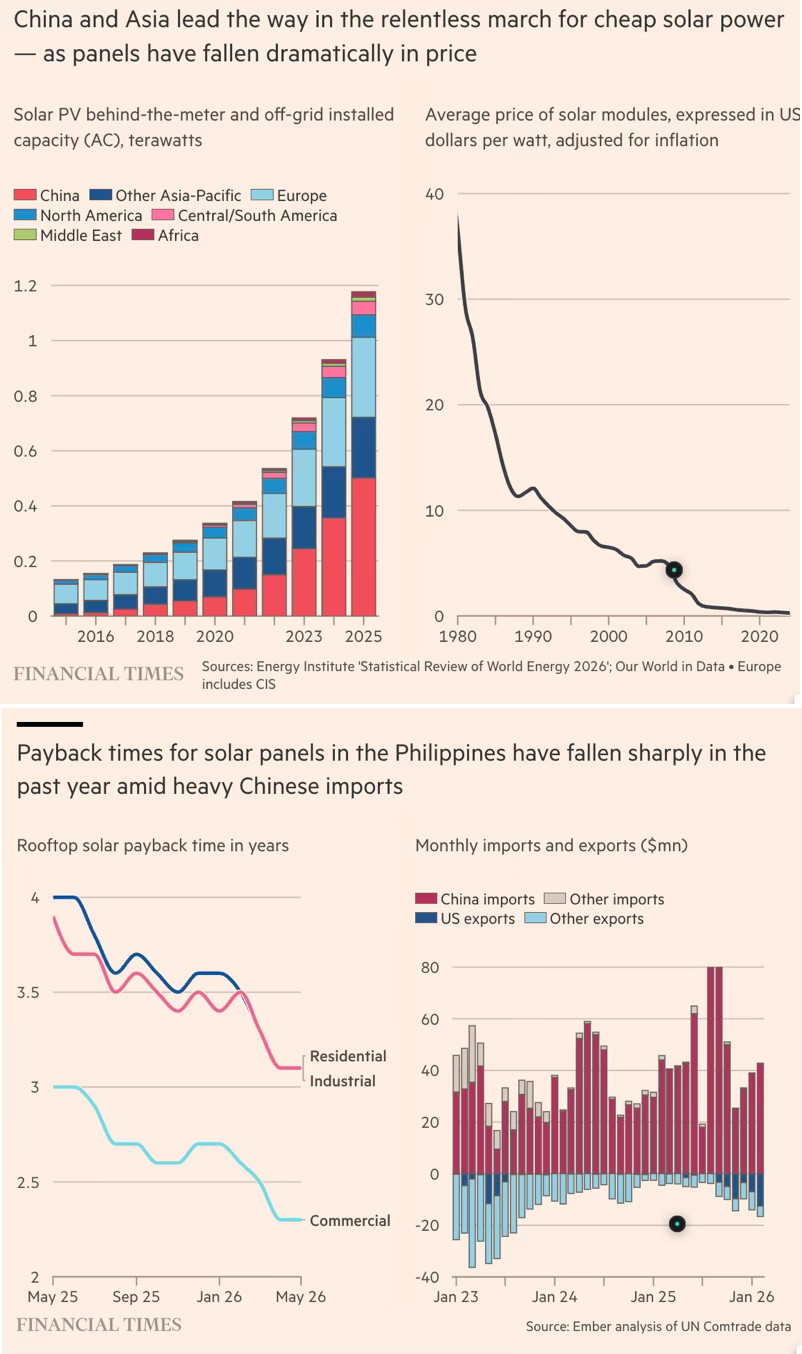
And the context, from the FT:
Rachel Millard, Humza Jilani, Monica Mark, & Krishn Kaushik: ‘Offensively Cheap’: Solar Power Is Looking Up <https://www.ft.com/content/8b704ae0-1fa2-4303-925f-170fa5d935b3?syn-25a6b1a6=1>: ‘In the badlands of Chakwal, in north-central Pakistan, Bestway Cement is transforming plots of dry earth and olive and peach groves into a forest of solar panels. Its efforts will add 6.34 megawatts of generation capacity by the end of the year…. Already, solar generates over a quarter of the electricity powering its cement plant…. The solar revolution made possible by cheap Chinese photovoltaic panels — and the rise of small-scale, individual power generation — is transforming energy…. Cheaper panels enabled a vast rollout in China itself and helped solar generation evolve from a subsidised technology deployed mostly in markets looking to decarbonise to a vital source of electricity in areas where power is scarce, expensive or unreliable. That process started in countries like Pakistan, Brazil and South Africa and has now spread….
The fallout from the US-Iran war has led to more interest in rooftop solar in Britain, where since the end of August households have been able to buy 800-watt solar panels in supermarkets or DIY stores to plug in at home…. Plug-and-play panels are proving popular in the US despite President Trump’s general antipathy to renewables and his decision to eliminate a tax credit for rooftop solar systems….
“Perth, for example, is covered in rooftop solar,” says Pierluigi Mancarella, chair professor of electrical power systems at the University of Melbourne. “If you have a massive cloud formation, the rooftop PV production can drop by so much that it looks like you have lost basically almost a nuclear power station.”… The system operator has very little visibility over the aggregate gigawatt of generation capacity thus created…
Two big questions:
First, is $0.12/W Chinese solar-panel export price a stable equilibrium price, one that is going to fall further, or a temporary low driven by overcapacity, dumping, and state subsidy?
Second, what is going on here in the United States, where things seem to have stalled even as they accelerate elsewhere?
I do not know the answer to the first. I think I understand the second (but I may not). Let me put this under the fold for now because I am not sure I am right here:
I see rushing by in my feed things like:
Average Solar Cost Per Watt: California 2026: Sep 2, 2026 — The average cost per watt for residential solar in California in 2026 is roughly $2.50–$3.50 per watt installed, before battery storage and…
Cost of Home Solar System: The True 2026 Price Guide: Aug 15, 2026 — The average gross cost for a standard 8kW system in 2026 ranges from $24,000 to $28,000 before state-level incentives…
Is solar still worth it under NEM 3.0 in 2026?: Aug 30, 2026 — Solar is still worth installing in Southern California in 2026, costs of $2.50–$3.50/watt and SCE’s average residential rate…
Solar Payback Period in California (2026): Jun 4, 2026 — California solar-plus-battery system typically pays back in roughly 7–9 years in 2026, then delivers a decade-plus of low bills on equipment…
In short: Whille the world is drowning in the “offensively cheap” Chinese photovoltaic modules an installed residential rooftop system here in California is still some $3.00/W, and the U.S. residential market is contracting. The abrupt death of the 30% federal tax credit was a big hit. Here in the U.S., rooftop solar’s fate rests on soft costs, tax policy, and tariff design, not on the hardware price. Residential solar in the U.S. has completely decoupled from the global module-price collapse.
Here in California, at least, the market’s center of gravity is shifting. We are rapidly going from ownership to third-party leases because those are where federal subsidy survives. We are rapidly going from bare panels to solar-plus-storage because under California’s current Net Billing Tariff rooftop-solar compensation régime, midday power exported back to the grid is credited only at the avoided utility cost of $0.06/kWh, not at the $0.35/kWh retail rate. Thus the winning design is a right-sized solar array, plus a battery that shifts cheap midday generation into the 4–9 p.m. peak when grid power costs $0.75/kWH. It makes sense only via storage and then self-consumption: a battery, not a bigger array, is the value driver here. (Unless you are in the municipal utility districts of LADWP, Burbank, Glendale, Pasadena, Anaheim, Riverside, and so forth.)
But is rooftop really the relevant margin at all here?. Might the U.S. transition run through utility-scale solar plus storage? A reallocation to where soft costs are lower?
I'm reminded of Noah Smith's enthusiasm for battery-powered household appliances.
Given the utter mess of centralized smart home tech and its likely enshittification (if it ever works), a distributed system of batteried appliances fed by solar seems like a pretty good method to achieve what you're suggesting. Maybe mix in a back-up power station/battery that becomes a daily source for some of your most energy-intensive needs during peak hours.
Now you're cooking with (solar-generated) electricity!
Like many things in economics there are multiple factors which interact with different and uncorrelated principle factors and scaling. Like some who installed solar after hot summers with old AC I now have excess rooftop solar with a new heat pump. Except for cold mornings (at 6000ft it often gets cold overnight in the winter and you can’t heat a 5000 sq ft house to 66deg when it’s -10 with a $30,000 heat pump so I have a 97% efficient gas furnace for initial heating) I can live with just my solar if I had batteries. Batteries don’t have much gain by scaling from house covering size to local utility size, I’d estimate <2x and having grid free power covers much of that gap (we had 55 hours of zero power last Dec for high wind fire protection, cutting power to over 150,000 homes). But the switching gear and inverter do have larger scaling relative savings at local utility scale.
But eventually our electrical life will switch to DC for most everything except long distance transmission. Future houses will have a battery (likely Na+ based) and many/most will have a way to charge the battery from the grid, but at much lower peak power than house service today.
My next city car will be electric and charged from my existing solar. But I still need my F250 for life hunting, fishing, skiing, cycling, camping in the west. And I still want gas heat on those mornings it’s -15.