

(VERY PARTIAL-)CROSSPOST: GARY MARCUS: Is Anthropic Making Money? How Much Money?
Nobody ought to get superrich selling LLM-services: Anthropic’s IPO & the "airline scenario"; the problem is that back in The Day I was the same bear on Google & FaceBook, & I was very wrong...

Plus: Amazon, Facebook, Google, and Microsoft are Agamemnon, Akhilleus, Odysseus, and Nestor, and they are burning cash to make sure no Anthropic, OpenAI, or other Hektor lives to see another sundown…
My personal Visualization of the Cosmic All is that nobody is going to make super-fortunes selling LLM model services to paying customers, whether enterprise or consumer.
Start with the supply side. The problem is this: the moats are shallow.
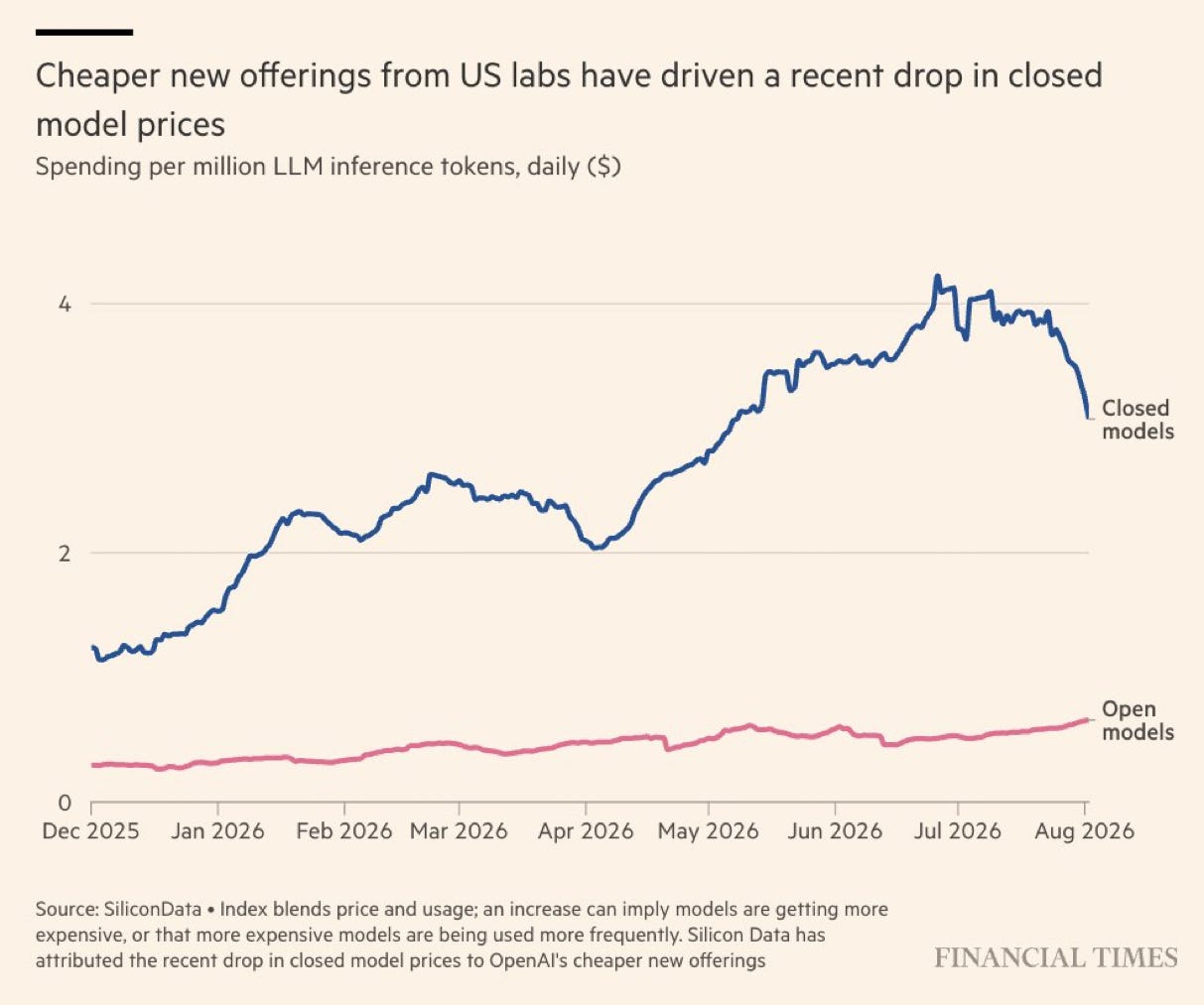
Nothing stops a rival from offering a near-equivalent model—if only by distilling yours, training a cheaper system on the outputs of the expensive one you spent a fortune to build. Moreover, whatever frontier edge you do manage to open up commoditizes fast: today’s lead is gone in months, as competitors catch up and open-weight models undercut proprietary pricing all the way down toward zero. Put those together. Selling LLM model services looks likely to become a commodity business. And commodity businesses, as every economist since Smith has known, do not earn large economic profits.
This is what I have called the “Airline Scenario”: a technology of huge user surplus and immense usefulness that nonetheless throws off next to no profit for the firms providing it.
The particular cost structure of LLM model-services makes it worse rather than better. Operating costs—compute, electricity, human oversight, error-correction—stay stubbornly high even as prices fall. Moreover, the models themselves offer no escape into economies of scale. They are “train and infer, train and infer”. There is no write-once, run-forever, zero marginal-cost software dynamic here. There is only the perpetual grind of building the next model and then paying again to run it.
Thus when the reported profits do appear, they arrive dressed in “adjusted operating income” and undisclosed math—which is the surest signal that the real profits are not there.
Durable value does exist in this business. Enormous durable value exists. But, in my view at least, it is highly unlikely to sit in the model. It sits in trusted data, in workflow, and in reliability. It sits in the harness and the curated datastores that turn a probabilistic text-generator into something an enterprise, or a consumer can actually depend on. Producer and consumer surplus thus flows to those who control those: end-users, data-cleaners and -curators, and (perhaps) harness providers. And harness-provision looks like it is rapidly becoming a commodity business as well. The raw model, in other words, and almost surely the harness as well, is the cheap and commoditized part. The valuable part is everything wrapped around it.
Moreover, even there is valuable margin harvestable somewhere between the end-user and the model-provider, that margin is under the most aggressive siege since the Trojan War, with Amazon, FaceBook, Google, and Microsoft as Agamemnon, Akhilleus, Odysseus, and Nestor, respectively:
Amazon’s Agamemnon-like power is infrastructural and logistical (AWS, the cloud, the “pick-and-shovel” business): it is the king who profits by outfitting everyone else’s campaign, with power resting on wealth and command rather than personal excellence in battle.
FaceBook’s Akhilleus-like persona exerts unbelievable raw force depending on the mood of a single rash personality, one day sulking in his tent, a second going all-in on open source models, and a third day turning academics into multi-billionaires if only they will come work for him and tolerate his adrenaline-rage emotional cycles; my view of FaceBook is that is is, indeed, both devastating and ultimately doomed by its many Akhilleus’s-heel characteristics.
Google: the wily one with cunning and adaptability, deploying its own models defensively, integrating AI into the browser, out-thinking the threat, and the survivor who will makes it home.
And Microsoft: perhaps Nestor, because it is also a veteran of an earlier generation of struggles, advancing through through wisdom and alliance-making, advising others when and whom they should fight, not always in their own interests but always in its.
They are all burning cash in unbelievable amounts precisely to deny everyone else any margin at all. Their spending is defensive. It is to protect the platform monopolies they already hold. That quadruple scorched-earth defense leaves no room for any new platform monopoly to grow up beside them. Anthropic should study Netscape and its fate. And so should those thinking of investing in its IPO.
But there is one problem with this Visualization of the Cosmic All of mine. Back in The Day, I had the same of view of Google as a good business but not a future Leviathan: the only way it could become a future Leviathan, I thought, was by selling its soul to SEO to boost its cash flow and then using that aggressively to scorch the earth around it. And, I was confident, selling your soul to SEO and charging for the eyeballs your second-rate search results trapped into repeated casts of the yarrow sticks would ultimately be self-defeating. Back in The Day, I had the same of view of FaceBook as a good business but not a future Behemoth: the only way it could become a future Leviathan, I thought, was by selling its soul to clickbait rage to boost its cash flow and then using that aggressively to scorch the earth around it. And, I was confident, selling your soul to clickbait-rage and charging for the eyeballs your outrage-bait feeds had trapped into doomscrolling would ultimately be self-defeating.
Guess what? Selling your soul to SEO was not self-defeating. Neither was becoming the master necromancer of rage-bait doomscrolling.
Am I missing something similar here and now?
And so we have:
(VERY PARTIAL-) CROSSPOST: GARY MARCUS: The hyping of Anthropic’s IPO
<https://garymarcus.substack.com/p/the-hyping-of-anthropics-ipo> <http://garymarcus.substack.com>
Some strong claims, dissected
Gary Marcus
Aug 16, 2026 ∙ Paid

I am watching something fascinating unfolding in real time. Anthropic is in an SEC-monitored “quiet period” before its IPO (expected sometime in the fall), somewhat limiting its communications (though not entirely; Amodei discussed governance matters on X yesterday, a rare appearance there for him, and the company continues to report on safety issues and so on). But that hasn’t stopped leakers and generative AI bulls from trying to convince audiences that Anthropic’s finances are spectacular.
Aside from the Friday Reuters report above in which Anthropic is said to be “projecting 2028 revenue of roughly $190 billion to $200 billion”, based of course on undisclosed math, “according to two [unnamed] people familiar with the company’s financials”, we also heard yesterday about how amazing their Q2 was (further details below), by way of documents that were leaked to Bloomberg News. Anthropic may be “quiet”, but its fans are not.
Moreover, in a Friday All-In podcast interview, Gavin Baker claimed that Anthropic was making money on every token. A couple weeks earlier the prominent podcaster Dwarkesh Patel projected (in a claim he partly walked back, see below) that “Anthropic likely ends the year with ~$100-150B of revenue”
Below, I dissect these claims and explain what’s been left out…
<https://garymarcus.substack.com/p/the-hyping-of-anthropics-ipo> <http://garymarcus.substack.com>
Brad DeLong here: That is all that Gary Marcus puts above his paywall.
However, what is below Gary Marcus’s paywall is free with a seven-day trial.
I do recommend that you do so to read the whole thing and to at least try to figure out whether Gary Marcus is someone you might well want to pay for.
Here is my summarization of his points:
Marcus believes that the bullish financial claims circulating about Anthropic ahead of its fall 2026 IPO:
a blowout Q2,
$100–150B annual revenue by 2026-end, and
now profitable on every token;
are either
misreading,
cherry-picked from an anomalous quarter, or
unverifiable
In Marcus’s view, the real question remains unanswered:
Can Anthropic ever be durably profitable once the full cost of constantly retraining rapidly-obsolescing models is counted?
For if Anthropic cannot, nobody else can.
Marcus believes that the second quarter of 2026 was an anomaly:
It was the peak of a now-dead “tokenmaxxxing” fad.
It was before Chinese open-weight models arrived to substitute for (the very impressive) Claude harness.
It was before the price wars produced by Chinese-lab entrance and serious attempts by other US labs to gain market share by underpricing Anthropic’s Claude.
It was when Anthropic’s revenue was substantially inflated by a unique demand from SpaceXAI.
Thus quadrupling that quarter’s revenue to give Anthropic a $50 billion current run rate overstates the trend. And to get to Dwarkesh Patel’s $100–150B year-2026 revenue for Anthropic requires a further explosion of demand for Claude harnesses without a fall in price, or in a super-explosion of demand with expected price declines. Moreover, Marcus argues, revenue is not equal to profit in an environment in which not only electricity and amortization are major variable costs but in which training new models approaches being a variable cost as well. Gary Marcus:
I don’t know much about [Gavin] Baker or his motivations or his calculations…. [My] most charitable read… is that… (a) the largest costs are training and researching models rather than running them, and that (b) in the moment of execution… [they] actually make money. That would be fine, if the half-life of the models was like the half-life of train tracks. But it’s not…. Models become old news in a matter of months. Anthropic’s market niche… is… training top models that quickly lose their edge. [That] is thus an ongoing cost of business for them, which can’t be ignored.
My guess is that once that massive cost and its depreciation is factored in, Anthropic is in fact not making a profit on every token. But again we just don’t have much transparency around these things. Hearsay on All In is not enough to clear things up…
For Anthropic’s ongoing new-model training costs to have a first-order effect on its profitability, it has to be the case that the models continue to get substantially better with every passing month, rather than models being “good enough” at natural-language processing and big-data high-dimension flexible-function classification so that usefulness comes from trusted and curated datastores and the harness though which language outputs from LLMs are then fed through deterministic software pipelines to emerge on the other side with trusted ground-truth outputs that can be then fed back into LLMs again. And if models are getting that much better every month, then they are either (a) adding more potential value to users, hence a provider oligopoly will be likely to be able to charge more to high-value users, or (b) selling to rapidly expanding market for whom new use cases become feasible, in which case you can make it up on volume.
Thus I find myself wondering: Is moving model-training costs to the “variable cost” bucket really the win that Gary Marcus thinks it is going to be for his bear thesis?
I mean, we have here:
Asymmetric skepticism: Marcus “doesn’t doubt” the revenue numbers but heavily discounts the profit ones. That is not implausible. But his priors as a prominent generative-AI skeptic shape which claims get scrutiny.
Hearsay cuts both ways I: Marcus rightly dismisses “hearsay on All-In,” which has been a striking source of misinformation: Trust All-In, and you are out there believing Travis Kalanick, who claimed his conversations with LLMs were at “the edge of what’s known in quantum physics…. I’m doing… vibe physics…. I’ve gotten pretty damn close to some interesting breakthroughs just doing that...” with all of the podcast hosts gullibly swallowing it.
Hearsay cuts both ways II: Note that several of Marcus’s own load-bearing facts, like the importance of SpaceX subsidies, the final death of tokenmaxxxing, and switching to China-provided models already in train are also it the realm of impressionistic near-hearsay.
The “disco fallacy” is a frame, not evidence: Whether Q2 was a transient peak or an early point on a steep adoption curve is exactly what is now unknown.
The model-depreciation argument needs numbers: The train-track analogy is rhetorically strong but unquantified — if inference volume scales fast enough, per-token margin can exceed amortized training cost even with short model half-lives. Marcus offers a “guess,” not a model.
The commodity-business assumption: Assumed, not argued. (echoed in the top comment) is assumed, not argued.
Do not get me wrong: I believe the commodity-business assumption. But it is an assumption, not something demonstrated.
happy paid subscriber to both DeLong and Marcus :)
I was piqued by your use [coughs at possible pun] of the term "user surplus." Users are users, not "consumers," after all, inside their own milieux.