


I have read and heard most of what Charlie Jane Anders has written and podcast over the past 6.5 years since the start of the plague, yet I do not think I have seen or had a two-way voice or video call with her since. Thus America today has, in my estimation, not a problem of asociality but of wrestling with a sociability that is no longer person-to-person network but rather profoundly parasocial, even when the parasociality is a two-way symmetric one:
I think the decline in sociality and sociability is very real, but is usually misdescribed.
We haven't become asocial. We have become parasocial. When we do person-to-person network socialize, we do so differently: at restaurants instead of in each other's homes, and through email, newsletters and feeds. We are connected to far more people than our grandparents ever reached.
But. There is a big “but”. From Data for Progress, via Adam Tooze:
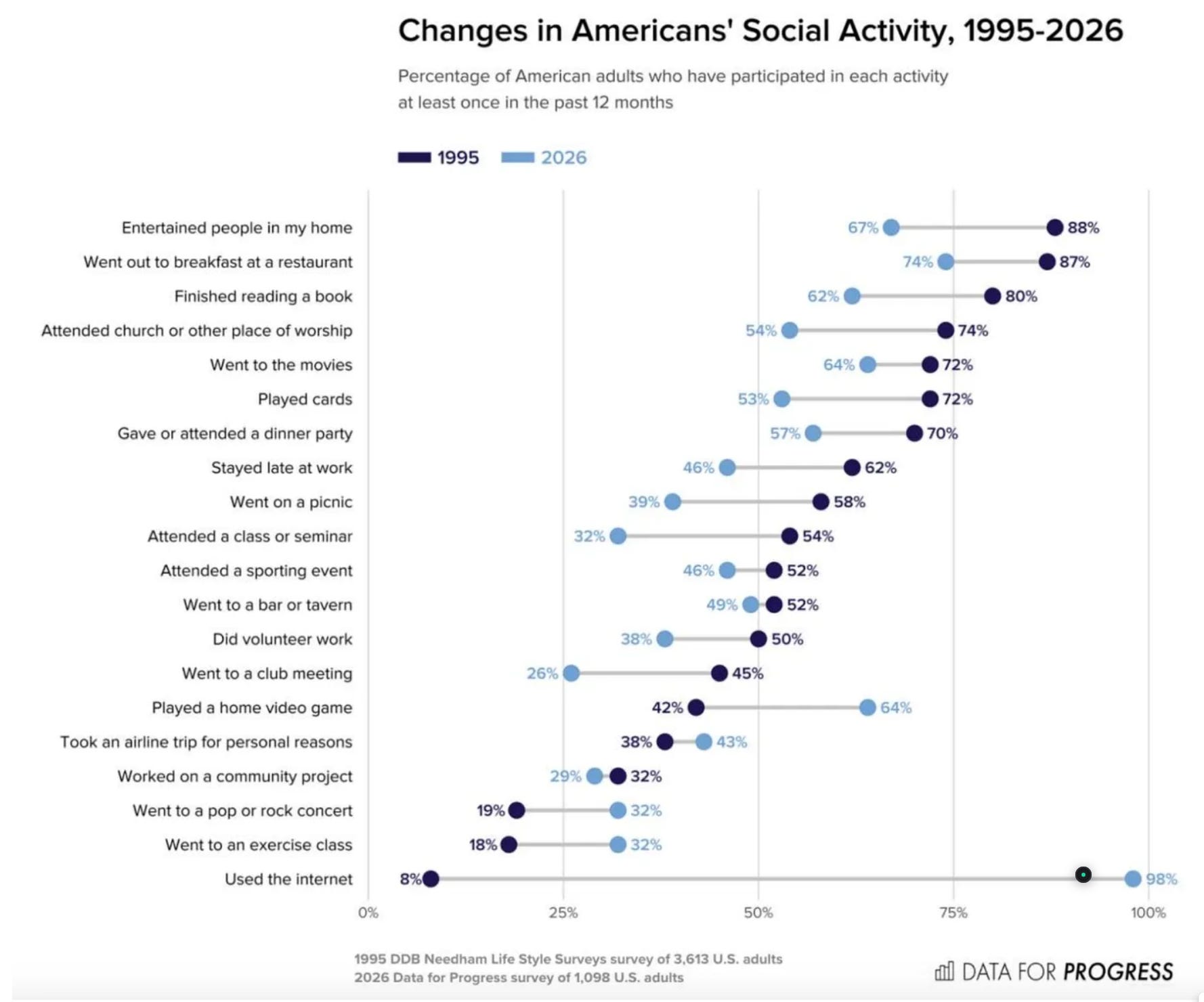
What would it have looked like from, say, 1955 to 1995, with the rise of TV? And my sense is that where my parents and grandparents would have had people over or gone to their houses, the youngs these days meet out at restaurants. Certainly we do—in fact, rather than having an out-of-town visitor over for dinner tonight, we are meeting at Gather <https://gatherberkeley.com/>, which claims that American Express lists it as one of the world’s best farm-to-table restaurants.
And, of course, I do communicate with vastly more people, friends and strangers alike, than did my grandparents with their in-person meetings, their low-audio-quality long-distance phone calls, and their Walter Cronkhite and Theodore H. White news funnels.
My view: There is a problem, but it is not exactly a problem of asociality here. As I wrote back (in email, of course) to a friend who I have not seen in—literally, years! since the plague?—even though she has been a substantial presence in my mind as I read pretty much all of her stuff <https://www.charliejaneanders.com/> <https://www.ouropinionsarecorrect.com/> <https://buttondown.com/charliejane/>:
No! No! Thanks much for writing! You are not taking up too much of my time! I wish you were taking up more of my time, here in this world in which even most of our social relationships are primarily parasocial or transactional! It is not a good timeline! And we have not gotten yet to the neofascists and the killer robots!
We are going to do lunch. Sometime. To keep our friendship from being totally two-way parasocial—where she has no idea of my reactions and absorption of her words, and I have no idea of her reactions and absorption of mine.
The bandaid I can start putting over this gaping, bleeding wound is to start dropping things in people’s comments sections. The problem, however, is this: we learned early in the internet age never to read our comments sections. The hope is that, on Substack, limiting comments to paid subscribers, we will get into the habit of our reading our comment sections again.
I have no idea how that is going for us.
Interesting post. I wonder whether men aren't especially socially impoverished. I'm 78, long retired. I've had no interest staying in contact with folks I worked with. My kids live far away. Of the four men I've loved the most, friends from college, three are dead & the fourth lives far away. Once a week he, the widow of one of the other guys, & I meet for cocktails via zoom. She has heaps of friends & travels widely with my ex-wife, her close friend for more than 50 years. My buddy? Not so much. Another friend of mine, not a close one, is still working at 80 because other than family it's his only social life. This a long windup to say that I think I use social media like Substack as a substitute for the social life I don't otherwise have. That doesn't seem ideal to me, but I'm not sure what to do about it.
If you compare American time use studies from 1965 and 1975, there was a big shift. Instead of socializing, people watched television. Reading dropped as well, but most other leisure time activities changed only slightly. (My girlfriend, who is from the South, says that it was television that ended lynching as a hobby since it cut into vicious gossip time and made it harder to round up a good crowd. Instead, we got Fox News.) My numbers were from Aguiar & Hurst. I can't find any numbers from radio days. Radio, even narrative radio, was often listened to while doing something else.
I noticed a collapse in social effort starting in the 1980s. Boomers and even those younger got involved in their careers. In my social class, the exempt, work hours increased. Commutes were longer. Suburban distances made getting together with friends more challenging. Also, the basics of socializing seemed to have been forgotten. It never got better. It's like in Asimov's Naked Sun, where socializing is at best teleconferencing.